OpenAI Python SDK v3.18.0 Released: Adds GPT-6 Sol and Luna Model Identifiers

OpenAI Python SDK v3.18.0 adds GPT-6 Sol and Luna model identifiers, hinting at next-gen models registered on the backend.
OpenAI's official Python SDK openai-python released v3.18.0 with a single core change: new model identifiers for GPT-6 Sol and GPT-6 Luna. Pushed by OpenAI's automated SDK pipeline, this update indicates these model IDs are already registered in the server-side API definition. The GPT-6 naming marks a new model generation, while the Sol/Luna pairing may suggest a high-performance and lightweight variant split. However, identifiers appearing in the SDK don't mean a public launch — developers should await official announcements for capability details and availability timelines.
OpenAI's official Python SDK (openai-python) has released version v3.18.0. While the version number suggests a routine minor update, a single line in the changelog has caught the developer community's attention — the SDK now includes model identifiers for GPT-6 Sol and GPT-6 Luna.
What's New in This Release
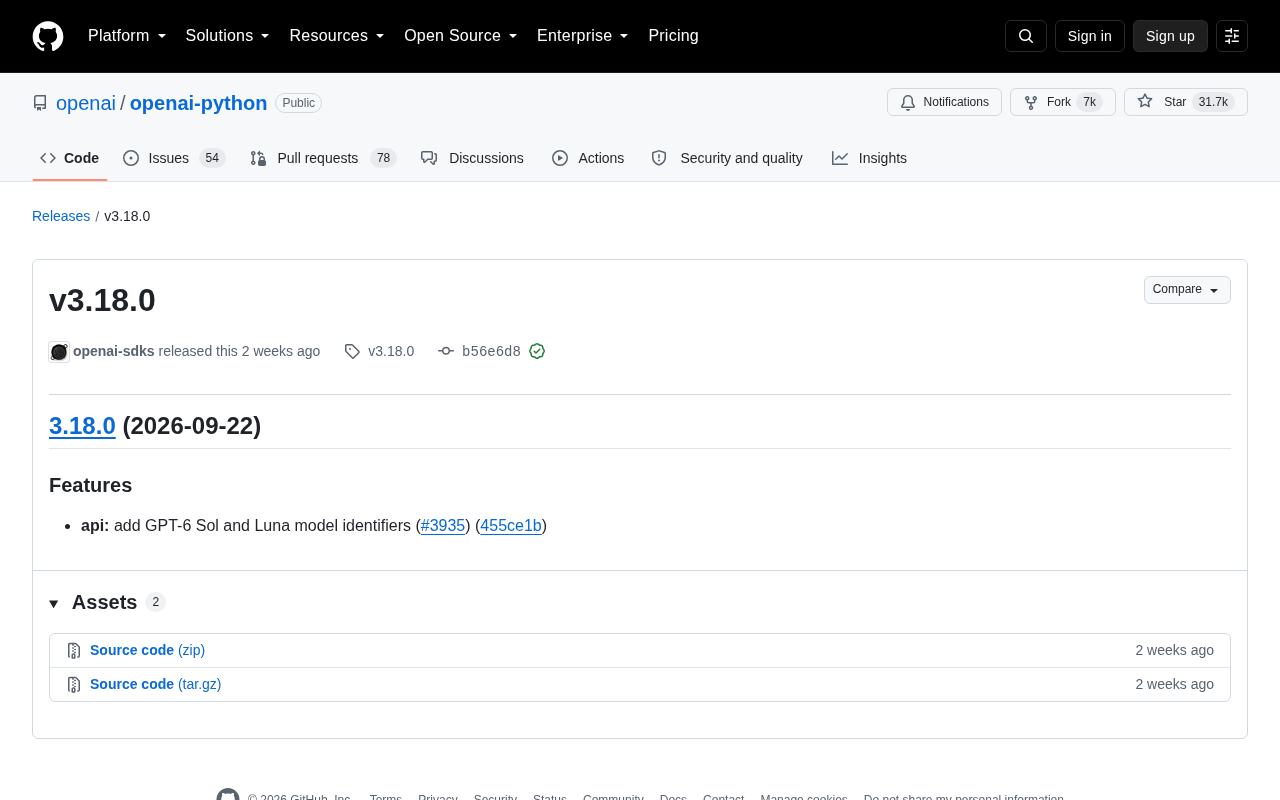
According to the GitHub Release page, the v3.18.0 changelog is concise, containing just one Features entry:
api: add GPT-6 Sol and Luna model identifiers (#3935)
This update was pushed by OpenAI's automated SDK release pipeline (openai-sdks), with the commit carrying a verified GitHub signature. In form, this is a routine version release triggered by an automatic sync from the API spec — OpenAI's SDKs typically auto-generate client code based on changes to server-side API definitions.
In other words, when a model identifier appears in the SDK, it usually means the corresponding model has already been (or is about to be) registered in OpenAI's API backend. This is a well-known pattern developers use to spot new model activity at the code level.
OpenAI's automated SDK release pipeline is key context for understanding the nature of this update. OpenAI maintains an internal API specification (typically in OpenAPI/JSON Schema format). When a new model ID or interface parameter is registered on the server side, the spec file is updated, and automated tooling scans the diff, generates the corresponding client code, and submits a PR — all with minimal human intervention. This means the GPT-6 Sol/Luna identifiers appearing here almost certainly originate from a real change in OpenAI's server-side API definition, not a manually entered placeholder or typo. The GitHub Verified signature further confirms the commit came from an official OpenAI machine account, ruling out third-party tampering.
What GPT-6 Sol and Luna Could Mean
The most noteworthy detail is the appearance of GPT-6 in the naming. Public discussion has largely centered on the GPT-5 series until now, so model identifiers containing GPT-6 appearing directly in the SDK signals that OpenAI's model naming convention has entered a new generation.
The Dual-Model Naming of Sol and Luna
The pairing of Sol (sun) and Luna (moon) is distinctive. Based on industry conventions, paired codenames like these typically refer to different tiers within the same model generation. Possible distinctions include:
- Capability and scale differences: one optimized for high-performance scenarios, the other for lighter, lower-latency, or lower-cost use cases;
- Different use-case focuses: for example, reasoning-intensive tasks versus everyday conversational tasks;
- Release stage identifiers: these may be preview or internal codenames that could change by the time of official launch.
It's worth emphasizing that the changelog itself reveals nothing about parameter sizes, capability boundaries, or pricing for these two models. The interpretations above are speculative inferences based on naming conventions, not official confirmations.
Naming AI models after celestial bodies is not uncommon in the industry. Anthropic uses Haiku, Sonnet, and Opus to differentiate tiers of the Claude series; Google divides the Gemini series into Flash, Pro, and Ultra; Meta introduced codenames like Scout and Maverick in Llama 3. This naming strategy aids marketing while creating clear product line distinctions at the technical documentation and API level. Sol (sun) and Luna (moon) as complementary yet contrasting celestial bodies semantically hint at a split between a "flagship powerhouse" and a "lightweight and flexible" product positioning — though this remains speculation, as OpenAI has not offered any official explanation of the naming logic.
Why This SDK Update Matters for Developers
For developers who rely on the OpenAI API, updates to model identifiers in the SDK carry practical engineering significance. Once new model IDs are written into the client library, developers can call those models directly using these identifiers after upgrading the SDK — provided their account has access and the server-side has opened up availability.
This "code-first" pattern is also a reflection of OpenAI's product release cadence: changes to the SDK and API definitions often precede formal product announcements. As a result, monitoring releases from official repositories like openai-python has become an effective way for the technical community to catch early signals of new products.
That said, it's important to stay grounded: a model identifier appearing in the SDK does not mean the model is available to all users, nor does it constitute an official launch. Historically, there have been cases where identifiers were registered ahead of time while actual functionality was delayed or even revised.
Summary
The v3.18.0 update to openai-python may contain just a single line of changes, but the addition of the GPT-6 Sol and Luna model identifiers sends a clear signal about OpenAI's progression into a new model generation. For developers and industry observers alike, this is a thread worth following — though the real capability details and release timeline will still require an official announcement from OpenAI to confirm.
Related articles

ChatGPT Space Launches: Team Collaboration and New Pages Features Explained
ChatGPT Space is OpenAI's new team collaboration feature with Pages, real-time collaboration, and Slack/Google Drive sync. We break down its privacy design, multi-platform integration, and the full workflow from conversation to document.

Migrating Apache Spark UDFs to GPU Acceleration with AI Agents
NVIDIA developer blog explains how AI Agents rewrite Apache Spark UDFs for GPU acceleration, covering migration criteria, agent rewriting and verification workflows, plus pitfalls like result consistency and CPU-GPU transfer overhead.

Zed Editor v0.40.4-rc2 Released: Usage Credits Now Available Without Upgrading
Zed editor releases v0.40.4-rc2, allowing users to use usage credits for AI features without upgrading to a paid plan, lowering the trial barrier.