OpenAI Python SDK v3.24.0 Released: Adds Custom Voice Creation and Agent Session Events

OpenAI Python SDK v3.24.0 adds custom voice creation, agent session events, and routing fixes.
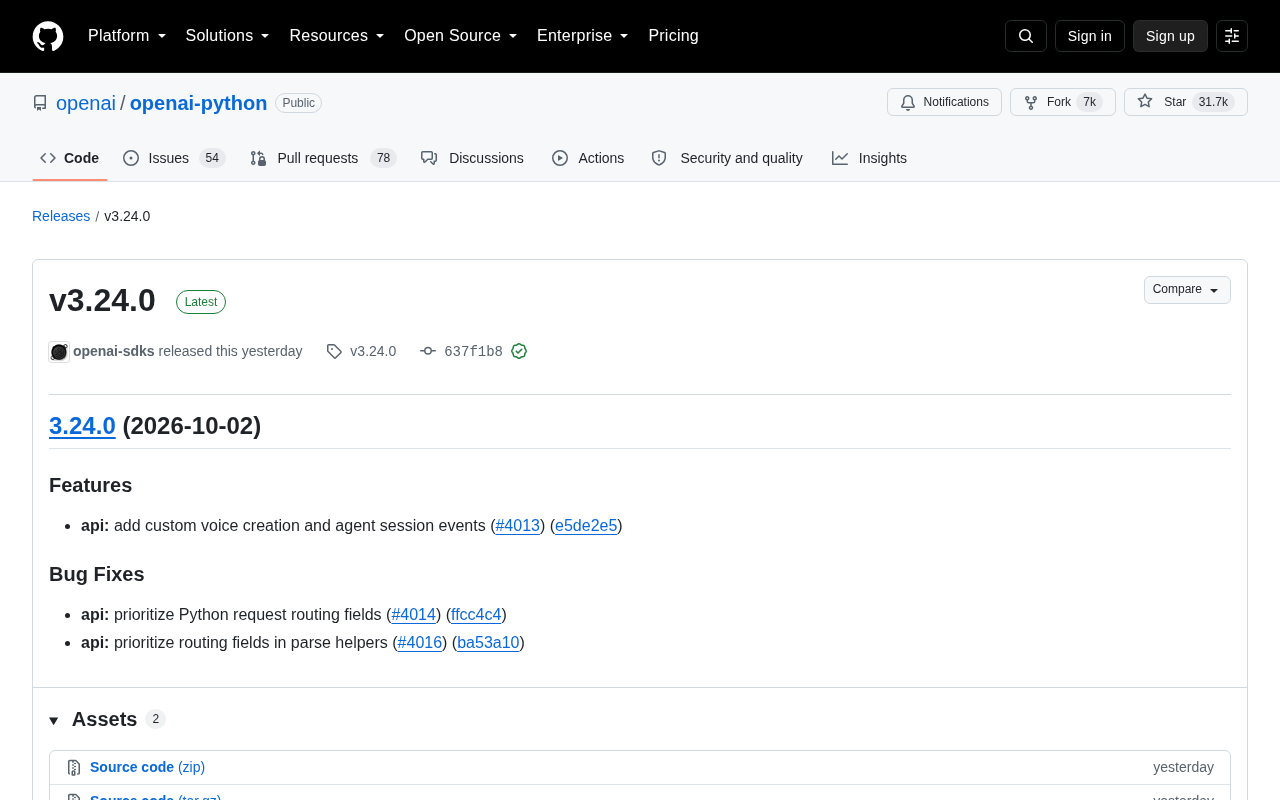
The official OpenAI Python client library, openai-python, has released v3.24.0 with two major new features: custom voice creation and agent session events support, targeting voice application development and agentic architecture use cases respectively. The update also fixes request routing field prioritization issues in both the Python request layer and the parse helper, reducing edge-case dispatching errors. Following SemVer conventions, v3.24.0 is a minor (backward-compatible) release, making it safe to upgrade for most existing projects. The library has ~31.7k GitHub stars and is the de facto standard for calling OpenAI services in Python.
OpenAI Python SDK v3.24.0 Released: Adds Custom Voice Creation and Agent Session Events
The official OpenAI Python SDK has received a v3.24.0 update. This open-source project — which boasts over 31,000 stars in the developer community — introduces custom voice creation capabilities and fixes several request routing issues. For developers building applications on top of the OpenAI API, this is an update worth paying attention to.
New Features: Custom Voice Creation and Agent Session Events
The most significant changes in this release are at the API level: support for custom voice creation and agent session events has been added (PR #4013).
The addition of custom voice creation means developers can now call OpenAI's text-to-speech capabilities directly through the SDK, with potentially more flexible voice customization options. As voice interaction grows increasingly important in AI products, this capability has clear practical value for building voice assistants, podcast generation tools, accessibility applications, and more.
The introduction of agent session events reflects the AI field's intense focus on agentic architectures. Session event mechanisms are typically used to track and respond to state changes across multi-turn Agent interactions, providing the underlying support needed to build more complex autonomous agent applications.
What are agent session events? During a multi-step task, the SDK exposes a series of lifecycle hooks or state notifications — such as session start, tool call initiation, tool result return, and session end. Developers can listen to these events to implement logging, real-time UI updates, error retries, or audit trails. This is closely related to OpenAI's Assistants API and its Thread/Run concepts. A complete task execution in an Agent architecture may involve multiple rounds of model inference and tool calls; the session event mechanism allows developers to observe and intervene in this process at a granular level, without having to poll API status endpoints.
Bug Fixes: Improved Request Routing Logic
In addition to new features, v3.24.0 includes two fixes related to request routing:
- Prioritize Python request routing fields (PR #4014): Ensures the SDK correctly identifies and prioritizes routing-related fields when constructing requests.
- Prioritize routing fields in parse helper (PR #4016): Further ensures routing field handling priority at the parse helper level.
While these may seem like minor details, they are critical for correct request dispatching and response parsing. Improper handling of routing fields can cause requests to be misdirected or parameters to be parsed incorrectly — so these fixes directly contribute to the SDK's stability and compatibility.
About the openai-python Project
openai-python is the officially maintained Python client library from OpenAI. It currently has approximately 31.7k stars and 7k forks on GitHub, making it the de facto standard tool for calling OpenAI services in the Python ecosystem. The project generates and publishes releases through an automated process; this v3.24.0 release was published by GitHub with a verified signature, ensuring the trustworthiness of the release package.
In terms of Semantic Versioning (SemVer), v3.24.0 is a minor release — meaning new features are added and bugs are fixed while maintaining backward compatibility. This means most existing projects can upgrade relatively safely without worrying about breaking changes.
What is Semantic Versioning? Semantic Versioning (SemVer) is a widely adopted versioning convention in the software industry, formatted as MAJOR.MINOR.PATCH. A MAJOR version change indicates backward-incompatible breaking changes; a MINOR version change adds features in a backward-compatible manner; a PATCH version change includes only backward-compatible bug fixes. The "24" in v3.24.0 is a MINOR increment, meaning existing code can generally continue to run without modification after upgrading, and new features are introduced as opt-in additions. For production environment maintainers, version constraints like
pip install 'openai>=3.24.0,<4.0.0'allow you to enjoy new features while guarding against the risk of potentially breaking major version changes.
Practical Impact for Developers
For teams currently using this SDK, upgrading to v3.24.0 offers two main benefits: access to the two new capabilities — custom voice creation and agent session events — which open up new development possibilities for voice and agentic applications; and improved request routing stability, which helps reduce edge-case anomalies.
Developers are encouraged to review the full changelog before upgrading and to validate the interface contracts of new features in a test environment — especially for newly added APIs like custom voice creation. Since this is an actively iterated open-source project, staying in sync with the official version generally means faster access to new features and bug fixes.
Related articles

Felix Rieseberg Personal Homepage
Felix Rieseberg's personal homepage sparks attention on Hacker News. This article covers the Slack engineer's technical background, the rise and fall of nativefier, and the value of a developer homepage as a tech calling card.

@ai-sdk/vue 3.0.306 Patch Release Syncs with [email protected] Update
@ai-sdk/vue 3.0.306 released, synced with [email protected]. A routine patch release for the Vercel AI SDK ecosystem with no public API changes; the Vue adapter layer stays version-aligned with the core package.

Gemini 4 Argon API Launches: The Era of Million-Token Output Begins
Google launches Gemini 4 Argon with sparse MoE architecture, up to 1M output tokens, and a 68.90% Vals Index score, available across API, AI Studio, and the Gemini app.