OpenAI Quietly Renames Data Centers 'Compute Campuses' — Can It Defuse Public Hostility?

OpenAI quietly renames data centers 'compute campuses' to counter public opposition through linguistic reframing.
OpenAI is quietly rebranding 'data centers' as 'compute campuses' — a subtle shift in external communications and brand messaging rather than a formal announcement. Data centers face rare bipartisan opposition in the US over noise, energy use, and visual blight, making siting and community relations real obstacles to AI compute expansion. 'Campus' carries positive university and corporate-park associations at near-zero cost. But critics ask whether a name change can address the real concerns: resource consumption and local impact.
Data centers — once the standard term for technical infrastructure — have now become almost public enemy number one in the court of public opinion. Noise, high energy consumption, visual blight: in America's polarized political environment, these labels have accomplished the rare feat of forging bipartisan consensus — against them. And OpenAI appears to be trying a low-cost solution: give them a new name.
According to tech outlet The Verge, OpenAI is quietly replacing the term "data centers" with "compute campuses." This change isn't an official announcement but a subtle adjustment woven into external communications and brand messaging.
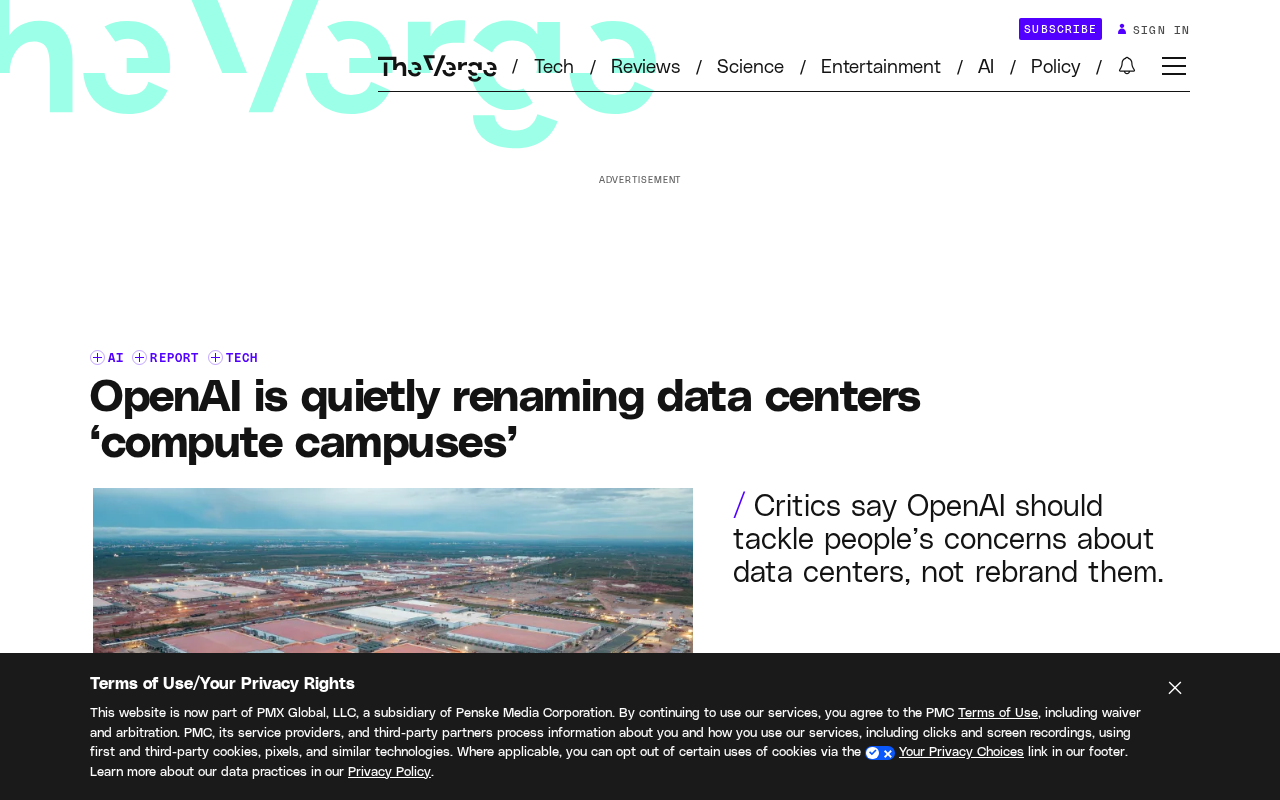
Why Are Data Centers Unpopular?
Data centers have long had a public image problem. They are the physical embodiment of the AI boom, yet also the classic target of community NIMBY sentiment. The original article notes that these facilities are "noisy, resource-hungry, and ugly" — so much so that in today's polarized political climate they've achieved "an almost impossible feat": genuine bipartisan opposition.
This opposition isn't unfounded. With the explosive growth of generative AI, hyperscale data center construction has accelerated, and site selection often involves massive land, power, and water consumption. Complaints from nearby residents about noise and strain on the power grid continue to mount. For AI companies that need to rapidly expand their compute infrastructure, site approval and community relations are becoming substantive obstacles.
NIMBY (Not In My Backyard) is the key concept for understanding data center siting controversies. It describes residents' opposition to facilities built near their communities that offer public benefits but may impose negative externalities — waste treatment plants, substations, prisons, and data centers are all typical examples. The paradox of NIMBY is this: people generally acknowledge the overall necessity of such facilities but don't want to bear the costs when they land next door. For AI companies, this means that even as society's demand for compute keeps climbing, every specific site can still face intense local resistance — turning macro-level "necessity" into micro-level "impossibility."
"Compute Campuses": A Linguistic Crisis-PR Move
The beauty of the phrase "compute campuses" lies in its associative migration. In English, "campus" naturally evokes positive imagery — university grounds, corporate parks — openness, greenery, an atmosphere of knowledge. By contrast, "data center" conjures windowless factories, roaring cooling systems, and endless power lines.
OpenAI seems to be betting on one thing: that a quiet name change might be enough to dissipate growing public hostility. The strategy costs almost nothing — no physical facilities need to change, only the way people talk about them.
Whether this linguistic maneuver will work, however, depends on whether the public truly cares only about the name. If the core of community opposition is resource consumption and real-world impact, then any goodwill boost from a rebrand is likely one-time and superficial. Critics can easily level the same objections at "compute campuses": call it a campus — does the power consumption disappear?
Euphemism and the framing effect provide the theoretical footnote for this renaming. A euphemism replaces expressions that trigger negative associations with milder or more neutral terms — like saying "restructuring" instead of "layoffs." The framing effect refers to how the same fact, presented through different wording, can trigger vastly different judgments — label the same cut of meat "75% lean" and "25% fat," and consumer acceptance differs. Corporate rebranding employs both mechanisms at once: swapping "center" for "campus" and overlaying a positive frame on existing associations. But research also shows that the framing effect is most powerful when information is asymmetric and audiences lack direct experience; once residents live through the noise and rising electricity bills, the linguistic filter quickly fails.
What the Rebrand Signals About the Industry
The move reveals a reality facing AI infrastructure providers: the bottleneck in compute expansion is shifting from technology to social license. When building data centers is no longer just an engineering and capital problem but requires community acceptance, policy support, and public narrative alignment, naming strategy becomes part of infrastructure strategy.
What's worth watching is whether this renaming spreads across the industry, and whether regulators and media follow suit in adopting the new term. If "compute campuses" gradually becomes standard terminology, this low-key brand adjustment may be seen as a successful narrative reframing; if public reaction is lukewarm, it may go down as nothing more than a linguistic curiosity on record.
Currently, OpenAI has not issued a formal statement on the matter, and the actual scope and consistency of the renaming remain to be seen.
Social license to operate refers to the non-mandatory, non-legal acceptance and trust a company or project earns within its operating community. It cannot be granted directly by permits or contracts; it can only be built gradually through transparent communication, genuine accountability, and long-term relationship management — yet it can be lost rapidly through a single incident or accumulated grievances. For asset-heavy, long-cycle infrastructure like data centers, a lack of social license means approval delays, more litigation, and rising siting costs. Describing the bottleneck in compute expansion as "shifting from technology to social license" is really saying: what increasingly determines whether a project can break ground is not engineering capability or capital, but whether the community will let you build.
One-line Summary
OpenAI quietly renames data centers "compute campuses" to counter public opposition through linguistic reframing.
Paragraph Summary
OpenAI is quietly rebranding "data centers" as "compute campuses" — not through an official announcement but through subtle adjustments in external communications and brand messaging. The article notes that data centers, due to noise, high energy consumption, and visual blight, have triggered rare bipartisan opposition in the US, with site approval and community relations becoming real obstacles to AI compute expansion. "Campus" naturally carries positive associations of university grounds and corporate parks; the rename costs almost nothing yet attempts to defuse public hostility. But the article also raises doubts: if the core of community opposition is resource consumption and real-world impact, any goodwill from the rebrand is likely superficial. The move signals that the bottleneck for AI infrastructure is shifting from technology to social license.
Related articles

AI Tools Quietly Altering Settings: Postman Silently Installs Plugin, Codex Sharing Option Auto-Resets
AI Daily reports: Postman silently installs a Mac plugin and self-approves startup hooks, logged as auto-existing upgrade; Hacker News developers say Codex data-sharing opt-out flips back. Plus Simon Willison's raw float weight experiment with QEN 3.8-27B.

AI Learns to Rewrite AI: MIT's "Weightspace Programming" Redraws the Path to Recursive Self-Improvement
MIT team proposes weightspace programming: GPT-6 Astra reads and edits AI model weights directly. Math scores jump several-fold, hand-written networks beat trained models. Eight experiments analyzed, plus Anthropic's same-day warning and the real boundaries of recursive self-improvement.

Running Qwen 3.8 on a Laptop to Read Raw Weights: 46 Minutes Per Answer
Simon Willison reproduced weight space programming with Qwen 3.8 27B on a laptop: a 17GB model file, 46 minutes per answer, 43,506 reasoning tokens, Pong over an hour, Freeway failed. Suited for interpretability researchers.