OpenAI Releases BioBasicsBench: Can AI Agents Handle Everyday Wet Lab Research?
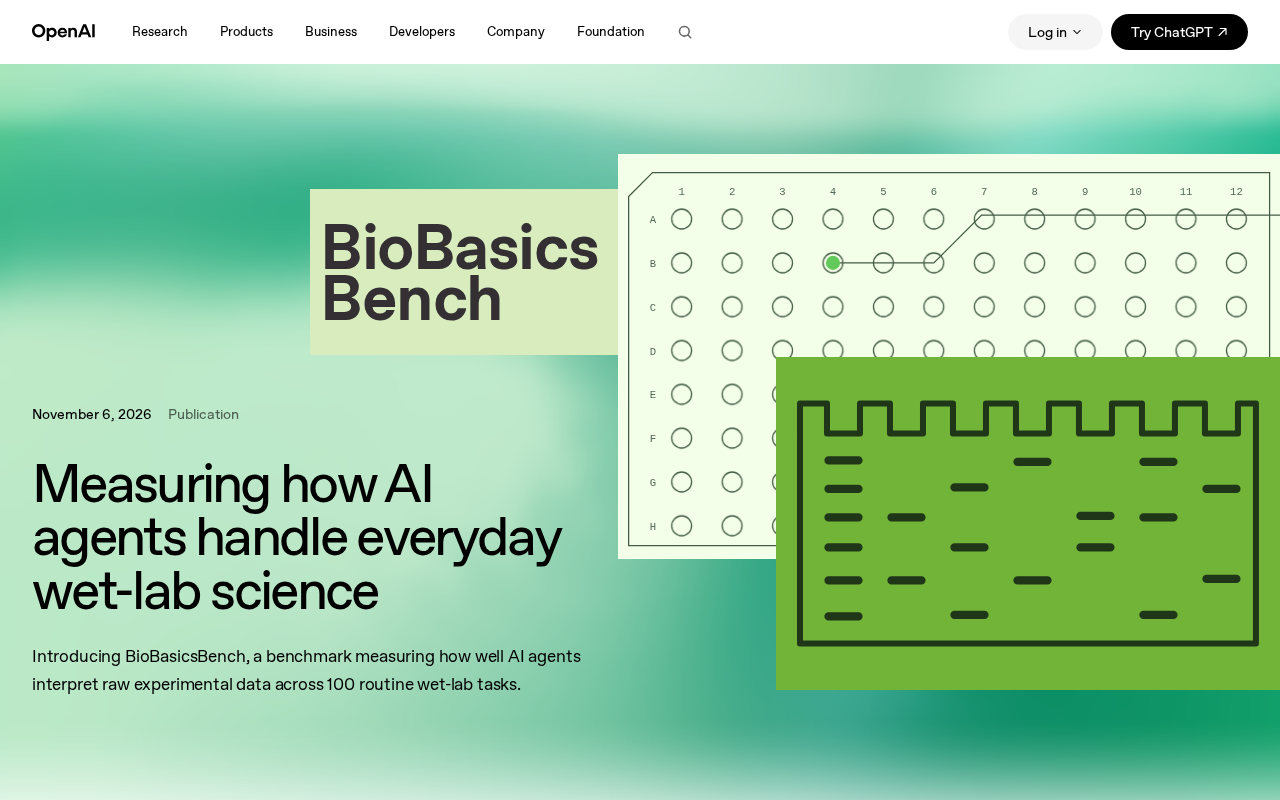
OpenAI releases BioBasicsBench, a 100-task benchmark evaluating AI agents on raw wet lab data interpretation.
OpenAI has released BioBasicsBench, a benchmark of 100 tasks designed to measure AI agents' ability to interpret raw experimental data and handle everyday wet lab scientific work. Unlike typical bioinformatics or literature Q&A benchmarks, it targets real operations and judgments at the lab bench in noisy, multi-step, context-dependent environments. The benchmark continues the trend of agent evaluation shifting from virtual tasks to real workflows, offering a public reference for research teams and developers. However, 100 tasks can hardly cover the full complexity of a wet lab, and benchmark performance does not equal zero errors in real experiments; specific tasks and results are yet to be disclosed.
AI agents are increasingly impressive at coding, writing, and data analysis—but can they actually step into a wet lab and handle the mundane yet critical day-to-day tasks of scientific research? OpenAI's answer: measure it first.
BioBasicsBench: A Benchmark Built for the Wet Lab
According to OpenAI, its newly released BioBasicsBench contains 100 tasks designed specifically to measure AI agents' ability to interpret raw experimental data and handle everyday wet lab scientific work. Unlike typical bioinformatics or literature Q&A benchmarks, it targets the real operations and judgments made at the lab bench.
Wet lab work is characterized by noisy data, multi-step procedures, and strong context dependence. An experiment often involves sample processing, instrument readings, troubleshooting anomalies, and recording results—any deviation in any step can affect the conclusion. BioBasicsBench breaks these tasks into 100 concrete, evaluable scenarios, attempting to answer a simple question: can an AI agent read raw data and make reasonable decisions like a trained researcher?
Benchmark in the AI field refers to a standardized set of tasks and scoring protocols used to compare the capabilities of different models or agents. A benchmark's credibility depends on whether its tasks reflect real-world use cases, whether scoring is reproducible, and whether it covers enough failure modes. Benchmarks also have clear limitations: when the number of tasks is limited, they can saturate or be targeted for optimization (overfitting), and static tasks struggle to keep up with the evolution of real workflows. Therefore, when interpreting benchmark scores, one should focus on task distribution and scoring criteria rather than just overall rankings.
Why "Raw Data" Is the Key to Evaluation
In most AI benchmarks, models receive cleaned, structured data with clear task boundaries and unique answers. But first-hand data in a wet lab is often anything but: instrument outputs come in various formats, readings may drift, and background noise mixes with real signal. BioBasicsBench's emphasis on "interpret raw experimental data" is precisely about placing agents in this imperfect information environment.
The deeper intent of this design is to distinguish "knowing how to answer questions" from "knowing how to do experiments." The former relies on pattern matching; the latter requires a basic understanding of experimental workflows—knowing what data is reasonable and what anomalies need re-checking. OpenAI did not provide specific scoring details in its introduction, but based on the task positioning, the benchmark focuses more on the quality of an agent's judgment in multi-step experimental contexts rather than recall of isolated knowledge points.
Wet lab refers to an experimental environment that requires handling actual biological or chemical samples, as opposed to a "dry lab" conducted entirely on computers (such as bioinformatics analysis). Typical wet lab work includes pipetting, centrifugation, culturing, sequencing sample preparation, and recording instrument readings. Its data characteristics are: raw files exported from instruments come in a wide variety of formats (e.g., chromatograms, microplate reader readings, raw sequencing signals), often accompanied by baseline drift, batch effects, and occasional outliers, and each step depends on the context of preceding steps. Precisely because of this, models that can handle clean spreadsheets may not be able to cope with first-hand wet lab data—which is why benchmarks like this make "raw data interpretation" a core evaluation point.
The Next Step for Scientific Agent Evaluation
The release of BioBasicsBench continues the trend of AI agent evaluation shifting from virtual tasks to real workflows. Coding agents have code execution and testing as natural verification, but scientific agents have long lacked a unified yardstick for validation. A benchmark covering everyday wet lab tasks provides a public reference for comparing the practical utility of different agents.
For research teams, the value of such benchmarks lies in reducing trial-and-error costs: before integrating an agent into experimental workflows, use standardized tasks to assess its reliability boundaries. For model developers, the failure modes exposed by 100 wet lab tasks may point to improvement directions more effectively than general benchmarks.
It is important to be objective: 100 tasks can hardly cover the full complexity of a wet lab, and benchmark performance does not equal zero errors in real experiments. OpenAI's announcement this time focuses primarily on the benchmark's positioning; specific task composition and evaluation results are yet to be disclosed. For AI agents to truly "get hands-on" in the lab, evaluation is only the first step.
Scientific agent typically refers to an AI system capable of autonomously planning multi-step tasks, invoking tools (such as code interpreters, database retrieval, instrument control interfaces), and adjusting strategies based on intermediate results—distinct from single-turn Q&A model calls. Its evaluation has long faced a "validation gap": coding tasks can be automatically judged with unit tests, whereas scientific task results often require expert judgment or real experimental reproduction, which is costly and difficult to scale. Existing biological benchmarks mostly focus on literature Q&A (e.g., PubMedQA) or structured bioinformatics pipelines, and struggle to reflect the ambiguity and multi-step nature of bench operations. BioBasicsBench is positioned precisely to fill this layer—using standardized tasks to turn "whether an agent can make reasonable judgments in experimental contexts" into a comparable score.
One-line Summary
OpenAI releases BioBasicsBench, a 100-task benchmark evaluating AI agents' ability to interpret raw wet lab data.
Paragraph Summary
OpenAI has released BioBasicsBench, a benchmark of 100 tasks designed to measure AI agents' ability to interpret raw experimental data and handle everyday wet lab scientific work. Unlike typical bioinformatics or literature Q&A benchmarks, it targets real operations and judgments at the lab bench, emphasizing the distinction between "knowing how to answer questions" and "knowing how to do experiments" in noisy, multi-step, context-dependent environments. The benchmark continues the trend of agent evaluation shifting from virtual tasks to real workflows, providing a public reference for research teams to assess agents' reliability boundaries and for developers to identify failure modes. However, 100 tasks can hardly cover the full complexity of a wet lab, and benchmark performance does not equal zero errors in real experiments; specific task composition and evaluation results are yet to be disclosed.
Related articles
 Tech Frontiers
MuJoCo: An Analysis of DeepMind's Open-Source General-Purpose Physics Simulator
An in-depth analysis of Google DeepMind's open-source physics simulator MuJoCo: high-performance C++ kernel, MJCF modeling format, contact solving principles, MJX GPU acceleration, and robot reinforcement learning use cases.
 Tech Frontiers
Claude API Quick Start: The Official Quickstarts Project Collection
Anthropic's official claude-quickstarts project collection helps developers quickly build deployable apps with the Claude API. Nearly 20k stars, Python-based, great for beginners and prototyping.
 Tech Frontiers
AI Agents Connecting Directly to APIs: Which Calls Can Be Safely Allowed?
AI agents can call any API, but the real challenge is deciding which calls can be safely allowed. This article analyzes allowance decisions from three dimensions—intent matching, least privilege, and controllable impact—and argues that the control layer should sit outside the agent, combined with audit traceability to build a trustworthy API call governance mechanism.