OpenAI Releases New Standard for Usage Policies: Expanding Responsible Access Through Consistent Norms

OpenAI implements consistent safety standards through distribution partners, using policy clarification to promote responsible broad access.
OpenAI released an update on its usage policies, with the core aim of achieving broader model access through collaboration with distribution partners under consistent safety standards while clarifying responsibility boundaries. The article notes that when models reach users through third-party channels such as cloud platforms and application developers, safety standards are prone to gaps, so OpenAI emphasizes three goals: consistent safeguards, responsible access, and clarified expectations. Usage policies are evolving from prohibition lists into collaboration frameworks to reduce communication costs across the chain. The tension between broad access and strict standards is balanced by "consistent standards." For ecosystem participants, this means channel safety requirements will trend toward unification, and compliance responsibility in the AI supply chain is layered, requiring careful assessment of use cases and identification of one's own position before integration.
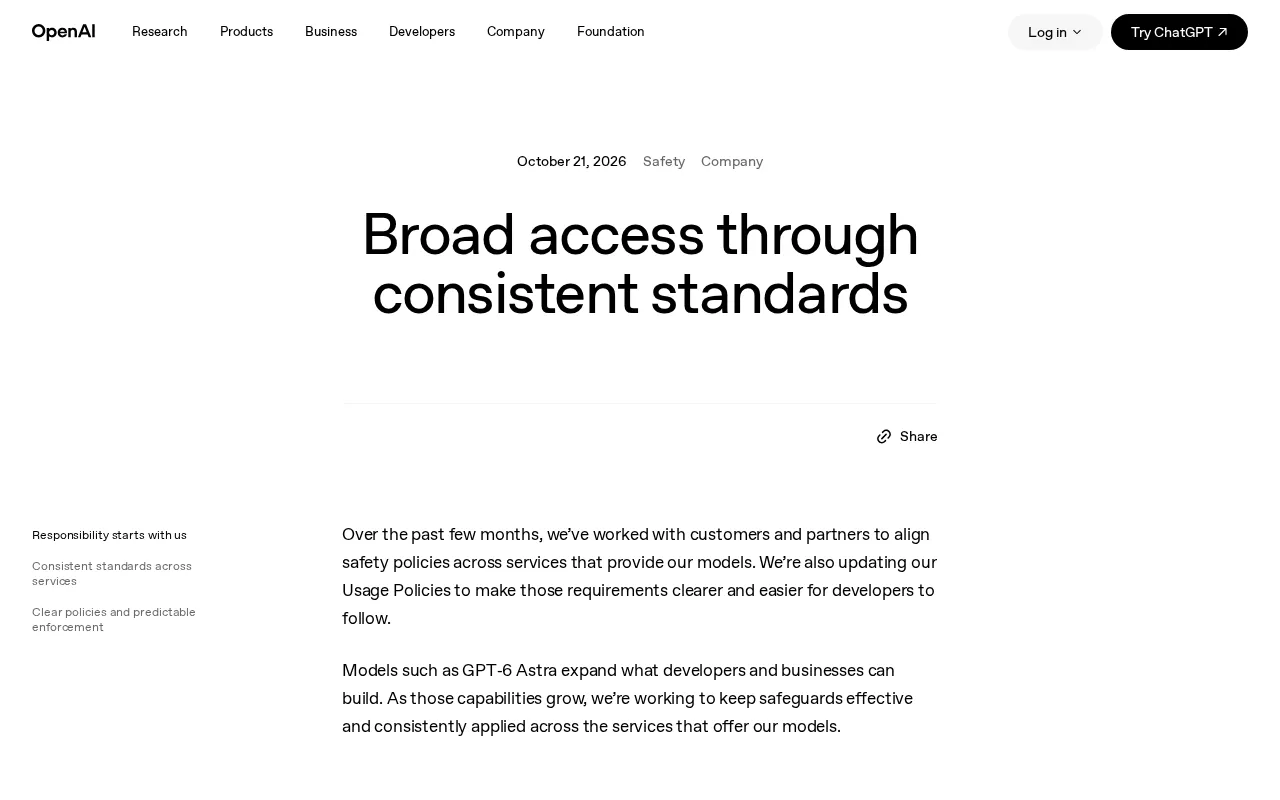
OpenAI recently published an explanation regarding its Usage Policies update, with a clear core message: achieve broader access through collaboration with distribution partners under consistent safety standards, while clarifying the boundaries of responsibility. This brief announcement from the official RSS feed, though short in length, reveals an increasingly important proposition in AI governance—how do safety guardrails remain consistent when model capabilities reach users through third-party channels.
Why Distribution Partners Become a Key Node in Safety Governance
OpenAI's models are not only offered through its own ChatGPT and API, but also enter more scenarios via distribution partners such as cloud platforms, application developers, and enterprise integrators. This means that the capabilities end users encounter may come from a multi-party chain. The longer the chain, the more likely gaps appear in the enforcement of safety standards.
The official explanation mentions three goals: maintain consistent safeguards, support responsible access, and clarify expectations in usage policies. These three form a closed loop—without consistent safeguards, broad access becomes risk exposure; without clear expectations, partners find it difficult to judge compliance boundaries.
From an industry perspective, this is also an inevitable step for AI companies moving from "governing their own products" to "governing the ecosystem." The diffusion speed of model capabilities far exceeds the control radius of any single platform, and embedding standards into partner relationships is more efficient than remedying problems after the fact.
Distribution partners in the AI context refer to enterprises or platforms that do not directly develop models but pass model capabilities to end users through APIs, cloud marketplaces, white-label products, and similar means. Common forms include cloud service providers (such as model hosting services on Azure and AWS), SaaS application developers, enterprise system integrators, and vertical solution providers for specific industries. Their role is to lower the barrier to model use and expand reach, but they thereby become an "intermediate layer" in safety governance: end users often do not interact directly with the model provider, but instead interact with the model through the partner's product interface. This requires model providers to transmit requirements such as usage policies, content filtering, and abuse monitoring to partners via contracts or technical interfaces, and partners then implement them in specific products. Any weak link in the chain can dilute safety standards.
The Role of Usage Policies: From a List of Restrictions to a Collaboration Framework
Traditionally, AI usage policies have often been viewed as a list of prohibitions. But OpenAI's emphasis this time on "clarifying expectations" suggests that the positioning of the policy is evolving toward a collaboration framework. For distribution partners, clearly defining which uses are permitted, which require additional review, and which must be blocked directly determines the feasibility of product design.
This shift has real-world pressure behind it. When enterprise customers access models through partners, the two sides may have differing understandings of "responsible use." The clarity of policy text actually reduces communication costs and compliance risks across the entire chain.
Usage Policies are formal rules set by AI service providers regarding acceptable and prohibited uses, usually existing as an attachment to terms of service or as a separate document. Early versions mostly adopted a "negative list" model, listing prohibited behaviors one by one (such as generating malicious code, harassing content, or disinformation). However, as models enter enterprise-level and third-party distribution scenarios, a simple prohibition list struggles to cover complex use cases, and policy text needs to simultaneously explain permitted boundaries, scenarios requiring additional review, and partners' implementation obligations. This trend toward a "collaboration framework" means the policy is no longer a one-way constraint, but a governance tool jointly interpreted and enforced by multiple parties. For developers, the clarity of the policy directly affects the space for product design; for regulators, policy text is also an important basis for judging whether a platform has fulfilled its duty of reasonable care.
The Tension Between Consistent Standards and Broad Access
There is an inherent tension between broad access and strict standards. Overly conservative standards will limit the implementation of innovative applications, while overly permissive ones may allow abusive behavior to spread through partners. OpenAI's wording chooses "consistent standards" as the balancing point—not unilateral tightening, but requiring all channels to enforce the same baseline.
This approach aligns with the current direction of AI governance discussions: safety is not a solo performance by one company, but a responsibility shared by every node in the distribution network. For developers, understanding this set of standards also has practical value—it affects the boundaries of behavior when calling models through third-party platforms.
"Consistent standards" in AI governance usually refer to different distribution channels enforcing the same safety baseline for the same model capability, including prohibited-use lists, content moderation thresholds, abuse reporting mechanisms, and so on. The difficulty lies in the fact that partners each have their own compliance systems, risk assessment methods, and product forms, and unified standards need to achieve interoperability without stifling local innovation. Common industry practices include: model providers publishing baseline policies, with partners layering industry-specific requirements on top; making some standards technical through API-level policy markers (such as use declarations and moderation hooks); and establishing joint review or audit mechanisms. Consistent standards do not mean completely identical implementation details, but rather sharing the same set of non-negotiable baselines while preserving space for each channel to refine them according to the scenario.
Practical Implications for Ecosystem Participants
For teams building products on OpenAI models, the signal from this announcement is worth noting: safety requirements for partner channels will trend toward unification, and policy expectations will become clearer. This means that before integration, teams need to more carefully assess whether their use cases fall within the permitted scope, especially in sensitive scenarios such as content generation and automated decision-making.
At the same time, this also reminds ecosystem participants that compliance responsibility in the AI supply chain is layered. Distribution partners bear the gatekeeping responsibility on the channel side, while end application providers remain responsible for specific use scenarios. Only by understanding this layering can they identify their proper position in product design and compliance review.
Layered compliance responsibility in the AI supply chain means that model providers, distribution partners, and end application providers each have distinct compliance obligations: model providers are responsible for the safety baseline of model capabilities and policy formulation; distribution partners are responsible for identity management, use review, and abuse monitoring on the channel side; and end application providers are responsible for the legality, transparency, and user notification of specific use scenarios. This layered structure is similar to the "shared responsibility model" in cloud computing—cloud vendors are responsible for infrastructure security, and customers are responsible for the security of their own data and applications. In AI scenarios, layered responsibility means no party can completely outsource compliance risk; contract terms, technical interfaces, and audit rights are key tools for implementing layered responsibility. Ecosystem participants need to clarify which layer of obligation they bear according to their position in the chain and reflect this in product design and compliance review.
Conclusion
OpenAI's explanation is limited in length, but it points to a significant issue: broad reach of AI capabilities requires consistent standards as a prerequisite. Translating usage policies into a common language in distribution partnerships is a key step for responsible access to move from slogan to implementation. For readers concerned with AI governance and ecosystem compliance, this is a direction worth continued tracking.
One-line Summary
OpenAI implements consistent safety standards through distribution partners, using policy clarification to promote responsible broad access.
Paragraph Summary
OpenAI released an update on its usage policies, with the core aim of achieving broader model access through collaboration with distribution partners under consistent safety standards while clarifying the boundaries of responsibility for all parties. The article notes that when models reach users through third-party channels such as cloud platforms and application developers, safety standards are prone to gaps, so OpenAI emphasizes three goals: consistent safeguards, responsible access, and clarified expectations. Usage policies are evolving from prohibition lists into collaboration frameworks to reduce communication costs across the chain. The tension between broad access and strict standards is balanced by "consistent standards." For ecosystem participants, this means channel safety requirements will trend toward unification, and compliance responsibility in the AI supply chain is layered, requiring careful assessment of use cases and identification of one's own position before integration.
Related articles

iPhone Duo Transformed into a Windows 98 Gaming PC: Hands-On Test and Experience
XDA tests turning the iPhone Duo foldable into a Windows 98 gaming PC using RetroArch and DOSBox Pure with virtual 3DFX, running Unreal Tournament, Half-Life, and Quake 3, plus Windows XP feasibility and limits.

Type-Safe Keep Rules in R8 and DEX Optimization in Practice
Google Play requires over 25% DEX optimization. This article explains the R8 configuration analyzer, Jetpack Keep type-safe annotations, and the Android CLI validation tool to help Android developers narrow keep rules, improve shrinking/optimization/obfuscation, and reduce ANRs.

Why Are Old Buildings More Beautiful Than New Ones? Pulitzer Prize-Winning Author Reveals an Overlooked Economic Truth
Pulitzer Prize-winning author Robert Caro found that poorer countries built more beautiful buildings. He reveals how cheap skilled craftsmen created the intricate details of old New York architecture, and how rising labor costs changed architectural aesthetics.