OpenAI Resets Again: A User Boon or Market Anxiety?

OpenAI's frequent usage-limit resets are seen as a gamified retention tactic in response to Claude competition.
Starting from a Reddit post about "OpenAI just got another reset," the article examines two interpretations: users see it as a benefit, while critics read competitive anxiety. Resets, often two to three times a month and tied to unfulfilled feature promises, are widely viewed as a response to Claude Opus 5.5—a gamified retention mechanism using intermittent rewards. Some warn the token subsidy era may be ending, with users already downgrading plans.
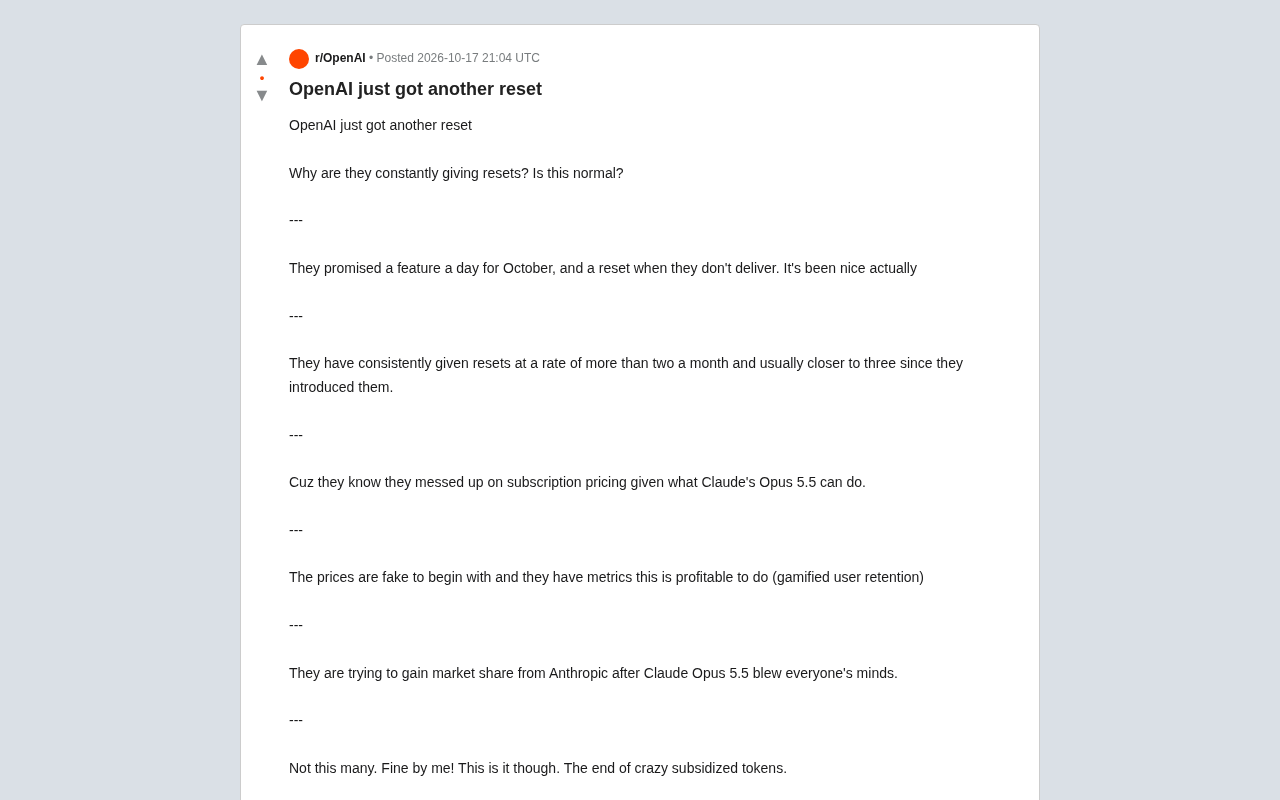
OpenAI has handed out another perk to users. A recent Reddit post sparked heated discussion: "OpenAI just got another reset." The poster asked, perplexed: why do they reset so frequently? Is this normal? The comments quickly split into two camps: one side saw it as a user benefit and happily accepted it; the other sensed a whiff of competitive anxiety.
How Frequent Are the Resets?
According to observations from Reddit users, the frequency of OpenAI's resets "has consistently stayed above twice a month, and usually closer to three times since launch." One user pointed out there's a promise behind it: "They promised one feature a day in October, and if they didn't deliver, they'd issue a reset." This "features-for-resets" mechanism has shaped a kind of expectation management among users.
On the surface, this shows a focus on user experience. But frequent resets also raise questions: why do they need to keep making up for things with resets?
A User Retention Strategy Under Competitive Pressure
Several commenters linked the resets to Anthropic's Claude Opus 5.5. One user said bluntly: "Because Claude Opus 5.5's performance made them realize they botched their subscription pricing." Another added: "They're trying to win back market share from Anthropic because Claude Opus 5.5 blew everyone away."
This interpretation points to a reality: competition in the AI assistant market is intensifying. When a competitor launches a more competitive model, OpenAI needs ways to keep users. Resetting usage limits is a low-cost, high-perceived-value approach—users won't cancel their subscriptions when they're getting a reset every two days.
One user hit the nail on the head: "They're trying to avoid losing subscribers while they're behind, because when you're getting a reset every two days, you're not going to cancel, right?"
Claude Opus 5.5 is the flagship large model released by Anthropic. Anthropic was founded in 2021 by former OpenAI VP of Research Dario Amodei and others, taking a "safety-first" approach, and its Claude series models have long competed head-on with OpenAI's GPT series on long-context understanding, code generation, and complex reasoning tasks. Opus is the highest-end tier in the Claude lineup, positioned to handle the most complex tasks and priced accordingly at the top of the range. The article's mention that Opus 5.5 "blew everyone away" refers to the leap this version made across multiple benchmarks and capability experiences, directly shaking some users' loyalty to their ChatGPT subscriptions. For OpenAI, a competitor's leap in capability not only affects new user acquisition but also accelerates churn among existing paying users, so it needs non-price levers like reset quotas to stabilize its subscription base.
Gamification of user retention (gamification) refers to introducing game mechanics such as points, rewards, and random drops into non-game products to boost user activity and renewal rates. The "intermittent rewards" described in the article are close to variable-ratio reinforcement in behavioral psychology—when the timing and number of rewards are unpredictable, users are actually more likely to keep checking in and using the product frequently. For subscription-based AI products, irregular quota resets create the expectation that "maybe there's a surprise today," thereby reducing the willingness to cancel. This mechanism costs less than a direct price cut while carrying no small perceived value, making it a common operational tactic during competitive periods.
A Signal That the Subsidy Era Is Ending?
Not all users see the resets as purely a good thing. One highly upvoted comment read: "No problem! But that's it. The era of crazy token subsidies is over." This implies the resets may be the final phase of a subsidy strategy.
Others analyzed it from a business-model angle: "The price was fake from the start, and they have metrics showing this is profitable (gamified user retention)." In other words, resets are not just a response to competition but also a carefully designed retention mechanism—maintaining user activity through intermittent rewards, akin to gamified operational tactics.
One user shared their own real-world action: "I just downgraded from the $500 plan to the $100 plan." This shows users are price-sensitive and that resets can't fully offset pricing pressure.
Token is the basic unit of measurement for text processed by large language models; one token roughly corresponds to half to one word in English, or one to two characters in Chinese. Usage limits, billing, and cost accounting for AI products are typically measured in tokens. The so-called "crazy token subsidies" refer to vendors offering usage to users at prices below actual inference costs, or indirectly expanding quotas through giveaways, resets, and similar means—essentially using money to buy user scale and usage habits. Inference costs are directly tied to model size, context length, and call frequency, so heavy users' marginal costs are far higher than those of light users. When subsidies are rolled back, it's often precisely these high-frequency users who are hit first; the user in the article who downgraded from the $500 plan to the $100 plan is a typical microcosm.
How Should Users View This?
For ordinary users, frequent resets are a short-term boon—more usage quota means lower marginal costs. But in the long run, the sustainability of this strategy is questionable. If resets are an emergency measure under competitive pressure, then once the competitive landscape stabilizes or the subsidy metrics stop looking good, reset frequency may decline.
OpenAI's reset behavior is essentially a microcosm of the AI assistant market shifting from technology competition to operational competition. As the capability gap between models narrows, user retention and pricing strategy become the new battleground. For users, there's nothing wrong with enjoying the current perks, but they should also realize: there is no forever reset, only forever cost-benefit calculation.
The discussion on Reddit also reveals a subtle mindset: users both enjoy the resets and remain wary of their motives. This contradiction precisely reflects the current normal of the AI subscription market—vendors trade subsidies for growth, users trade loyalty for perks, and both sides are testing each other's bottom line.
One-line Summary
OpenAI's frequent usage-limit resets are seen as a gamified retention tactic in response to Claude competition.
Paragraph Summary
Starting from a Reddit post titled "OpenAI just got another reset," the article sorts out two interpretations of the phenomenon among netizens. Supporters see it as a user benefit, while critics read competitive anxiety into it. The article notes that reset frequency has long stayed at two to three times a month and is often tied to "unfulfilled feature promises." Many commenters believe this is a direct response to Anthropic Claude Opus 5.5's impressive performance and market-share gains, aimed at preventing subscriber churn while OpenAI is behind. On a deeper level, resets are interpreted as a gamified retention mechanism—using intermittent rewards to maintain activity, costing less than price cuts while carrying no small perceived value. Some users also warn that the era of crazy token subsidies may be nearing its end, and some have already downgraded their subscription tiers due to price sensitivity. The article concludes that this marks the AI assistant market's shift from technology competition to operational competition—a short-term boon for users, but with questionable long-term sustainability.
Related articles

Chain of Thought Isn't Just for AI: How Humans Can Use CoT to Improve Thinking Quality
Chain of Thought isn't just a prompt trick for large models. Starting from a Hacker News discussion, this article analyzes why CoT works for human thinking too, breaks down actionable ways to transfer it, and highlights the key differences between human CoT and machine CoT.
Cloudflare Teams Up with OpenAI: Closi…
Cloudflare Teams Up with OpenAI: Closing the Loop from Vulnerability Discovery to Defense with AI
Cloudflare uses OpenAI Daybreak to investigate security vulnerabilities and generate reviewable remediation plans, while developers use Codex to boost coding efficiency and quality.

Orca Multi-Agent Orchestration in Practice: A Guide to Parallel Collaboration with Claude and Codex
Orca is Stable AI's free open-source agent workbench supporting 34 agents like Claude Code and Codex in parallel. Learn its Git worktree isolation, multi-model orchestration, and mobile management.