OpenAI Restarts Robotics as Tesla Supply Chain Weekly Output Surges 10x: A Full Breakdown of the Embodied AI Industry Chain

Embodied AI's bottleneck shifts from hardware to models as OpenAI enters and Tesla's supply chain ramps.
Based on an embodied AI industry discussion, the article argues humanoid robots' core bottleneck is shifting from hardware to models. About 90% of mature firms choose VLA, still pre-GPT-1 in scale, with generalization and cross-embodiment issues; world models remain fragmented. OpenAI restarted robotics in 2026 and plans a 2027 prototype, while Tesla's supply chain ramped weekly output ~10x in Q3 mainly for training data. The chain forms four layers, with investment following realization speed and technology positioning.
An industry discussion on embodied AI models, robot mass production, and the physical AI supply chain delivered the core verdict on the current landscape: humanoid robot hardware iteration is already relatively mature, and the main bottleneck for scaling is shifting from hardware to models. OpenAI's restart of robotics R&D, combined with Tesla's supply chain rapidly ramping production, is for the first time tightly linking model capability, real-machine data, and hardware mass production.
The Model Route Debate: VLA Dominates, World Models Await a Breakthrough
Embodied AI models currently fall into roughly two camps. About 90% of mature companies choose VLA (vision-language-action models), which add action output on top of large language or multimodal models. A representative company, Physical Intelligence, released π0 in 2024 and updated to π0.7 in 2026, but the latest model's parameter count is still only a few B—roughly equivalent to the pre-GPT-1 iteration stage. Current evaluation relies mainly on lab and simulation leaderboards; commercial value in real-world scenarios remains unclear, and generalization capability and cross-embodiment adaptation are still bottlenecks.
The other route is world models. Since 2026, players led by NVIDIA have accelerated investment, many startups were founded in this period, and overseas valuations can reach tens of billions of dollars. But model architectures across teams are not unified, and the field overall remains in frontier exploration. Tencent launched the Hunyuan Warp series, covering 3D scene generation, reconstruction, and interaction; Alibaba is building robot models within its Tongyi system, with Amap providing spatial data; ByteDance is also advancing 3D models and world models, with public demos clearly superior to ordinary video generation in spatial sense and viewpoint changes. World models may become an important variable in the next stage, but a unified route has yet to form.

VLA (vision-language-action model) is an embodied AI architecture that unifies visual perception, language understanding, and action generation into a single model. The typical approach adds an action head on top of a pretrained multimodal large model, mapping image observations and natural language instructions into control sequences for robot joints or end effectors. VLA's core advantage is reusing the semantic understanding and commonsense reasoning already present in large models, giving it some generalization to unseen objects and instructions. Representative works include RT-2, OpenVLA, and Physical Intelligence's π series. Current VLA limitations include action output frequency being constrained by large-model inference speed, difficulty transferring across different robot embodiments, and real-machine data scale being far smaller than internet text data.
World model refers to a generative model that can learn environmental dynamics and predict future state evolution. In the embodied AI context, a world model can predict the next moment's visual frame or physical state based on current observations and candidate actions, allowing robots to plan and trial-and-error in "imagination" and reducing dependence on real interaction. It differs from video generation models in emphasizing action conditioning and physical consistency, requiring predictions usable for closed-loop control. NVIDIA's Cosmos and Tencent's Hunyuan Warp belong to this direction. World model challenges include modeling accuracy of physical laws, error accumulation in long-horizon prediction, and the lack of unified evaluation benchmarks.
OpenAI Re-enters: From Software Models to Hardware Engineering
OpenAI previously explored robotics, then shrank its team and pivoted to large language models as iteration slowed. In June 2026 the company restarted robot team hiring, with roles covering sensors, controllers, actuators, and other hardware areas; in September it explicitly laid out humanoid robots and plans to launch a prototype in 2027. The discussion noted that GPT-6 training incorporated hundreds of thousands of hours of robot data, including real-machine and EGO data, already possessing embodied control capability and performing notably in RoboDojo evaluations.
Judging by hiring direction, OpenAI does not merely want to provide software models—it is simultaneously building up hardware engineering capability. The company recently recruited some hardware talent from China, with sensors, controllers, and actuators all within hiring scope. This means that in the future, beyond the Tesla chain and domestic robot chains, an OpenAI hardware chain may also form, along with robot supply chains for other North American model companies. For the industry, this is not simple share transfer but industry expansion driven by a growing number of customers, suppliers, and ecosystem partners.
More noteworthy is iteration speed. Leveraging existing algorithms, data, and agent capabilities, OpenAI demonstrated capability surpassing many robotics startup models in a short time. If robot data grows from hundreds of thousands of hours to millions or even tens of millions of hours in the future, combined with scalable sources like simulation and EGO, the next generation of models still has room to improve perception, reasoning, and control—and competitive pressure on pure model companies will increase markedly.
But this does not mean embodied AI will be winner-take-all. The large models in VLA mainly determine perception and reasoning; entering the physical world still requires handling touch, force sensing, friction, deformation, and adaptation to different embodiments and scenarios. Large model companies raise the capability foundation, while vertical companies still need to deliver localized policies, motion control, and industry deployment.

EGO data refers to robot or human manipulation data collected from a first-person perspective, typically from head-mounted devices, glasses, or cameras on the robot itself. Compared with third-person external views, EGO data is closer to the operator's own perception distribution, providing hand motion, object interaction details, and gaze guidance information—an important data source for training embodied policies. Because collection cost is relatively manageable and scalable, EGO data is seen as an important means of offsetting the scarcity of real-machine teleoperation data.
RoboDojo is a simulation and data infrastructure platform for robot model training and evaluation, conceptually similar to Tesla's Dojo supercomputer and simulation system for autonomous driving. It generates diverse scenarios and tasks through large-scale parallel simulation and standardizes scoring of model control capability, enabling rapid iteration before real-machine deployment. The value of such platforms lies in turning model evaluation from scattered lab demos into reproducible, comparable benchmarks, though the sim-to-real gap remains a core challenge.
Tesla Supply Chain: Weekly Output Up ~10x, Ramping for Data
An important purpose of Tesla's rapid production ramp this round is to use real-machine operation to supplement physical data on friction, deformation, and other factors that simulation cannot fully cover; data acquisition speed directly affects model training and the commercialization pace of future general-purpose robots. The supply chain has therefore been asked to rapidly increase capacity.
According to feedback from core supply chain sources, Q3 2026 weekly output grew about 10x from the low tens per week in Q2, currently reaching several hundred per week, and may hit 1,000 per week by late October. By year-end the supply chain is ramping toward a target of about 2,000 per week, equivalent to 100,000 units annually, and some segments are preparing for 200,000-unit capacity next year. It should be noted that these products mainly serve internal training and data collection; the official Optimus product has not yet been released, and a future launch remains a potential catalyst rather than a realized fact.
In supplier selection, the key is no longer just having a concept but whether a company can enter the core chain and generate clear revenue next year. Beite Technology covers both body lead screws and micro lead screws for dexterous hands; the discussion estimates hand and body lead screws each account for roughly half of per-unit value, with total per-unit value above 10,000 yuan—implying revenue potentially approaching 1 billion yuan at 100,000 units. Shuanghuan Driveline's traditional core business provides fundamental support; its ~60%-owned Huandong Technology has halted its spin-off, the company has won robot lower-limb joint orders, and serves as sole supplier for some joints. Hengbo Holdings mainly supplies PEEK material parts, currently covering hand sleeves and potentially expanding to large joint sleeves later; supporting volume and per-unit value depend on rising requirements for robot lightweighting and motion performance.

Broader component coverage also includes lead screws, motors, and sensors, with Hengli Hydraulic, Wuzhou Xinchun, Shenyang Rongtai, Wolong Electric, Inovance Technology, and Orbbec mentioned as long-term tracking targets. Two types of logic should be distinguished: companies with small traditional core businesses where robot revenue brings more pronounced elasticity, and companies with solid traditional businesses where robotics provides incremental growth with relatively lower volatility. Ultimately, judgments should still rest on design wins, sample delivery, actual shipments, and revenue recognition.
Planetary roller screws are key transmission components in humanoid robot linear joints. Compared with traditional ball screws, they achieve contact between multiple planetary rollers and the screw and nut simultaneously, offering higher load capacity, impact resistance, and service life while delivering high thrust in a small volume—making them suited to leg and arm linear actuators in humanoid robots. Micro lead screws are used for linear actuation of dexterous hand fingers, requiring higher diameter, precision, and consistency, with high machining difficulty and high per-unit value. The barrier in the lead screw segment lies mainly in grinding processes, material heat treatment, and batch consistency control—which is why its per-unit value accounts for a relatively high share of the whole machine.
PEEK (polyether ether ketone) is a high-performance semi-crystalline thermoplastic engineering plastic with high temperature resistance, wear resistance, self-lubrication, low density, and good chemical stability. In humanoid robots, PEEK is often used to replace metal in lightweight structural parts such as sleeves, gears, and joint bushings, reducing overall weight and inertia while maintaining strength, thereby improving motion performance and battery life. PEEK parts are typically formed by injection molding or machining, and per-unit usage is directly tied to the robot's lightweighting design approach.
Machine Vision and Physical AI: Rising Value of Data and Scenarios
Machine vision is another key segment. Global leader Keyence has annual revenue exceeding 40 billion yuan, with pure vision business reaching the tens-of-billions level at roughly 80% gross margin, and its products have extended from traditional inspection to robot applications. Domestically, OPT and Luster LightTech were the focus of discussion.
OPT established a dedicated robotics business unit in 2025, advancing around visual sensing, motion control, and AI; robot-related revenue that year was about 23 million yuan, completing a 0-to-1 buildout. The company offers stereo structured-light, LiDAR, and structured-light cameras, and filled out precision transmission through acquiring Dongguan Tailai, forming a closed loop of perception and actuation hardware. 3D vision is already used for bin picking in collaborative robots and for screw fastening, dispensing, and precision assembly in 3C and automotive industries. In May 2026 the company reached a strategic partnership with Dobot, in April jointly launched an optical-intelligence integrated solution, and in July showcased automotive e-drive dispensing and seat inspection solutions with Siemens and Dobot. Its core accumulation comes from over 10,000 industrial inspection projects and hundreds of billions of vision data points, supporting flexible production lines that learn and optimize while running.

Luster LightTech's physical AI business is mainly undertaken by Yuanke Shijie, whose core product is an optical motion capture system serving robot data collection and production-line inspection, and which has integrated into NVIDIA's ecosystem through partnerships with BAAI and Yushu. Related revenue grew over 70% year-on-year in 2025; the discussion stated its data collection precision reaches 0.1 microns, improving data continuity in occluded scenes; mass-production inspection achieves millimeter-level positioning and cuts per-unit inspection time from 4 hours to 15 minutes. On the algorithm side it has the Virobot platform and is building a common technology foundation with industrial vision large models. In February 2026, Yuanke Shijie and Zhipu Huazhang jointly built a next-generation model, and related solutions have entered Foxconn 3C inspection scenarios beyond robotics.
Physical AI software and training scenarios also deserve attention. Fengyuzhu's original business is providing creative planning for government clients such as urban planning museums, Party history museums, and cultural centers, involving multimedia equipment integration and engineering delivery; its real-space design, 3D digitization, and complex project implementation capabilities can extend to robot training ground construction. The company has participated in Hangzhou's national-level embodied AI pilot base, building independent scenarios for home elderly care, commercial services, and industrial manufacturing for robots to repeatedly train, test, and validate. On the software side, the company formed a joint venture Fengying Technology with Songying Technology, with Fengyuzhu holding 70% and Songying 30%; Songying's Ouka physical AI operating system benchmarks NVIDIA Omniverse, and the two aim to combine real venue resources with physical simulation and robot training capabilities, covering physical AI digital twins and virtual-real integration. Meanwhile, Fengyuzhu's traditional 2G business is also advancing debt resolution: in H1 2026 the bad debt provision ratio on receivables was 50.6%, two batches of debt restructuring involved original receivable value of nearly 75 million yuan with expected recovery exceeding 58 million yuan, of which nearly 50 million yuan has been received, expected to add 30–39 million yuan in profit. Collections exceeding book net value can also generate impairment reversals and improve cash flow.
Structured-light cameras project known patterns (such as coded gratings or speckle) onto object surfaces and solve for depth from pattern deformation—an active 3D vision approach. Stereo structured light combines stereo vision with structured-light projection, achieving high-precision point clouds on weakly textured surfaces and in close-range scenarios, commonly used for bin picking and precision assembly. Optical motion capture systems place reflective markers on targets, observed synchronously by multiple infrared cameras and triangulated, achieving sub-millimeter or even micron-level pose tracking. Originally used in film VFX and biomechanics, they are now being brought into robot data collection to provide high-precision, low-latency ground-truth poses for training and validating vision algorithms, and to maintain data continuity in occluded scenes through multi-camera redundancy.
Omniverse is NVIDIA's real-time collaboration platform for physical simulation, built on the USD (Universal Scene Description) format, supporting physics engines, ray tracing, and digital twins, usable for building robot training scenarios and virtual-real simulation. Domestic physical AI operating systems benchmarking Omniverse aim to integrate rigid/soft body physics, sensor simulation, and robot control interfaces in a unified 3D scene, so that virtual data from training grounds can transfer to real production lines.
Four-Layer Division of the Industry Chain and Two Investment Threads
Putting these segments together, the embodied AI industry chain is forming a four-layer division: the top layer is the language, multimodal, and world model foundation provided by OpenAI, NVIDIA, and domestic internet giants; the second layer is OEMs and vertical model companies adapting general capabilities to industrial, warehousing, consumer, and service scenarios; the third layer is hardware such as lead screws, joints, motors, PEEK materials, cameras, and sensors; and the fourth layer is real-machine data collection, optical motion capture, production-line inspection, physical simulation, and training venues. Rising model capability will not eliminate the latter three layers—it will instead raise the value of real data, reliable hardware, and scenario delivery.
Investment judgment can proceed along two threads. The first is speed of realization, focusing on component companies that have entered core customer supply chains, are ramping weekly output, and may contribute revenue and profit in 2027. The second is technology positioning, focusing on machine vision and physical AI companies with proprietary industrial data, inspection precision, simulation platforms, or real-scenario resources. For OEMs, compare motion control, cost, mass-production capability, and specific applications rather than judging by model parameters alone. In the discussion, Beite Technology and Hengbo Holdings were emphasized more for business elasticity, while Shuanghuan Driveline was emphasized for traditional business support and supply certainty; all these judgments rest on specific production assumptions and still need adjustment based on actual orders.
Overall, embodied AI is still not a mature industry with a completed commercial loop. VLA has generalization and cross-embodiment bottlenecks, world models are not yet unified, and OpenAI's prototype, Tesla's official product, and large-scale external sales all require subsequent validation. But two clear changes have emerged: first, large model companies are extending language and agent capabilities into embodied control, and the model foundation may mature faster; second, Tesla's supply chain is rapidly ramping production for real-machine data collection, bringing lead screws, joints, PEEK materials, machine vision, and inspection equipment closer to revenue realization. Going forward, continue tracking model operational iteration, real-world task success rates after prototype launch, supply chain weekly output, and actual revenue and profit contributions of relevant companies—avoiding equating training-stage orders with end-market commercialization prematurely.
One-line Summary
Embodied AI's bottleneck is shifting from hardware to models, with OpenAI's entry and Tesla's supply chain ramp reshaping the industry chain division.
Paragraph Summary
The article, based on an embodied AI industry discussion, notes that the core bottleneck for humanoid robots is shifting from hardware to models. About 90% of mature companies choose VLA, but parameter counts and iteration stage remain pre-GPT-1, with generalization and cross-embodiment adaptation as main obstacles; world models are being accelerated by NVIDIA, Tencent, Alibaba, and ByteDance, but no unified route exists. OpenAI restarted its robotics team in 2026 and is building hardware engineering, planning a prototype in 2027; GPT-6 has incorporated hundreds of thousands of hours of robot data. Tesla's supply chain weekly output grew about 10x in Q3 versus Q2, targeting ~2,000 per week by year-end, mainly for internal training and data collection. The industry chain thus forms four layers—model foundation, OEMs and vertical models, hardware, and data/simulation—with investment following two threads: speed of realization and technology positioning.
Related articles
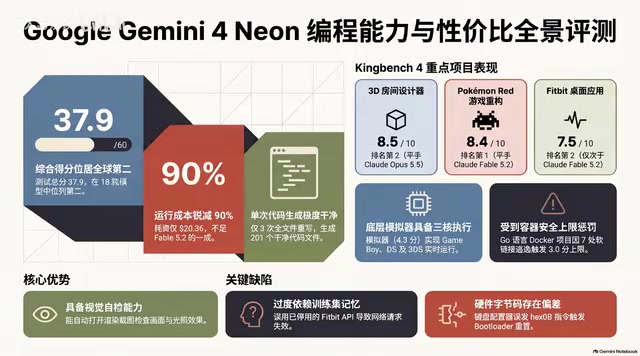
Gemini 4 Neon Hands-On: Value King or Confident Catastrophe?
Gemini 4 Neon review: 1M-token context, four thinking levels, 201 files in one KingBench4 pass at one-tenth Fable 5.2's cost—but it hallucinates fake data, leaves 7 symlink escapes, and bricks keyboards.

Google Gemini 4 Neon Hands-On: 6 3D Works That Impress and Fail
Hands-on with Google Gemini 4 Neon on a 3060 laptop: 6 3D works tested. Sunshower Fishing Harbor and mechanical keyboard impress; soft-body physics and faces fall short.
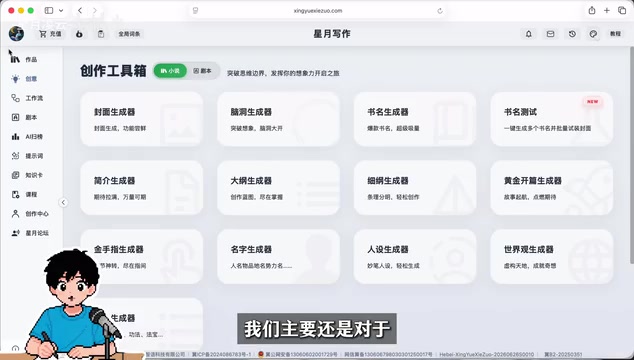
Gemini 4 Neo Web Novel Writing Test: Faint AI Flavor, Textured Dialogue
Bilibili creator's first-look review of Gemini 4 Neo for Chinese web novel writing: testing a Three Kingdoms transmigration opening with faint AI flavor, emotionally textured dialogue, and strong crisis building, plus comparison of 4A/4H/4C models and full workflow demos.