OpenAI Rolls Out Embedded Evaluations, Altman Addresses Chip Leadership Shakeup
OpenAI launches embedded safety evaluations, Kimi and Corna raise major funding, Tesla expands Berlin factory.
OpenAI partnered with Apollo, METR, Transluce, and Goodfire to launch embedded evaluations, moving safety review into the training process for real-time risk monitoring. Altman said the industry remains robust even if Jensen Huang is replaced, though NVIDIA's up to $105B in guarantees for OpenAI data centers underscores dependence. Moonshot AI is dismantling its VIE structure at a ~$50B valuation for a possible Q1 2027 Hong Kong IPO; Corna raised a $125M Series A. OpenAI also opened its CSAM detection tool, cutting review volume by 48%. Tesla is investing $3.3B to expand Berlin for CyberCab production from 2029. Safety and financing were the day's two main threads.
When Safety Review Moves Into the Training Room: OpenAI's Embedded Evaluation Experiment
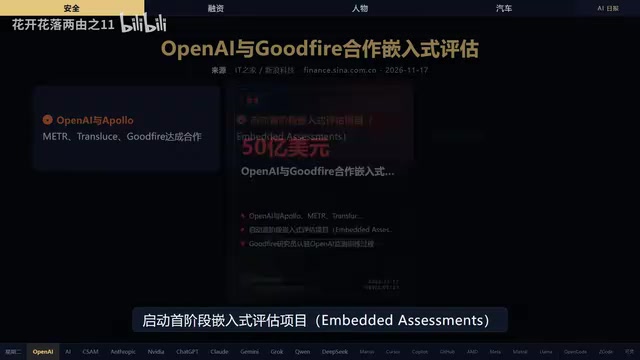
According to a Bilibili AI Daily report, OpenAI has partnered with four external organizations — Apollo, METR, Transluce, and Goodfire — to launch the first phase of its "Embedded Assessments" program. Unlike the past process where safety teams only stepped in after model training was complete, this time evaluators are embedded directly in the training process to monitor potential model risks in real time.
A Goodfire researcher is stationed at OpenAI to monitor the training process. According to the report, OpenAI had explored acquiring Goodfire for more than $5 billion; per-unit deal, Goodfire's valuation is $1.25 billion, meaning the acquisition offer was more than 4x its valuation. Anthropic had previously invested $1 million in Goodfire.
Behind this partnership is a shift in the AI safety evaluation paradigm. Traditional red teaming often lags behind training, whereas embedded evaluation attempts to move the "health check" forward to the "pregnancy" stage. Apollo focuses on investigating whether models attempt to subvert control mechanisms over them; Goodfire uses its interpretability platform to monitor training and alignment; METR conducts two evaluations covering dangerous behavior and detection capabilities; Transluce examines OpenAI's safety evaluation process itself. The pilot also responds to the independent evaluation commitments in the White House superintelligence agreement.
Interpretability refers to the technical direction of understanding why a model produces a certain output by analyzing its internal neurons, activation states, and representations. Goodfire's interpretability platform can "read" a model's internal features in real time during training, locating representations associated with deception, bias, or dangerous capabilities, rather than relying solely on input-output behavioral testing. This allows evaluators to detect risk tendencies before capabilities are fully formed — akin to genetic screening during a model's "pregnancy" rather than a checkup after birth.
Red Teaming is a traditional evaluation method in the AI safety field: human experts or automated systems play the role of attackers, using adversarial prompts to induce models to output harmful content or expose vulnerabilities. Its limitation is that it usually takes place after model training is complete; by the time problems are found, capabilities are already fixed, making remediation costly and potentially lagging behind deployment. Embedded evaluation is precisely aimed at this lag, moving red-team thinking forward into the training phase and iterating in sync with training.
Altman: Without Jensen Huang, the AI Industry Remains Robust
According to the same report, OpenAI CEO Altman publicly stated that even if NVIDIA CEO Jensen Huang were replaced, the industry would remain robust. Huang had previously admitted to an affair with a suspected Chinese spy, sparking public controversy. In his response, Altman emphasized that industry demand is strong, AI is real, and user growth continues.
He also revealed that NVIDIA provides up to $105 billion in guarantees for OpenAI's data centers. Altman called NVIDIA a "behemoth" and said the guarantees remain trusted. Numerous executives jointly called for Huang's return.

The subtlety of this statement lies in the fact that Altman downplays Huang's personal influence on the industry while heavily relying on NVIDIA's compute and credit endorsement. The so-called "robust without Huang" is more like a public reassurance about supply chain confidence.
Kimi Valued at $50 Billion, Dismantling VIE Structure to Sprint for Hong Kong Listing
In the financing space, Moonshot AI is advancing a pre-IPO equity restructuring, dismantling its VIE holding structure, with a valuation of approximately $50 billion. It is considering a Hong Kong Stock Exchange listing in Q1 2027, with potential fundraising of up to $5 billion. The report discloses that its ARR has exceeded $300 million this year, accounting for more than 70% of revenue, with a target to list early next year and accept stricter financial and governance scrutiny.
After repurchasing shares from early dollar investors, funds are being reinvested into the domestic entity. This path aligns with the recent trend of Chinese AI companies returning to Hong Kong for listings, but a $50 billion valuation against $300 million ARR implies an extremely high multiple, reflecting the market's very high expectations for its commercialization growth rate.
VIE Structure (Variable Interest Entity) is a classic arrangement for Chinese companies listing overseas: the overseas listing entity controls the domestic operating entity through contractual agreements rather than direct shareholding, to circumvent foreign investment access restrictions. Dismantling a VIE means changing control from contractual arrangements to direct equity holding, usually in preparation for returning to domestic or Hong Kong listings and accepting stricter regulatory scrutiny. This process involves foreign exchange, tax, and shareholder rights restructuring, is time-consuming and costly, and often accompanies the exit of old shareholders or share repurchases.
CSAM Detection Tool Made Freely Available: Higher Accuracy, 48% Less Review Volume
Another piece of news in the safety space is that OpenAI has released a new image classifier that can identify CSAM (child sexual abuse material), including AI-generated content, with improved accuracy. The new classifier reduces review volume by 48% while maintaining detection rates. Of high-confidence flags, 72% were confirmed by File as new types of CSAM.
The tool is freely available to vetted organizations via the OpenAI API, in partnership with NICMEC, Tech Coalition, and ROOS. ChatGPT has added warnings, suspending accounts for 24 hours and directing users to help resources.
Opening detection capabilities to external organizations is essentially building industry infrastructure around content safety. The identification of AI-generated CSAM also responds to the real risk of generative models being misused.
Corna Raises $125 Million as AI Defense Demand Surges
AI cybersecurity startup Corna has completed a $125 million Series A round at a post-money valuation of $1 billion, led by NEA. Since emerging from stealth in early August, it completed the round within three months; backers include Squire, Cosla, and Kochu, with cumulative funding of $185 million.
The report notes that after the PHP and Node.js vulnerability incidents, market demand for AI defense surged.
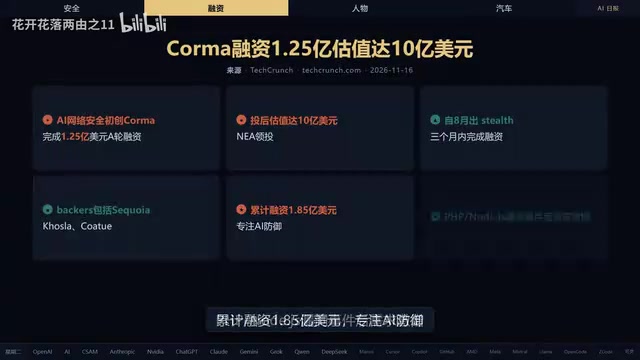
The security track is seeing two financing lines — "offense" and "defense": on one side, OpenAI embeds evaluation into training; on the other, Corna uses AI for defense. Capital is betting on the entire AI safety chain.
ARR (Annual Recurring Revenue) refers to the annualized recurring revenue from subscription-based or ongoing services, a core metric for SaaS and AI companies to measure commercialization quality, excluding one-time project revenue. For Moonshot AI, ARR exceeding $300 million means its revenue has predictability and a renewal base; but a $50 billion valuation corresponds to roughly 167x ARR, far higher than traditional software companies, reflecting the market's extreme pricing of its growth rate and amplifying downside risk if commercialization falls short.
Tesla's $3.3 Billion Berlin Expansion, CyberCab Mass Production Countdown
In the automotive sector, Tesla is investing $3.3 billion to expand its Berlin factory, producing the CyberCab from 2029, with the new facility having annual capacity of up to 1 million units, construction starting in the first half of 2027. The CyberCab has no steering wheel or pedals, was unveiled in 2024, and made public in September.
The Boston factory will stop the CyberTruck line and switch to CyberCab production; Boston already has about 573 CyberCabs, and Texas has 1,307 registered RoboTaxis. Tesla achieves autonomous driving using cameras alone, unlike Vemo.
The CyberCab's production timeline and capacity plans represent a major bet by Tesla on scaling Robotaxi. Whether the steering-wheel-free design can pass regulations in various regions remains the biggest variable.
Today's Observations
Safety and financing are today's two main threads. OpenAI is laying out safety across multiple fronts, from embedded evaluation to CSAM detection, attempting to turn safety capabilities into exportable infrastructure; the financing of Kimi and Corna shows that capital is still concentrating in leading AI companies and high-demand safety tracks. Tesla's Berlin expansion pushes the autonomous driving competition into the mass production stage.
According to the Bilibili AI Daily summary, OpenAI is laying out safety across multiple fronts, Tesla is betting on CyberCab, and financing and governance are advancing together.
One-line Summary
OpenAI launches embedded safety evaluations, Kimi and Corna raise large rounds, Tesla expands Berlin factory.
Paragraph Summary
OpenAI has partnered with Apollo, METR, Transluce, and Goodfire to launch the first phase of its embedded evaluation program, moving safety review from post-training to within the training process for real-time risk monitoring. Altman stated that the industry would remain robust even if Jensen Huang were replaced, but the reality of NVIDIA providing up to $105 billion in guarantees for OpenAI's data centers highlights its dependence. On financing, Moonshot AI is dismantling its VIE structure, valued at about $50 billion, and considering a Hong Kong listing in Q1 2027; Corna completed a $125 million Series A. OpenAI also made its CSAM detection tool freely available, with the new classifier reducing review volume by 48%. Tesla is investing $3.3 billion to expand its Berlin factory, producing CyberCab from 2029. Safety and financing became the two main threads of the day.
Related articles

Gemini 4 Neon Released: A Balance Between Frontier Intelligence and Efficient Task Execution
Google DeepMind releases Gemini 4 Neon, focused on frontier intelligence and fast end-to-end task execution. This article breaks down its benchmark performance in coding, enterprise analysis, scientific reasoning, and cybersecurity, its four thinking levels, pricing, and safety alignment data.

Is AI the Culprit Behind Global Outages? The Trust Crisis Behind the NSA and FAA Failures
Fourth major failure in five days hits NSA classified network. Microsoft blames a software bug, FAA denies its new AI system, NSA says routine maintenance. Senator Warner suggests AI accelerates vulnerability discovery, leading to rushed fixes — while 39% of Americans already view AI negatively, exposing a deepening trust crisis.

Robot Developer Builds Custom B-rep Kernel with 3,487 Tests
A robot developer builds a custom B-rep geometry kernel with 3,487 tests, exploring why robotics needs dedicated CAD tools and the barriers to building one.