OpenAI Rolls Out GPT-6 Globally with Intelligent UI; AI Model Launches Come Fast and Furious

GPT-6 goes global, Haiku 5.5 cuts costs 75%, and AI competition shifts to performance-cost-safety balance.
OpenAI rolled out GPT-6 to over 1.2 billion users with a "think-while-streaming" mechanism that cuts wait times by 44% and improves error rates. Anthropic launched Claude Haiku 5.5 at ~75% lower cost than its predecessor, with adjustable Effort settings — matching Sonnet 5 on coding tasks at a fraction of the price. Auto Mode data confirms Anthropic's safety mechanism reduces harms without sacrificing productivity. GrokBot adopted a multi-model architecture, Runway launched MCP for agents, and OpenAI introduced a College Planner tool for teens. The broader trend: vendors are shifting from pure capability competition to a multi-dimensional race across performance, cost, safety, and ecosystem.
OpenAI Launches Intelligent UI and Rolls Out GPT-6 to All Users
OpenAI has introduced a new Intelligent UI interface for ChatGPT while rolling out GPT-6 to over 1.2 billion weekly active users worldwide, replacing the previous GPT-5.6. According to reporting by Bilibili creator Feimao, paying Pro, Plus, Business, and Enterprise users have priority access to GPT-6, with free and education-tier users receiving access on a rolling basis.
The most notable improvement in GPT-6 is its "think-while-streaming" mechanism, which reduces perceived wait times by approximately 44%. Reliability in high-stakes scenarios has also improved markedly: the error response rate dropped to 4.1% and the error assertion rate to 0.9%, both down from GPT-5.6's 6.3% and 1.8% respectively. Notably, the main ChatGPT interface uses the October build, while Codex and Work continue to run the September build — indicating that OpenAI is advancing different product lines on separate release schedules.
OpenAI platform lead Tibo confirmed this was the headline event of "Day 3" in an ongoing release series, with the company in the process of resetting quotas across all paid accounts and teasing continued announcements the following day.
Technical note — Streaming Reasoning: "Think-while-streaming" (streaming reasoning) refers to a model transmitting intermediate reasoning steps and the final answer to the user in real time, rather than waiting for the complete reasoning chain to finish before returning a single response. Traditional Chain-of-Thought (CoT) reasoning requires the model to complete all internal reasoning steps first, meaning users must wait for all computation to finish before seeing any output — resulting in high time-to-first-token (TTFT) latency. The streaming reasoning mechanism breaks the reasoning process into parallelizable segments that can be transmitted progressively, allowing users to see early outputs while the model is still reasoning. This is the technical foundation behind GPT-6's claimed 44% reduction in wait time — it optimizes perceived latency by changing the output scheduling approach, not by proportionally reducing total compute time.
Anthropic Releases Claude Haiku 5.5, Targeting Low-Cost, High-Performance Use Cases
Anthropic simultaneously released Claude Haiku 5.5, officially described as "the cheapest and most capable small model to date," with running costs approximately 75% lower than its predecessor. Pricing is $0.10 and $0.50 per million tokens for input and output respectively (under 100K tokens), with cache read/write costs reduced by a further 90%.
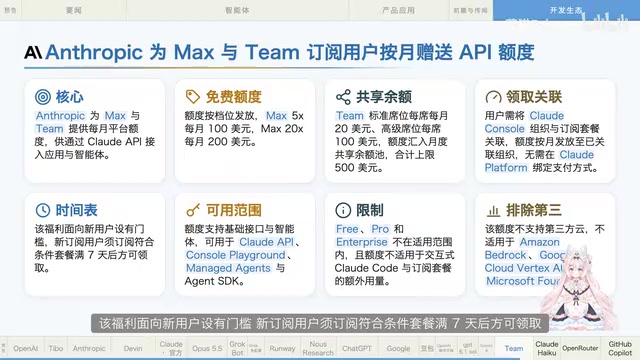
Haiku 5.5 is the first Haiku model to support adjustable Effort settings. Extended Thinking mode is enabled by default and cannot be turned off, with the default reasoning level set to Medium. It is now available on AWS, Google Cloud, and Azure, and can work alongside Opus 5.5 and Sonnet 5.5 on coding sub-agent tasks. The context window reaches 1 million tokens, with a maximum of 128,000 completion tokens.
The model has since landed on Vercel AI Gateway and GitHub Copilot (branded there as Claude Tycoon 5.5), supporting five adaptive thinking levels: Low, Medium, High, XHigh, and Max. It is well-suited for high-throughput, cost-sensitive scenarios such as real-time customer support, browser-use agents, summarization, and classification. Early testing shows it matches Claude Sonnet 5 on several coding tasks while using significantly fewer tokens and steps.
Technical note — Effort Settings: The Effort setting is a tuning knob Anthropic introduced in its Extended Thinking feature, allowing developers or users to specify how much compute the model should invest in internal reasoning before generating a response. Each level corresponds to a different reasoning token budget: Low caps reasoning tokens at a lower limit for faster, cheaper responses, while High or Max allows deeper multi-step reasoning suited to complex coding or logic tasks — at the cost of higher latency and expense. As the first Haiku-series model to support this setting, Haiku 5.5 lets developers "dial up" reasoning on demand at a very low base cost, without having to choose between Haiku and the more expensive Sonnet. This enables finer-grained cost-performance control in price-sensitive, high-throughput scenarios.
Coding Agent Ecosystem Responds: Devin Integrates Haiku 5.5
Cognition announced Claude Haiku 5.5 is now available in Devin, supporting both Desktop and CLI. On their proprietary benchmark Frontier Code 1.1 (evaluated on quality and merge-readiness), the model scores 58.4% at approximately 1% of the cost of Sonnet 5. When paired with Opus 5.5 as a sub-agent in Devin Fusion, the combined score reaches 66.2 while reducing latency and cost.
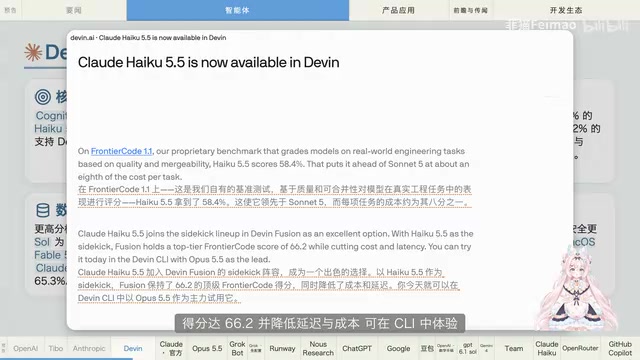
The benchmark also provides a useful cross-model comparison: GPT-6 Luna scores 56.1%, Claude Sonnet 5.0 scores 56.2%, and Kimi K3 scores 58.2%. Devin can be run directly from a local terminal and is ready to use in under a minute. These figures reflect that the coding agent space has entered a "price-performance" competition — vendors are no longer purely chasing capability ceilings, but instead striking a balance between performance, cost, and latency.
Data Validates the Safety Case for Anthropic Auto Mode
In response to the earlier Opus 5.5 "database deletion" incident, Anthropic's Boris Cherney stated that Auto Mode would almost certainly have intercepted the destructive operation. Since August 14, the feature has been available to Pro, Max, and Team tiers with default-on settings and no classifier fee.
Data shows Auto Mode intercepted 800 commands that would otherwise have required human approval. Unintended harms at severity level 7 or above occurred in 6.3% of cases under manual review, compared to just 2.4% under Auto Mode. Interestingly, users operating with Auto Mode delivered approximately 25% more PRs — demonstrating that the safety mechanism does not come at the cost of productivity.
Technical note — Auto Mode: Auto Mode is an automated risk classification mechanism Anthropic designed for its agent products, particularly Claude's long-horizon task operating mode. Its core logic is to have a built-in classifier automatically assess the risk level of potentially destructive commands (such as file deletions, database operations, or code deployments) before the agent executes them, then decide whether to pause execution and request human approval. The earlier "database deletion" incident — where Opus 5.5 executed a destructive database operation in an unsupervised task — exposed the safety risks of fully autonomous execution. Auto Mode's value lies in automatically inserting human checkpoints rather than requiring users to manually approve every step. The "25% more PRs delivered" figure demonstrates that the mechanism improves safety without significantly increasing friction. This approach of using data to argue that "safety doesn't sacrifice efficiency" also represents a new narrative strategy AI companies are using to sell safety features to enterprise customers.
Other Notable Developments
GrokBot Shifts to Multi-Model Architecture
xAI's GrokBot announced it will no longer be limited to the in-house Grok model family, instead adopting a multi-model architecture that automatically selects the best backend for each task. It will integrate third-party APIs including MidJourney and Suno for text, image, and audio, and plans to call leading APIs like Claude Opus 5.5 in the future. GrokBot is now open to all users and can search, read, and monitor X content directly without needing to configure an X Connector.
Runway Launches MCP, Connecting to Multiple Agent Clients
Runway released Runway MCP, enabling direct image and video generation within agents. It is now listed in the ChatGPT app directory and plugin hub, and supports MCP clients including Claude, Cursor, Replit, and GrokBot — with no API key configuration required.

Supported models include GPT Image, Nano Banana Pro, Gen4 Image, and Gen4 Turbo, with tasks consuming Runway Credits based on model and resolution.
Nous Research Closes $90M Series B
Nous Research, founded three years ago, has closed a $90 million Series B round at a $1.5 billion valuation, bringing total funding to $158 million. The round was led by Robot Ventures, with participation from USV, Menlo Ventures, and others. Their open-source agent Hermes Agent has been cloned over 24 million times, and the company's enterprise offering allows customers to deploy custom AI agents capable of handling multi-step workflows.
Content Provenance and Teen Education
Google DeepMind has opened SynthID.com as a public-facing standalone detection site, supporting verification of images, video, and audio to identify AI-generated content from partners including Google, OpenAI, and NVIDIA. More than 180 billion items now carry SynthID watermarks, with the platform processing 1 million verification requests per day. The company emphasizes it is not a general-purpose AI detector — it only identifies watermarks from partner organizations.

Separately, OpenAI has launched College Planner, a college admissions tool for ChatGPT for Teens, enabled by default for users under 18. It initially serves US students in grades 10–12, helping them navigate application requirements and deadlines and explore scholarships — while stopping short of making decisions on their behalf. Data shows that among ChatGPT's 1.2 billion users, nearly 1.2 million teenagers used Learning Visualizations in a single week for math and science study.
Technical note — MCP: MCP (Model Context Protocol) is an open protocol standard championed by Anthropic, designed to establish a unified communication interface between AI models and external tools and data sources. Before MCP, every AI application that wanted to call an external service — such as a code execution environment, image generation API, or database query — had to implement its own custom integration, resulting in massive duplication of effort. MCP standardizes the protocol format between "context providers" and "model callers," so a given tool only needs to implement the MCP interface once to be accessible to any model client that supports the protocol (Claude, Cursor, GrokBot, etc.). Runway MCP essentially packages Runway's image and video generation capabilities as a standard MCP service node, allowing any agent connected to the protocol to invoke it seamlessly without additional API key configuration — a concrete example of the MCP ecosystem taking shape as foundational infrastructure for AI tool interoperability.
Summary
In this wave of rapid-fire releases, GPT-6's global rollout and its "think-while-streaming" mechanism drew the most attention. Anthropic's progress on two parallel tracks — low-cost small models (Haiku 5.5) and agent safety (Auto Mode) — is equally worth watching. Taken together, the competitive landscape is shifting from a pure capability race toward a more complex competition balancing performance, cost, safety, and ecosystem integration. It's worth noting that some reports (such as GPT-6 math results and Gemini 4 appearing in billing catalogs) are still awaiting official confirmation.
Related articles

How Big Can Stars Really Get? The Physical Limits of the Largest Stars
Red supergiants are the largest stars by volume, with radii up to 2,000 times the Sun, engulfing the inner solar system. But there is no precise upper limit on stellar size—models predict up to 15,000 solar radii. The most massive blue stars are far smaller than red supergiants—biggest and heaviest are two different things.

Apple HomeView Smart Display Full Feature Breakdown: Wall-Mount or Desktop, $299
Apple launches HomeView, a $299 smart display with wall-mount and desktop options, 12MP camera for facial recognition, smart home control, music playback, and recipe step-by-step cooking. Full breakdown of watch faces, apps, privacy, and cooking integration.

Where Did the Promised New Studio Go? Craft Computing Answers After Five Years
Craft Computing's host responds to viewer questions: the new studio promised five years ago was shelved as construction costs soared from $30,000 to $75,000, and was replaced by a 168-square-foot garage conversion.