OpenAI's $3 Billion Windsurf Acquisition: How Will It Reshape the AI Coding Tool Landscape?

OpenAI acquires Windsurf for $3B, making its biggest bet yet on the AI coding tool ecosystem.
OpenAI is acquiring AI coding tool Windsurf (formerly Codeium) for approximately $3 billion—its largest acquisition to date. After failing to acquire Cursor, OpenAI turned to Windsurf. With investments in Cursor and ownership of Windsurf, OpenAI gains significant control over the AI coding space, creating a complex competitive dynamic with Microsoft's GitHub Copilot. The move aims to capture programming data and build an Apple-like closed ecosystem, though the industry broadly faces profitability challenges due to high inference costs.
According to Bloomberg, OpenAI has agreed to acquire AI coding tool Windsurf (formerly Codeium) at a valuation of approximately $3 billion, making it OpenAI's largest acquisition to date. Behind this deal lies the fierce competition in the AI coding tool space, as well as OpenAI's strategic ambition to build a complete AI ecosystem.
The Acquisition Story: A Winding Path from Cursor to Windsurf
Bloomberg, citing sources familiar with the matter, reports that the deal has not yet been finalized, and both OpenAI and Windsurf have declined to comment. However, multiple signs indicate that the acquisition is virtually a done deal.
Here's an interesting detail: OpenAI's original acquisition target was actually Cursor, but that attempt was unsuccessful. Cursor, developed by Anysphere, is also built on the VS Code core but features extensive innovations in AI interaction design—its core competitive advantage lies in an exceptionally smooth "Tab completion" experience, multi-line code prediction, and a built-in conversational programming assistant. Cursor recently closed a new funding round at a valuation of approximately $9 billion—a staggering figure. According to reports, Cursor's annualized recurring revenue (ARR) surpassed $300 million in 2024, with an extremely steep user growth curve. Notably, Cursor supports multiple underlying large models (including GPT-4o, Claude Sonnet, Gemini, etc.). This model-agnostic strategy allows it to consistently deliver the best coding experience available, but it also means Cursor isn't tied to any single AI vendor's ecosystem—which may be one reason OpenAI's acquisition attempt fell through. After failing to acquire Cursor, OpenAI turned its attention to Windsurf, a competitor in the same space.
Windsurf's predecessor, Codeium, was founded in 2021 and initially launched as a free AI code completion tool, positioning itself as an open-source alternative to GitHub Copilot. In late 2024, Codeium rebranded as Windsurf and transformed from a simple code completion plugin into a full AI-native code editor (forked from VS Code's open-source core). Windsurf's key technical highlight is its "Cascade" feature—a deeply context-aware AI agent workflow that can understand an entire codebase's structure and autonomously execute multi-step coding tasks, including cross-file editing, terminal command execution, and automated debugging. This Agentic programming paradigm represents a critical step in the evolution of AI coding tools from "completion suggestions" to "autonomous execution."
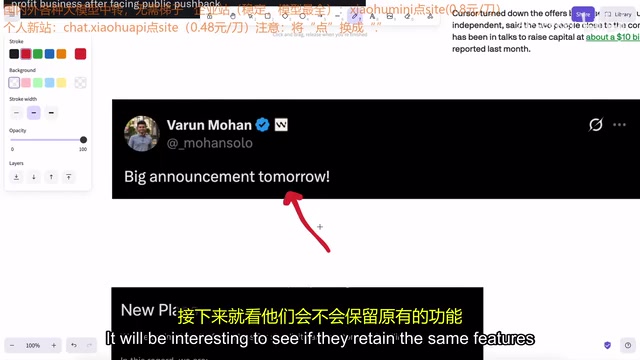
In fact, signs of the acquisition had already emerged: Windsurf team members began appearing in OpenAI's product launch livestreams, and Sam Altman started retweeting posts from Windsurf's CEO. Windsurf's CEO even directly previewed that "a major announcement is coming tomorrow," all but confirming the merger with OpenAI.
Additionally, Windsurf had previously made O4 and GPT-4.1 models available to users for free, hinting at its increasingly close relationship with OpenAI. During the acquisition rumors, Windsurf also adjusted its pricing strategy to more closely align with Cursor's price structure—likely an effort to accumulate as many users as possible before the merger.
Competitive Landscape: One Company Controlling Two Major AI Editors
The most noteworthy aspect of this acquisition is that OpenAI is also an investor in Cursor. This means OpenAI effectively controls two of the leading products in the AI coding tool space, profoundly impacting the market's competitive dynamics.
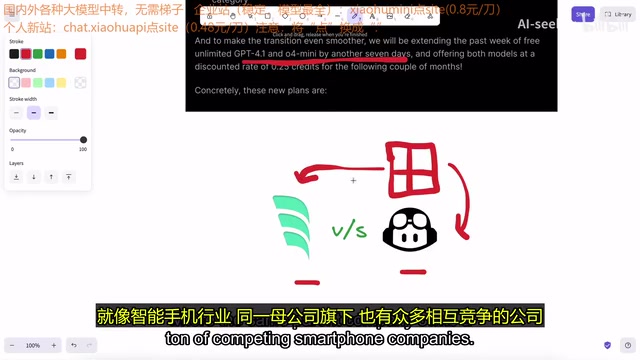
To complicate matters further, Windsurf has been directly competing with GitHub Copilot in features and pricing. Copilot is operated by GitHub under Microsoft, and Microsoft is simultaneously OpenAI's largest investor. GitHub Copilot was jointly launched by GitHub and OpenAI in 2021 as one of the earliest commercialized AI programming assistants. It currently has over 1.5 million paying users and more than 77,000 enterprise customers, making it the AI coding tool with the highest market share. Microsoft's interests in this space are extremely complex: as OpenAI's largest investor (with cumulative investments exceeding $13 billion), Microsoft is both OpenAI's strategic partner and, through GitHub Copilot, a direct competitor to the Windsurf that OpenAI is about to own. Previous reports have indicated that Microsoft internally has grown wary of OpenAI's expanding product ambitions, as OpenAI is transforming from a pure model provider into a company that directly serves end users—creating increasing overlap with Microsoft's own product lines. After the acquisition closes, Windsurf and Copilot will exist under the same "umbrella."
This situation is analogous to the smartphone industry—where a single parent company owns multiple competing brands. From a business logic perspective, it's better to have your own products compete with each other than to let external rivals erode your market share. But this also means GitHub Copilot may no longer enjoy the "exclusive treatment" it once had.
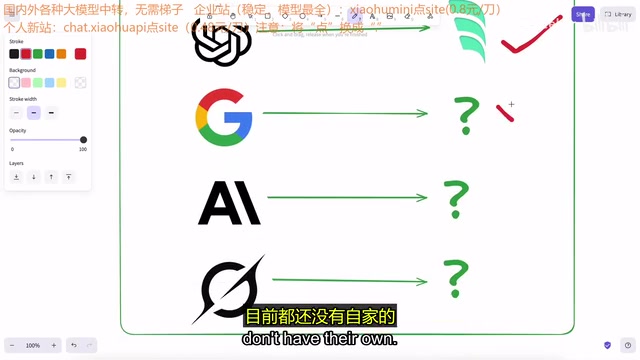
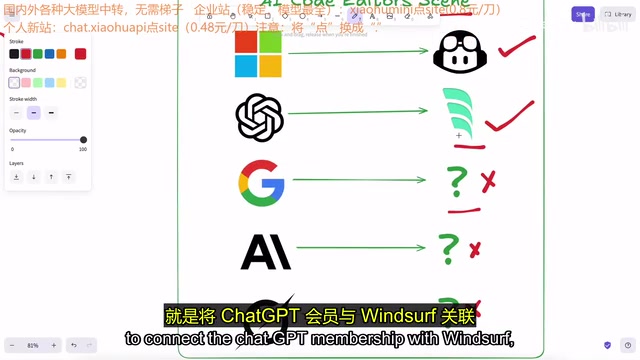
Here's how the major AI giants are currently positioned in the coding tool space:
- Microsoft/OpenAI camp: GitHub Copilot + Windsurf (+ Cursor investment)
- Anthropic: Partnership with Zed editor, plus command-line tools like Claude Code
- Google: Project IDX / Firebase Studio (cloud IDE), but lacking a local-first editor
- Open source: Zed's Agent mode is currently the most noteworthy open-source option
Why Did OpenAI Choose to Acquire Rather Than Build?
A question worth pondering: OpenAI is valued at approximately $300 billion—why not build an AI code editor from scratch?
From a technical standpoint, building a code editor with integrated AI capabilities isn't an insurmountable challenge. But the reality is that building a product from scratch with a mature user base and comprehensive features requires far more time and resources than one might imagine. Windsurf has accumulated significant innovations in core AI editor interactions and feature design, particularly its Cascade workflow representing the Agentic coding paradigm—where AI agents autonomously plan implementation steps, write code, run tests, debug errors, and even browse documentation and search for solutions—this experience cannot be replicated in a short timeframe.
OpenAI's "buy rather than build" strategy is essentially trading capital for time. By acquiring Windsurf, OpenAI gains not just a mature product and user base, but more importantly, massive amounts of real-world programming data. This coding data from real development scenarios is extremely valuable for training and optimizing next-generation AI programming models. By controlling the complete chain from model training to end-user products, OpenAI can achieve a data flywheel effect—programming data collected by Windsurf feeds back into model training, stronger models improve the product experience, attracting more users, creating a positive feedback loop.
Future Outlook: OpenAI's "Apple-ification" Ecosystem Strategy
From a broader perspective, OpenAI is attempting to become the Apple of AI—creating a closed but superior ecosystem by tightly integrating models with products.
This analogy isn't mere rhetoric. Apple's core business model creates user experiences that competitors cannot replicate through vertical integration of hardware (iPhone, Mac) and software (iOS, macOS), while continuously generating revenue through platforms like the App Store. OpenAI is replicating this logic: its underlying models (GPT series, o-series reasoning models) are equivalent to Apple's chips and operating system, ChatGPT is equivalent to the iPhone, and Windsurf is equivalent to a specialized application in a vertical domain. The risk of this closed-loop strategy is that it may alienate third-party developers who build products on OpenAI's API, as OpenAI is transforming from a platform provider into their direct competitor.
After acquiring Windsurf, OpenAI will likely push forward in several directions:
Building Dedicated Coding Models
OpenAI will very likely develop specially optimized coding models for Windsurf, delivering superior coding experiences while controlling inference costs. The "Agentic coding" mentioned here is the most important technical trend in AI programming for 2024-2025—traditional AI programming assistance primarily follows a "human-led, AI-suggests" model where developers write code and AI provides completion suggestions; Agentic coding instead lets AI play the role of an autonomous "software engineer agent," where developers describe requirements in natural language and the AI agent independently completes the entire workflow from planning to implementation. Similar to Gemini 2.5 Pro's outstanding performance on benchmarks like SWE-bench, OpenAI needs to release specialized models that truly lead in these multi-step, long-context programming scenarios.
Subscription System Integration
A key question is: Will Windsurf be bundled into ChatGPT's $20/month subscription? If OpenAI takes this route, it would dramatically increase the appeal of ChatGPT Plus subscriptions, while simultaneously creating enormous pricing pressure on Cursor and Copilot.
The Choice Between Model Exclusivity and Openness
It remains unclear whether Windsurf will continue to support third-party models like Anthropic Claude and Google Gemini, or shift to OpenAI model exclusivity. From a business perspective, an exclusive strategy helps boost OpenAI model usage and data accumulation, but may drive away developers who prefer other models.
The Profitability Dilemma: Concerns Behind the $3 Billion Bet
It's worth noting that whether it's Windsurf, Cursor, or OpenAI itself, all currently face profitability challenges. While low-price subscription strategies can rapidly acquire users, the computational costs of AI inference are extremely high, leaving nearly all these companies operating at a loss and requiring new funding rounds every few months.
The profitability challenge for AI coding tools is rooted in the high computational costs of large language model inference. Every time a user triggers a code completion, initiates a conversation, or runs an Agentic task in the editor, the backend needs to call GPU clusters for real-time inference. Taking GPT-4 level models as an example, a single complex inference request might cost anywhere from a few cents to tens of cents, and an active developer might trigger hundreds or even thousands of inference requests per day. When subscription prices are only $10-20 per month, heavy users' inference costs can easily exceed subscription revenue. This is also why Cursor adjusted its usage quota policies multiple times in 2024, limiting the number of calls to advanced models. The industry's current strategy is to acquire users and data through losses, hoping that future inference costs will continue to decline (following a compute cost reduction trend similar to Moore's Law) and that profitability can be achieved through economies of scale.
This $3 billion acquisition is both OpenAI's major bet on the future of AI programming and yet another example of the industry's "burn money for growth" model. Whether profitability can ultimately be achieved through ecosystem integration will be the key criterion for judging whether this deal succeeds or fails.
For developers, the short term may bring more free or low-cost AI coding services, but in the long run, increasing market concentration could mean fewer choices and higher prices. The competition in AI coding tools is far from over, but the landscape has fundamentally changed.
Key Takeaways
- OpenAI is acquiring AI coding tool Windsurf for approximately $3 billion—its largest acquisition to date—after an earlier attempt to acquire Cursor was unsuccessful
- OpenAI simultaneously invests in Cursor and is acquiring Windsurf, establishing significant market control in the AI coding tool space
- The core value of the acquisition lies in gaining a mature product, user base, and valuable programming training data, rather than pure technical capabilities
- OpenAI is attempting to become the Apple of AI, building a closed ecosystem through tight integration of models and products
- The AI coding tool industry broadly faces profitability challenges, with the contradiction between low-price strategies and high AI inference costs still unresolved
Related articles
 Tech Frontiers
A Rare Quiet Day in AI: Recursive Self-Improvement Stirs Beneath the Surface
A rare quiet day in AI sees multiple sources go silent simultaneously. Behind the calm, Recursive Self-Improvement (RSI) research continues. What this means for the industry.
 Tech Frontiers
Reve 2 vs. Ideogram 4: A Deep Dive into Layout Control in AI Image Generation
A deep comparison of Reve 2 and Ideogram 4's layout control capabilities, covering technical approaches, real-world use cases, and industry trends for designers and creators.
 Tech Frontiers
In the Weights: Check Your Influence Score in the AI World
In the Weights is an AI influence search engine that quantifies your presence in the AI world with a score. Explore how it evaluates practitioners and what it means for digital identity.