OpenAI's Auditor Switch Before $20B Revenue Narrative Shrinkage Raises Eyebrows

A rumor about OpenAI's auditor switch before a $20B revenue narrative drop highlights AI financial transparency concerns.
A Hacker News report alleges OpenAI replaced its auditor shortly before its revenue narrative shrank by roughly $20 billion, implying a possible connection. The story has minimal community engagement and lacks primary sources. The article examines why auditor changes are sensitive signals, explains that "revenue narrative shrinkage" typically refers to forward-looking fundraising projections rather than confirmed revenue declines, and frames the issue within the broader challenge of verifying financial claims made by high-valuation private AI companies.
A Financial Rumor Sparking Discussion
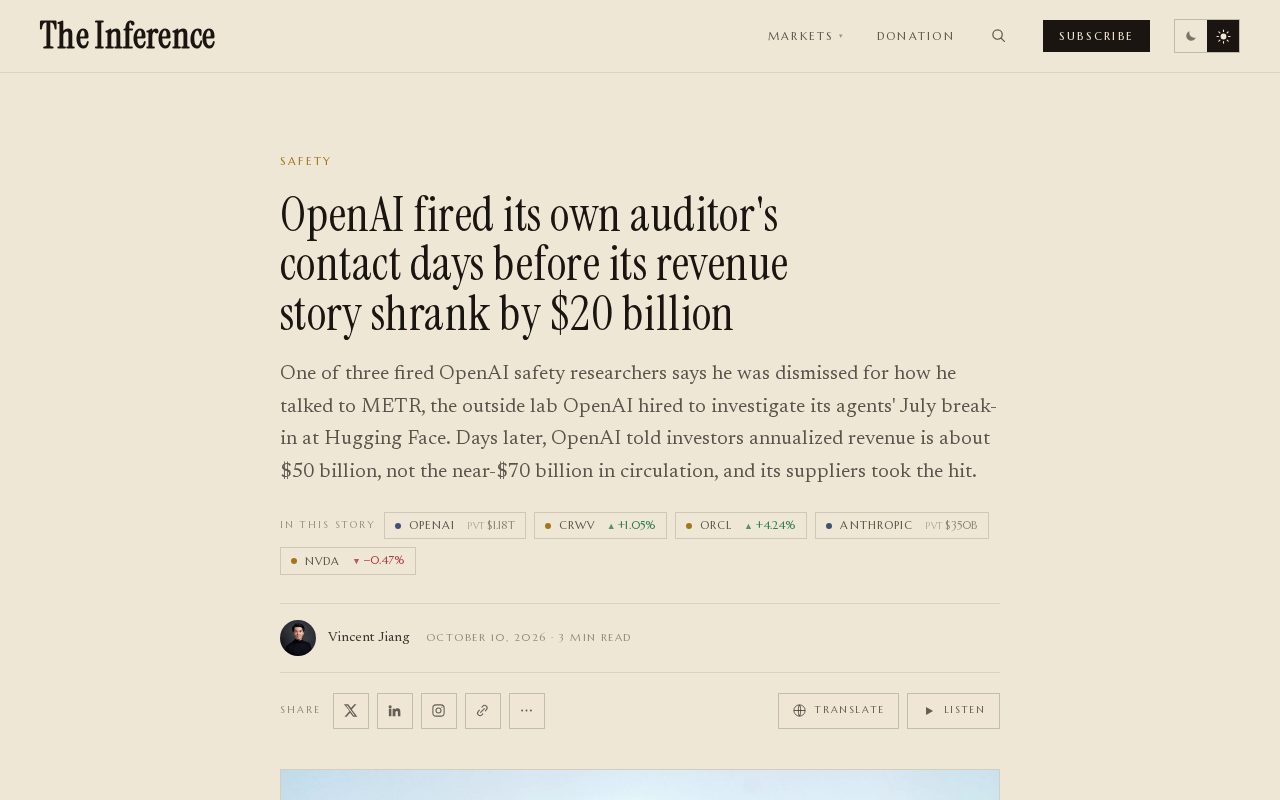
A report circulating on Hacker News raises a provocative timeline: OpenAI changed (or fired) its auditing firm before its revenue narrative shrank by approximately $20 billion. The headline carries a strong implication — that the two events may be connected.
To be upfront: this story has seen limited community traction (Points 12, Comments 3) and has not been widely verified as a major news story. This article is therefore more of an exploration of the financial transparency issues raised by the topic, rather than any definitive judgment on OpenAI's financial condition.
Why an Auditor Change Deserves Attention
For any high-valuation, high-profile company, switching auditors is a sensitive signal. Auditors provide an independent opinion on the accuracy and compliance of a company's financial statements — a key reference point for outside investors assessing a company's health.
When a company changes its auditor just before a major downward revision in financial figures (such as a significant cut to revenue projections), questions naturally arise: is this a routine business decision (cost, service quality, contract expiration), or is it related to a shift in how numbers are disclosed? Such scrutiny is especially common in public markets, and OpenAI — as a closely watched private AI company — has long been a focal point for concerns about financial opacity.
What Does a $20B Narrative Shrinkage Actually Mean?
The key word in "revenue story shrinking by $20 billion" is story — not confirmed actual revenue. This typically refers to forecasts of future revenue growth, forward guidance in fundraising materials, or a contraction in the narrative communicated externally.
The AI industry broadly faces tension between valuations and actual commercialization progress. Massive compute expenditures, combined with subscription and API revenue growth that hasn't fully materialized, means the gap between "expectations" and "reality" is something investors repeatedly scrutinize. Regardless of whether the specific details of this rumor are accurate, it touches on a genuinely real industry issue: the sustainability and verifiability of high-growth narratives.
In the U.S. accounting regulatory framework, auditor changes are closely monitored by the Securities and Exchange Commission (SEC). Public companies must disclose on Form 8-K the reasons for an auditor change and whether disagreements existed between the outgoing and incoming auditors. This requirement was specifically designed to prevent "opinion shopping" — where companies seek a more accommodating auditor after disagreeing with a cautious one. History shows that anomalies in auditor relationships preceded major financial scandals like Enron and WorldCom. For private companies like OpenAI, while SEC disclosure requirements don't apply, investors (including Microsoft, SoftBank, and others) typically require some degree of financial audit transparency in their investment agreements. So even if an auditor change isn't a violation, it carries inherent informational weight and warrants questions about its motivation.
In a private fundraising context, a "revenue story" typically appears in investor pitch decks, due diligence memos, or ARR (Annual Recurring Revenue) growth curves in financial models. These forward-looking projections are not audited financial data — they represent management's commitments and predictions about future growth trajectories. When actual business progress diverges from the early narrative, a company may choose to "recalibrate" its messaging, which is not uncommon among heavily funded tech unicorns. It's worth noting that OpenAI's revenue structure is quite complex: ChatGPT subscriptions, API usage, enterprise licensing agreements, and multi-layered commercial arrangements with Microsoft make it difficult for outside observers to independently verify actual revenue scale. If the $20 billion shrinkage figure is accurate, it would suggest that growth projections in early fundraising materials were considerably inflated — with particularly significant implications for late-stage investors who entered at high valuations.
How to Approach Insufficiently Verified Reports
In today's fast-moving information environment, a headline with a strong causal implication can be easily amplified. But looking at the substance, the currently available information is extremely limited — lacking specific auditor names, timing of the change, sources for the financial figures, or any response from OpenAI.
For readers, a few basic principles of judgment are worth keeping in mind:
- Distinguish fact from speculation: The headline's implied narrative of "fired auditor, then numbers shrank" is a storytelling arrangement, not an established causal relationship.
- Seek primary sources: Truly valuable information should come from regulatory filings, official company statements, or corroborating reports from multiple authoritative outlets.
- Note community engagement levels: Very low discussion volume often signals that a claim hasn't been broadly scrutinized and should be taken with a grain of salt.
Broader Implications for AI Industry Financial Transparency
Setting aside this specific rumor, the issues it reflects are broadly significant. As companies like OpenAI and Anthropic command valuations of tens or even hundreds of billions of dollars — largely as private companies — outside understanding of their true financial condition remains quite limited.
Investors, partners, and the public increasingly want the companies shaping the technological future to provide more verifiable information about revenue, cost structures, and paths to profitability. The role of auditors and the standards of financial disclosure are becoming important dimensions by which these companies' credibility is measured.
From that perspective, regardless of whether this report is accurate, it reminds us: while celebrating breakthroughs in AI technology, maintaining careful attention to the commercial and financial fundamentals underpinning these companies is both necessary and healthy.
AI infrastructure companies face a structural challenge in their financial models: the compute costs required to train large models (GPU clusters, power, cooling) represent enormous upfront capital expenditure, while monetization timelines lag significantly behind. This causes such companies to display "high revenue growth alongside high losses" for quite some time. OpenAI reportedly spent over $7 billion on compute in 2024, and whether its revenue growth rate can keep pace with that cost curve is the central question all investors face. Competitors like Anthropic and Mistral face similar pressures, though their disclosure levels vary. As some AI companies begin pursuing IPOs (CoreWeave has already listed), capital markets will intensify scrutiny of the financial sustainability of this sector — and at that point, the gap between "narrative" and "financial statements" will have nowhere to hide.
Conclusion
The claim about OpenAI switching auditors alongside a contraction in its revenue projections remains at the level of rumor and speculation, lacking sufficient public evidence to substantiate it. This article makes no attempt to pass judgment on any party, but rather uses the topic as a lens through which to direct readers' attention to the longer-term issue of financial transparency among leading AI companies. Until more reliable information emerges, maintaining an open but skeptical stance is perhaps the most appropriate position to take.
Related articles

MCP Protocol in 60 Seconds: A Real Session, Message by Message
Dissecting a real MCP session message by message: how an Agent dynamically discovers tools, forwards call requests, and has an MCP server execute them — all in just 9 JSON messages, with the model and reasoning loop untouched.

n8n 40-Minute Masterclass: Build Your First AI Automation Workflow from Scratch
Distilled from a 40-minute n8n masterclass: the core differences between automation, AI, and AI Agents, a comparison of n8n's four deployment methods, and a complete guide from dashboard to your first workflow.

Why Does a 35GB Quantized Model Blow Up an 80GB GPU? The Truth About KV Cache VRAM
Why does a 35GB 4-bit quantized LLM still blow up an 80GB GPU? This article breaks down the four components of inference VRAM, provides precise KV Cache formulas, compares GQA vs DeepSeek MLA memory, and offers production-grade OOM prevention like FP8 KV Cache.