OpenAI's Five Leading Indicators: Why It Remains the Front-Runner in the AI Race

Analyzing OpenAI's dominant position in the AI industry across five key dimensions.
This article analyzes OpenAI's leading advantages across five dimensions: Codex's explosive growth and developer stickiness in AI programming; full cloud platform coverage that lowers enterprise migration barriers; ChatGPT as the only proven consumer AI application leveraging data flywheel effects to build irreplicable scale moats; and an acceleration-focused compute strategy. Together, these indicators demonstrate OpenAI's comprehensive lead across technology, product, and business dimensions.
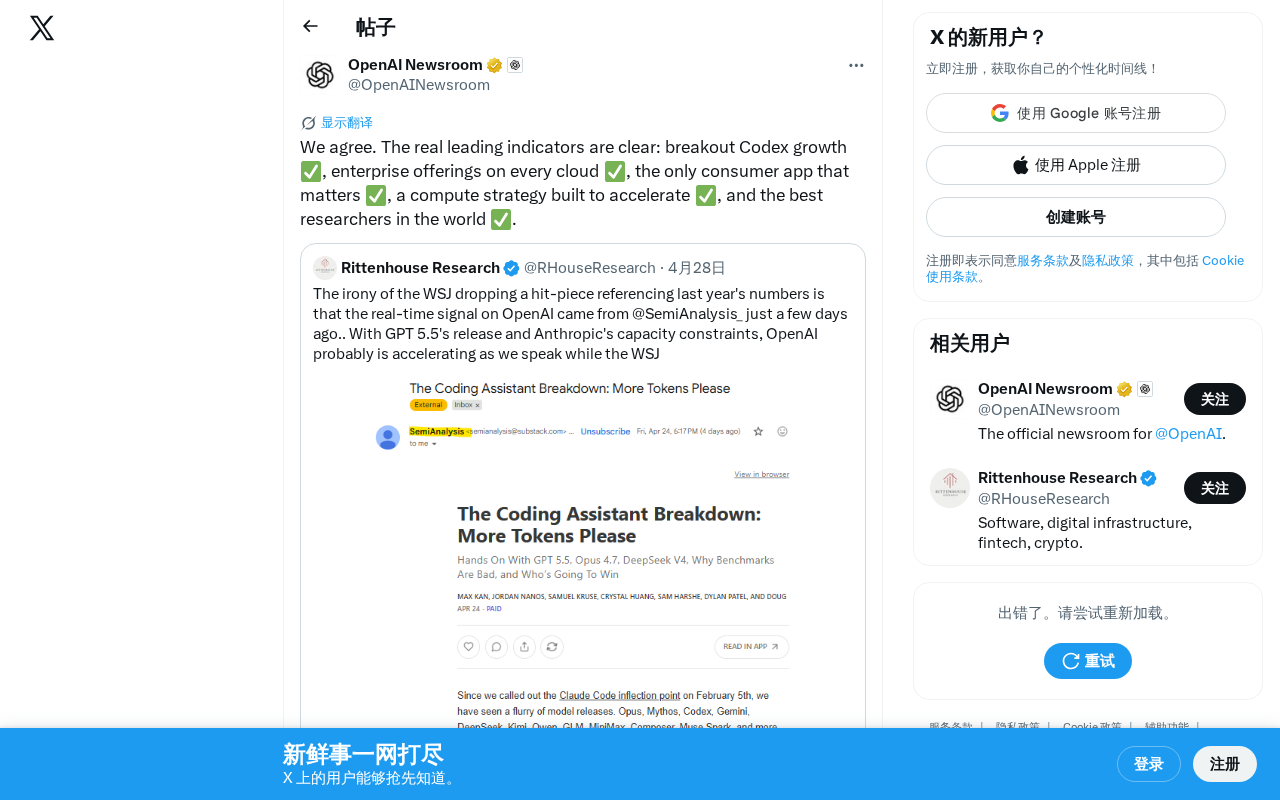
Recently, a tweet about OpenAI's competitive advantages sparked widespread discussion. The author summarized OpenAI's current leading indicators across five dimensions, arguing that these signals clearly demonstrate its dominant position in the AI industry. Let's break down these five indicators one by one to understand exactly why OpenAI remains firmly in the pole position of the AI race.
Codex's Explosive Growth: Developers Voting with Their Feet
OpenAI's Codex (AI coding assistant) is experiencing breakthrough growth. As a core product for developers, Codex has long moved beyond being just a code completion tool—it's redefining software development workflows.
Codex's technical evolution trajectory is worth examining in detail. Initially released in 2021, Codex was built on the GPT-3 architecture with specialized fine-tuning on code data, and subsequently became the underlying engine for GitHub Copilot. Its core breakthrough lies in combining natural language understanding with the syntactic and semantic structures of programming languages, enabling it to interpret comment intent and generate contextually logical code snippets. After 2023, OpenAI integrated Codex capabilities into the GPT-4 series and launched the Codex Agent with autonomous execution capabilities, evolving it from "code completion" to an autonomous system capable of independently completing multi-step programming tasks—representing a paradigm shift in AI coding tools from "copilot" to "autopilot." From GitHub Copilot to the latest Codex Agent, OpenAI's AI programming portfolio now provides complete coverage from individual developers to enterprise teams.
The reason Codex's growth is considered a "leading indicator" is straightforward: developers are the most sensitive early adopters of AI technology. When developers embrace an AI tool at scale, it typically means the tool has crossed the threshold from "useful" to "indispensable." Once this stickiness is established, competitors find it extremely difficult to dislodge.
Full Cloud Platform Coverage: Enterprise AI Infrastructure Ambitions
OpenAI's enterprise products now cover all major cloud platforms. Whether a company uses Azure, AWS, or Google Cloud, they can seamlessly access OpenAI's model services. This "omnipresent" distribution strategy dramatically lowers migration costs and decision-making barriers for enterprise customers.
Understanding this strategy requires familiarity with enterprise AI procurement decision-making. Large enterprises typically face strict data compliance requirements (such as GDPR, SOC2 certification), internal IT governance standards, and existing cloud contract constraints. OpenAI's multi-cloud strategy essentially adapts to the enterprise customer's "path of least resistance"—companies don't need to restructure their existing cloud architecture to adopt AI tools. From a technical implementation perspective, this relies on OpenAI's standardized REST APIs and SDK-wrapped model calls, making the engineering cost of cross-cloud deployment extremely low.
From a business perspective, the brilliance of this strategy lies in the fact that OpenAI no longer depends on a single channel (such as Microsoft Azure), but positions itself as a cross-platform AI infrastructure provider. This both expands the potential customer pool and strengthens bargaining power with cloud vendors—through distributed deployments across multiple cloud platforms, OpenAI gains leverage to negotiate simultaneously with all three cloud giants: Microsoft, Amazon, and Google. For enterprise CTOs, choosing OpenAI means not being locked into any single cloud ecosystem—a highly significant advantage in enterprise procurement decisions.
ChatGPT: The Only Consumer AI Application That Truly Works
ChatGPT remains the only AI application that has truly established itself in the consumer market. Despite an endless stream of competitors—Google's Gemini, Anthropic's Claude, and various vertical AI products—ChatGPT still leads by a wide margin in user scale, brand recognition, and daily usage frequency.
The strategic value of this point is often underestimated, and the core mechanism behind it is the data flywheel effect. The flywheel logic works as follows: more users → more data generated → better model training → improved product experience → attracting more users. In the era of large language models, this mechanism takes on new technical significance: ChatGPT's massive user interaction data doesn't just provide labeled material for supervised learning; more critically, it supplies preference signals for RLHF (Reinforcement Learning from Human Feedback)—which answers are accepted by users, which are regenerated, and which trigger negative feedback. These implicit signals constitute the core data asset for model alignment optimization. Hundreds of millions of users' interaction data provides a continuous stream of feedback signals for model optimization, creating a scale effect that pure B2B companies find nearly impossible to replicate—even B2B companies with excellent foundation models struggle to obtain such diverse, large-scale real user feedback.
ChatGPT has become the "default AI entry point" in many people's daily work and lives. The value of this mental positioning is immeasurable. Just as Google once became synonymous with search, ChatGPT is becoming synonymous with AI.
A Compute Strategy Built for Acceleration
In the AI race, compute power is ammunition. OpenAI's compute strategy isn't just about "hoarding more GPUs"—it represents a comprehensive strategic layout designed for sustained acceleration in model training and inference at scale. The ability to secure and efficiently utilize massive compute resources directly determines the upper bound of model capability improvement and the speed of product iteration.
Related articles
Meta Muse Hits 900K Downloads in Six D…
Meta Muse Hits 900K Downloads in Six Days: The AI Agent Era Has Officially Arrived
Meta's AI agent Muse hit 902K downloads in 6 days, topping US App Store and Google Play charts above ChatGPT and Claude. A deep dive into Muse's capabilities and the AI Agent race.
 Industry Insights
IRS Fully Embraces Claude AI, Accelerating Federal Government's AI Adoption
The IRS is recruiting staff with 24/7 Claude AI access, marking Anthropic's breakthrough into the federal government. Explore the strategic implications and tax use cases.
 Industry Insights
The IRS Mobile App Debate: A Trust Crisis in Government Digital Transformation
The IRS's proposed mobile app has sparked heated debate. This article analyzes the core arguments, exploring data security, privacy, and the trust crisis in government digital transformation.