OpenAI's Internal Model Astra Allegedly Solves 10 Math Problems — How Credible Is It?

Analyzing the credibility of claims that OpenAI's internal Astra model solved 10 major math open problems.
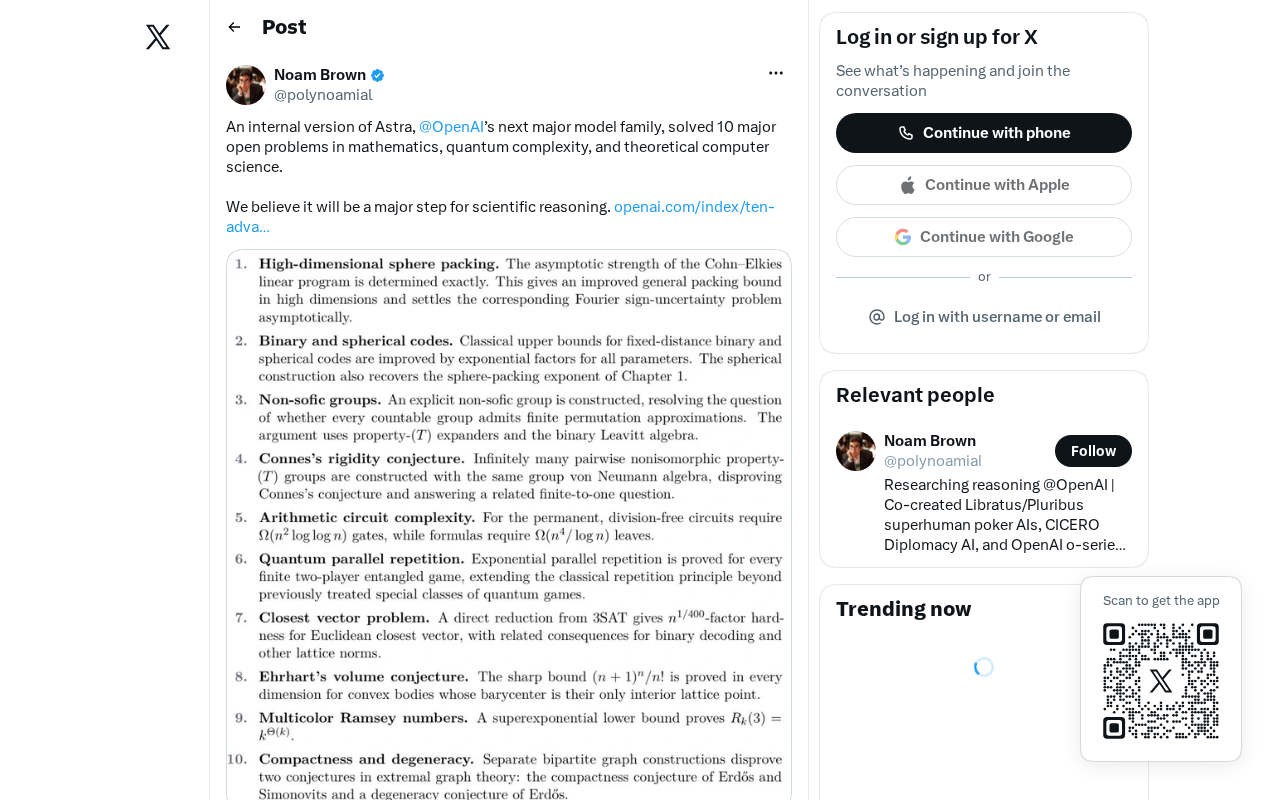
Reports circulating in tech communities claim OpenAI's internal model "Astra" has solved 10 major open problems in math and computer science. This article examines the claim's credibility by assessing source reliability, evidence completeness, and consistency with known AI capabilities. It contextualizes the claim against verified milestones like AlphaProof and AlphaGeometry, and argues that without formal proofs or peer review, such extraordinary claims should be treated as unverified rumors.
Event Overview: Rumors of OpenAI's Astra Model Solving 10 Math Problems
Recently, reports have circulated on Hacker News and other tech communities claiming that an internal OpenAI model codenamed "Astra" has successfully solved 10 major open problems in mathematics and computer science. The claim quickly sparked intense debate among practitioners and researchers — if true, it would mark a critical step forward for large language models in formal reasoning and mathematical discovery; if exaggerated, it would be yet another typical case of overhyped AI capabilities.
As of now, OpenAI has not issued any official statement regarding the "Astra" model or the alleged breakthroughs on ten major problems. The information primarily comes from community discussions, lacking verifiable papers, proof processes, or third-party reproduction records. Therefore, this article will review the event while focusing on a credibility assessment framework for such claims, as well as the actual stage of AI capabilities in mathematical research.
What Does It Really Mean for AI to "Solve Open Problems"?
In mathematics and theoretical computer science, an "open problem" refers to a proposition that has remained unproven or unrefuted for an extended period. These problems are typically extremely difficult — for example, the P vs NP problem and the Riemann Hypothesis — and solving any single one of them would be enough to make history.
The P vs NP problem is the central question in computational complexity theory, asking: if a solution to a problem can be verified in polynomial time, can the problem also be solved in polynomial time? This problem has remained unsolved for over fifty years since Stephen Cook formally posed it in 1971. It is one of the seven Millennium Prize Problems designated by the Clay Mathematics Institute, with a one-million-dollar bounty. The Riemann Hypothesis concerns the deep patterns underlying prime number distribution, proposed by mathematician Riemann in 1859, asserting that all non-trivial zeros of the Riemann zeta function have a real part equal to 1/2. If proven, it would have profound implications for number theory, cryptography, and even quantum physics, and is likewise a Millennium Prize Problem. These two problems represent the highest difficulty level of open mathematical problems, and any claim to have solved problems at this level requires extremely rigorous verification.
The Core Issue Is Verifiability of Proofs
Determining whether AI has truly "solved" a mathematical problem hinges not on what answer it outputs, but on whether its proof process can be rigorously verified. Modern mathematics increasingly relies on formal proof assistants (such as Lean, Coq, and Isabelle) to ensure every logical step in a proof is correct.
Formal proof assistants are software systems based on type theory or higher-order logic that translate mathematical proofs into a formalized language checkable by computers. Take Lean as an example — developed by Microsoft Research, it uses dependent type theory as its logical foundation, requiring users to encode each reasoning step as a strict type judgment; any logical leap is rejected by the compiler. Coq, originating from France's INRIA, is based on the Calculus of Inductive Constructions and has been used to verify the proof of the Four Color Theorem. Isabelle adopts a more flexible framework supporting multiple logical systems. The core value of these tools is that while human reviewers may overlook subtle errors in proofs, formal verifiers will not. In recent years, an important trend in mathematics has been "formalizing" classical proofs — for instance, Peter Scholze's Liquid Tensor Experiment verified a key theorem in condensed mathematics through Lean, and Kevin Buzzard's team is formalizing large amounts of undergraduate mathematics. For AI-generated proofs, formal verification provides the only objective criterion for determining correctness.
If Astra's results are indeed valid, the ideal evidence chain should include:
- Complete, machine-verifiable formal proofs
- Peer review by an independent team of mathematicians
- Clear identification of the specific names and sources of the problems solved
In the absence of any of the above, the statement "solved 10 major problems" should be treated with extreme caution. Community commenters have also directly questioned: which "10 problems" exactly? How is their difficulty defined? The absence of these details is precisely the critical red flag for judging the veracity of such claims.
The Real State of AI Mathematical Reasoning
Setting aside this unverified rumor, AI's progress in mathematical reasoning is both real and rapid. Reviewing recent public achievements gives a more objective view of the reasonable boundaries for claims like those about "Astra."
Established Milestone Achievements
Google DeepMind's AlphaProof and AlphaGeometry have achieved silver-medal-level performance on International Mathematical Olympiad (IMO) problems, with results backed by verifiable formal proofs.
AlphaGeometry was published in Nature in early 2024, specifically targeting geometry proof problems. Its architecture combines a neural language model (for proposing auxiliary constructions, such as adding auxiliary lines) with a symbolic reasoning engine (for executing strict deductive reasoning). This neuro-symbolic hybrid approach enables it to solve IMO-level geometry problems at a level approaching gold medalists. AlphaProof, demonstrated in mid-2024, is trained on the Lean formal language and uses reinforcement learning to explore the formal proof search space, essentially transforming mathematical proof into a search problem similar to Go. On the 6 problems of the 2024 IMO, AlphaProof solved 4 algebra and number theory problems, achieving a combined silver medal score with AlphaGeometry. Notably, these systems' success depends on the precise feedback signal provided by the formal environment — the system can definitively know whether a reasoning step is correct — which stands in stark contrast to open problem research where clear objective functions are lacking.
Additionally, top mathematicians like Terence Tao have publicly discussed the potential of large models as "research collaborators" — for generating conjectures, exploring proof paths, and checking tedious calculations.
However, two levels must be distinguished:
- Solving competition problems: While difficult, these problems have known answers and fall under "reproducing knowledge humans have already mastered."
- Solving open problems: This means creating entirely new mathematical knowledge — territory that humans have not yet breached.
The vast majority of publicly verifiable AI achievements still remain at the first level. "Solving major open problems" belongs to the second level, where the threshold differs by orders of magnitude. Competition problems have clear answers for verification, abundant similar problems for training, and solution techniques that, while elegant, fall within the scope of known methodologies. Open problems often require entirely new conceptual frameworks, cross-disciplinary insights, or even the invention of new mathematical languages. Historically, the resolution of major open problems has often been accompanied by the birth of entirely new branches of mathematics — for example, Andrew Wiles developed the modularity lifting theorem when proving Fermat's Last Theorem, and Grigori Perelman used Ricci flow surgery techniques when proving the Poincaré Conjecture. This kind of creative leap has not yet been demonstrated by any AI system. Therefore, the claim that an internal model "solved 10 at once" is, from the perspective of probability and historical patterns, questionable in credibility.
Why Such AI Breakthrough Rumors Warrant Skepticism
In recent years, unverified leaks of "major breakthroughs" in AI have become frequent, and their spread often follows a similar pattern: a sensational headline, vague technical details, lack of reproducible evidence, amplified rapidly through social media and tech forums.
Three Dimensions for Rationally Evaluating AI Breakthrough Claims
When encountering information like "Astra solves ten major problems," practitioners should establish a basic evaluation framework:
- Source reliability: Is it an official announcement, a peer-reviewed paper, or an anonymous leak? This particular claim currently exists only at the community discussion level.
- Evidence completeness: Are there verifiable proofs, datasets, code, or reproduction paths? All are currently missing.
- Consistency with known patterns: Is the magnitude of the breakthrough consistent with current technological capabilities? "Solving 10 major open problems at once" far exceeds the capability ceiling of any publicly known system.
The low engagement on Hacker News — only 30 upvotes and 11 comments — also suggests that the professional community maintains a cautious, even skeptical attitude toward this claim and has not treated it as confirmed major news.
Conclusion: Maintaining Both Expectation and Caution Toward AI Mathematical Breakthroughs
AI-assisted mathematical research is undoubtedly one of the most exciting frontier directions. It's reasonable to expect that in the coming years, large models will play an increasingly important role in generating conjectures, assisting proofs, and discovering counterexamples — and may even collaborate with humans to solve certain long-standing open problems.
But precisely because expectations are high, we need to approach every "breakthrough" claim with rigorous standards. Until OpenAI provides verifiable formal results, "Astra solving 10 major mathematics and computer science problems" should be treated as an unverified rumor, not an established fact. True scientific breakthroughs never fear verification — they actively welcome it.
Related articles

From DevOps to MLOps: Market Demand, Transition Path, and Practical Advice
In-depth analysis of transitioning from DevOps to MLOps: core differences, market demand, required skills, and a practical three-step path for operations engineers making rational career decisions.

How Realistic Is ChatGPT's Live Voice Feature? Its Human-Like Quality Is Downright Unsettling
ChatGPT Live Voice hands-on: natural interruptions, human-like pauses, and realistic breathing. Two phones chatting sound like real people. A deep dive into the tech and uncanny valley effects.

Training ASR Models with Simulated Call Center Audio: Can the Gap Between Simulated and Real Data Be Bridged?
Deep dive into training ASR models with simulated call center audio: analyzing codec simulation, code-switching, and diarization bottlenecks that reveal the gap between simulated and real phone data.