OpenAI's Official Plugin codex-plugin-cc: Calling Codex Inside Claude Code for Dual-AI Collaboration

OpenAI's codex-plugin-cc brings Codex into Claude Code workflows, enabling dual-AI code review and task delegation.
OpenAI has released codex-plugin-cc, an open-source plugin that lets developers invoke Codex directly inside Claude Code for code review and task delegation. The project surpassed 22,674 GitHub stars rapidly, reflecting strong demand for cross-model interoperability. Built on the Tool Use mechanism, it wraps Codex as a natively callable tool within Claude Code, signaling that AI coding is entering a multi-model collaborative era.
A Fascinating Cross-Vendor Collaboration
OpenAI recently released an open-source project called codex-plugin-cc with a clear purpose: letting developers call Codex directly inside Claude Code for code review or task delegation.
The project took off almost immediately — GitHub stars have surpassed 22,674, with 1,379 forks and 352 new stars in a single day. For a utility plugin, that kind of growth curve is remarkably rare, and it speaks directly to how much the developer community has been craving interoperability between AI coding assistants.
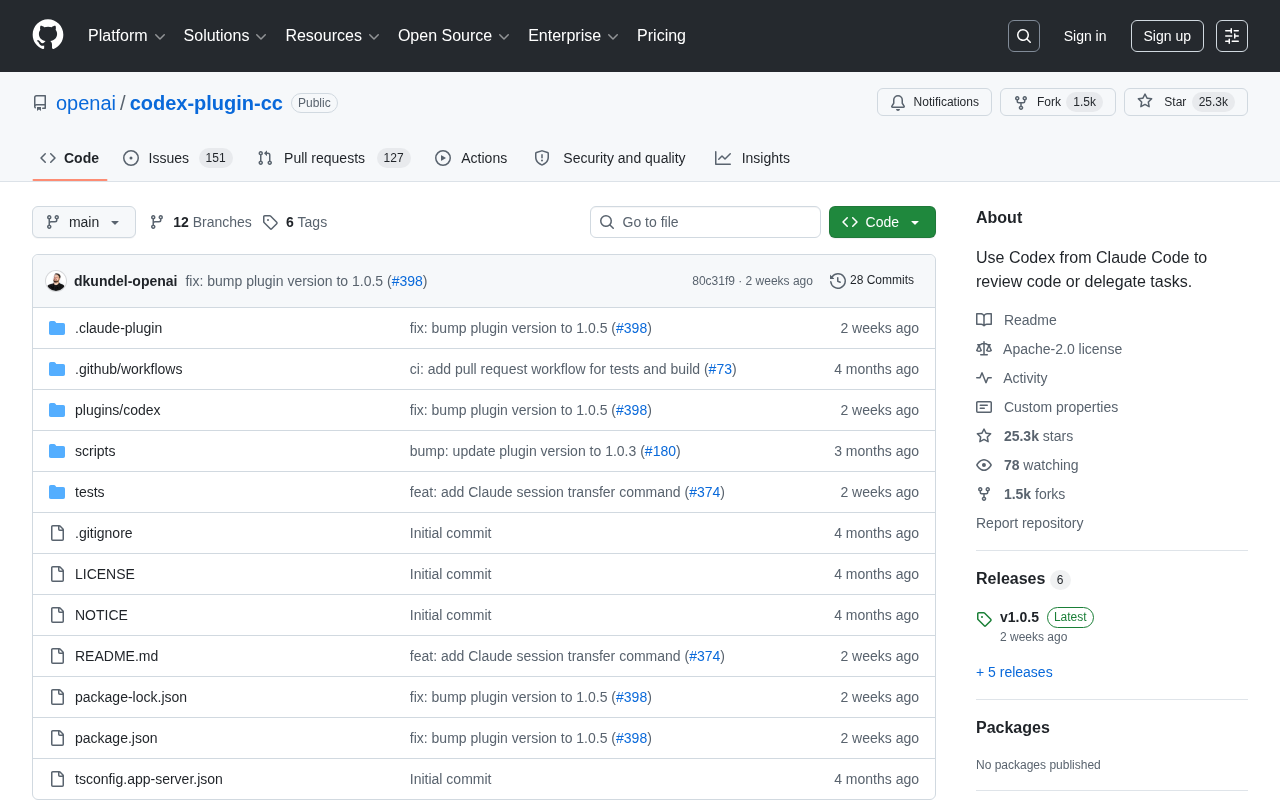
What makes this particularly noteworthy is that this is an official OpenAI repository actively building an adapter plugin for a competitor's ecosystem — Anthropic's Claude Code. Against the backdrop of direct competition between these two AI giants, this kind of tool-level "you're in my world" collaboration signals that AI-assisted development is rapidly moving toward a multi-model cooperative paradigm.
Background: The Technical Identity of Each Player
OpenAI Codex's story begins in 2021, when OpenAI fine-tuned GPT-3 on code-heavy datasets to produce the Codex model, which served as the underlying inference engine for GitHub Copilot. At the time, Codex scored 28.8% pass@1 on the HumanEval benchmark, far outpacing its contemporaries and cementing its technical standing. Through multiple iterations — from code-davinci-002 to GPT-4's integrated code capabilities, and re-emerging in 2025 as the Codex CLI — Codex has evolved from a single model into a cluster of specialized capabilities under the OpenAI umbrella, covering code generation, debugging, comprehension, and review. Its API supports standalone invocation and remains competitive in scenarios like function-level code generation, unit test generation, and documentation completion.
Claude Code, meanwhile, is Anthropic's command-line-native AI coding assistant launched in 2025, designed for "working directly with codebases in the terminal." Unlike pure chat-based code assistants, Claude Code can read and write files, execute shell commands, invoke Git operations, and understand entire project structures through a persistent context window. Its underlying Claude 3.x model series offers notable advantages in long-context processing (up to 200K token context windows) and complex reasoning chains — especially in large codebases where cross-file dependency understanding is critical. The two models overlap heavily in core capabilities, but differ in training data distribution, context-handling strategies, and stylistic preferences — which is precisely what makes cross-model collaboration genuinely valuable.
What Problem Does This Actually Solve?
From "Single Assistant" to "Multi-Model Collaboration"
Historically, developers using AI coding assistants were locked into a single-model ecosystem: Claude Code meant Claude models only; Codex meant OpenAI models only. But real development workflows are more nuanced — different models genuinely excel at different things. Some are better at code generation; others shine at long-context reasoning or code review.
The core value of codex-plugin-cc is breaking down that wall. It integrates Codex as a callable "external capability" within the Claude Code workflow, enabling developers to:
- Cross-review code: Have Codex perform a secondary review of code generated by Claude or written by hand — a "dual-AI gatekeeper" approach.
- Delegate tasks: Route subtasks better suited to Codex out of the Claude Code workflow, letting Codex handle them independently.
Lightweight JavaScript Plugin, Low Barrier to Entry
Technically, the project is primarily written in JavaScript, which aligns with the mainstream implementation approach of the Claude Code plugin ecosystem.
Background: Claude Code's Plugin System and Tool Use Mechanism
Claude Code supports extending its capabilities through a standardized plugin interface, with a plugin ecosystem built primarily on JavaScript/TypeScript and grounded in the large language model "Tool Use" mechanism. The standardization of this mechanism has an interesting history: OpenAI first formalized it in June 2023 as "Function Calling," allowing developers to describe external function signatures using JSON Schema, with the model automatically deciding when to trigger a call during inference. Anthropic subsequently introduced a semantically equivalent "Tool Use" specification, and substantially improved tool call stability and parallel multi-tool invocation in the Claude 3 series. The core workflow unfolds in four stages: ① the model identifies during inference that it needs to invoke an external capability; ② it outputs a structured tool call request (containing the tool name and parameters); ③ the host application (such as Claude Code) intercepts the request, executes the actual API call, and retrieves the result; ④ the result is injected back into the context, and the model continues reasoning with complete information.
codex-plugin-ccwraps the Codex API as a standard tool description conforming to this specification, enabling Claude to natively recognize "this task should go to Codex" moments in its reasoning chain and complete the entire call loop — without the user needing to manually switch interfaces or copy-paste context. The whole process is transparent to the user.
The project is best understood as a bridge — smoothly integrating Codex capabilities into existing editor and command-line workflows through a standardized plugin interface, rather than reinventing the wheel. The lightweight implementation lowers the barrier to adoption while leaving ample room for customization.
Why Does This Matter?
AI Coding Enters the "Multi-Agent Collaboration" Era
The era of a single AI assistant handling everything is coming to an end. Whether it's "cross-validation" in code review scenarios or "task delegation" in complex workflows, both point to the same trend: organizing multiple AI models into collaborative pipelines.
Background: The Engineering Evolution of Multi-Agent Systems
Multi-Agent Systems (MAS) have undergone three clear generational shifts in AI engineering. The first generation (early 2023), represented by AutoGPT and BabyAGI, used a single-model self-loop approach — the model was both planner and executor, autonomously deciding next steps without explicit task boundaries. This architecture worked reasonably well for short-chain tasks but frequently fell into loops or compounding hallucinations in complex engineering workflows requiring multi-step reasoning. The second generation (2024), represented by LangGraph, CrewAI, Microsoft AutoGen, and OpenAI Swarm, shifted to a "directed graph scheduling" approach: clearly separating an orchestration layer (responsible for task decomposition, routing, and result aggregation) from an execution layer (responsible for completing specific subtasks), enabling heterogeneous cross-model scheduling where different subtasks can be handled by different models or tools. In code engineering scenarios, typical architectures include: an orchestration agent decomposes requirements → code generation agents generate multiple candidate implementations in parallel → a testing agent validates correctness → a review agent checks style and security → the orchestration layer aggregates results. The third generation is beginning to take shape, referencing the standard topologies described in Anthropic's official multi-agent documentation: parallelization, pipelines, and evaluator-optimizer loops are gradually being standardized. The task delegation mechanism in
codex-plugin-ccis a direct manifestation of second-generation architectural thinking at the everyday developer tooling layer, marking an acceleration of multi-agent systems' penetration from framework-level abstractions into ordinary developers' daily toolchains.
One model generates, another reviews — or the most suitable model is dynamically selected based on task characteristics. The "multi-agent" philosophy is moving from research concept to engineering practice, and codex-plugin-cc can be seen as its earliest concrete implementation at the tooling layer.
"Dual-AI Review" Meaningfully Improves Code Quality
Code review is one of the highest-stakes quality gates in software engineering. Having models from different vendors with different training backgrounds review each other's output can, to a meaningful degree, reduce "same-source bias" — the cognitive blind spots a single model has toward code it generated itself.
Background: Same-Source Bias, Cross-Validation, and the Statistical Case for AI Review
The root of "same-source bias" lies in how large models encode training data distributions and parameterized memory. When the same model reviews code it generated, it's essentially using the same weight distribution to evaluate output produced by that same weight distribution — it tends to treat code patterns that frequently appeared in training data as "correct," even when those patterns carry systematic security vulnerabilities or logical flaws. Academic benchmarks have quantified this: on SWE-bench (real GitHub issue resolution tasks), fix success rates between models from different vendors can differ by 15–30 percentage points. In targeted tests against CWE (Common Weakness Enumeration) vulnerability categories, different models show statistically significant differences in detection rates for SQL injection (CWE-89), integer overflow (CWE-190), authentication bypass (CWE-287), and other vulnerability types — and these differences are strongly model-specific, meaning one model's blind spot is not the same as another model's blind spot. This provides a quantitative justification for heterogeneous cross-review. Current mainstream AI review practices fall into two categories: single-model self-review has low latency and low cost but carries systematic blind spots; heterogeneous cross-model review is analogous to the dual-track "static analysis tool + human review" mechanism in traditional software engineering — different training distributions mean different defect sensitivities, and each additional perspective adds another class of potentially detectable flaws. The logic closely mirrors that of classical "peer review," which reduces cognitive blind spots by introducing an external viewpoint as a quality assurance mechanism.
The combination of Claude generating and Codex reviewing (or vice versa) can theoretically catch more issues than either model would alone, offering teams focused on high-quality delivery a practical, actionable approach.
A Rational Take: Where Competition Ends and Collaboration Begins
Despite the plugin's cross-ecosystem promise, a few points deserve sober consideration:
- Maintenance continuity: Tool-level collaboration between competing vendors is vulnerable to shifts in commercial strategy. Future maintenance commitment and compatibility will require ongoing monitoring. API versioning changes, pricing adjustments, or shifts in the competitive landscape could all affect long-term usability.
- Cost and configuration overhead: Calling two vendors' models simultaneously means developers need multiple API keys and will incur compounded per-call costs — especially in high-frequency review scenarios, where dual-model token consumption could substantially increase usage bills. At current pricing, a full dual-model review of a 500-line file might consume 2–3× the tokens of a single-model review.
- Benefits vary by context: "Dual-AI review" isn't a silver bullet. Introducing a second model for simple tasks may add unnecessary complexity and response latency. For mature, well-tested modules with comprehensive coverage, the marginal benefit of dual-model review may be outweighed by the latency cost it introduces.
Conclusion
codex-plugin-cc may look like a lightweight Claude Code plugin on the surface, but the signal it sends is hard to ignore: AI coding tools are moving from closed, single-model ecosystems toward open, multi-model collaboration. For developers, this means being able to mix and match the most suitable AI capabilities for different tasks — handing generation to the model most skilled at creative code synthesis, review to the model most sensitive to security vulnerabilities, and test generation to the model with the most comprehensive edge-case coverage.
Hundreds of stars in its first day alone confirm the community's strong appetite for a "model interoperability" paradigm. Regardless of which vendor ultimately sets the standard, open collaboration clearly serves developers' real interests better than closed competition — and OpenAI's deliberate choice to build tooling for a competitor's ecosystem may itself be the most powerful footnote to that conclusion.
Key Takeaways
codex-plugin-ccis an official OpenAI plugin for Claude Code that enables calling Codex directly within Claude Code workflows for code review and task delegation- The project surpassed 22,674 GitHub stars with 352 new stars in a single day, reflecting strong community demand for cross-model interoperability
- Technically, it's built on the large language model "Tool Use" mechanism, wrapping the Codex API as a standard tool that Claude can natively invoke — transparently, without user friction
- "Dual-AI review" introduces a heterogeneous model perspective that can effectively address the systematic detection blind spots caused by single-model same-source bias
- The project is a prime example of multi-agent collaboration patterns moving from framework-level abstractions into everyday developer toolchains, marking a new phase of multi-model cooperation in AI coding
- Real-world adoption requires weighing dual-model token costs, API key management complexity, and long-term maintenance sustainability
Related articles

SeaTicket: An AI Agent That Automatically Resolves GitHub and Discord Issues
SeaTicket is an AI Agent that automatically resolves GitHub Issues and Discord questions. This article analyzes its architecture, use cases, challenges, and value for open-source maintenance.

Breaking Through CI/CD Storage Bottlenecks: Why Senior Engineers Are Returning to the Storage Domain
Exploring overlooked storage and caching bottlenecks in CI/CD pipelines, how Blacksmith redesigns storage architecture to accelerate builds, and why storage is a rebirth opportunity in cloud-native.

SeaTicket: An AI Agent That Automatically Resolves GitHub and Discord Issues
SeaTicket is an AI Agent that automatically resolves GitHub Issues and Discord questions. This article analyzes its architecture, use cases, challenges, and value for open-source maintenance.