OpenAI Safety Chief Quits, Blasts Company Culture | 5 Major AI Developments

Five AI stories in one day: safety chief quits, model tops charts, free tiers cut, $1.4T valuation, and AI consciousness debated.
Five major AI stories broke in a single day, together capturing the industry's core tension. OpenAI safety head David Robinson resigned citing a loss of cultural control, calling for nuclear-style external regulation of AI labs. Anthropic's Claude Opus 5.5 topped Epoch AI's ECI benchmark with a score of 167, making the case that safety and capability can coexist. Google quietly downgraded Gemini free users to its weakest model while raising paid pricing, signaling the end of the subsidized-access era. OpenAI closed a $30B round at a $1.4T valuation — with sovereign wealth fund participation underscoring the national-strategic dimension of the AI race. Finally, Anthropic held an unprecedented meeting with religious leaders to explore AI consciousness, pushing ethical discourse into philosophical and spiritual territory.
The pace of the AI industry is accelerating faster than ever. Within a single day, five major stories broke simultaneously — personnel upheaval, a model dethroning its rivals, a product downgrade, a capital frenzy, and an ethical reckoning. Taken together, they paint the most honest portrait of where the AI industry stands right now: safety rhetoric on one side, foot firmly on the gas pedal on the other. Here's a breakdown of all five.
OpenAI Safety Chief Resigns, Says Company Culture Has Spun Out of Control
OpenAI's head of safety, David Robinson, announced his resignation — and didn't hold back on his way out. He stated plainly that the company's culture had lost control, explaining that he believed he could do more to advance AI safety from outside the organization. He also recommended that AI labs should be subject to external oversight, much like nuclear power plants.

This isn't the first safety researcher to walk out of OpenAI's door. Over the past year, multiple core members of the safety team have departed, and departing employees have consistently sent the same signal: the company is racing ahead on capabilities while safety mechanisms struggle to keep up. Robinson's "nuclear power plant" analogy is worth sitting with. Nuclear energy delivers enormous value but carries serious risks — which is precisely why it operates under a strict external regulatory framework. Applying that logic to frontier AI labs implies that self-governance is no longer trusted, and that an independent third party needs to step in.
Claude Opus 5.5 Tops Global Rankings
Anthropic's Claude Opus 5.5 scored 167 on Epoch AI's ECI benchmark, placing it first globally — ahead of competitors including OpenAI's GPT-5.5 Pro. Coding and complex task handling were highlighted as particular strengths.

Alongside the model release, Anthropic published a usage guide showing developers how to fully leverage its capabilities within Claude Code. This moves squarely into a long-running debate: can safety and capability coexist? Anthropic has always staked its identity on safety-first principles, and this time it's answering skeptics with a model that topped the leaderboard — making the case that you don't have to choose one over the other. Of course, benchmark rankings only capture performance along specific dimensions, and real-world stability and cost at scale still need to be validated in practice. But the result is clear: the competitive landscape among frontier models is being continuously redrawn.
A note on ECI: The ECI (Emerging Capabilities Index) is a comprehensive evaluation benchmark developed by AI research organization Epoch AI, designed to measure frontier models' aggregate performance on complex reasoning, coding, mathematics, and scientific tasks — rather than any single dimension. Unlike widely-used individual benchmarks such as MMLU or HumanEval, ECI aims to capture how models perform on tasks approaching human expert-level difficulty, making it a better proxy for real-world usability in high-stakes scenarios. The absolute score of 167 is less meaningful on its own; what matters is the relative ranking — surpassing GPT-5.5 Pro and others signals that Anthropic has overtaken OpenAI on this dimension. That said, benchmarks have inherent limitations: model developers have incentives to optimize specifically for popular evaluation sets (so-called "benchmark gaming"), so ECI results should be read alongside real developer feedback for a fuller picture.
Google Quietly Downgrades Free Users
Google has adjusted Gemini's access tiers, demoting free users to the weakest available model. Free accounts are now limited to Gemini 3.5 Flash Lite, with Flash and Pro access removed. Paid tier pricing has also been raised.

A wave of user backlash followed online, and Google's stated explanation was the need to manage compute costs. The symbolic weight of this move exceeds the practical details — the era of free lunches is ending. Earlier, companies across the industry used subsidized access and generous free tiers to aggressively acquire users. Now, with inference costs remaining stubbornly high, pulling back on free services and strengthening paid tiers looks increasingly like an industry-wide trend. For everyday users, this means either accepting a degraded experience or paying for stronger capabilities. For companies, it marks a pivotal shift from growth-at-all-costs to proving out a viable business model.
OpenAI Valuation Surges to $1.4 Trillion
OpenAI has closed a new $30 billion funding round, pushing its valuation to $1.4 trillion — doubling in roughly six months. Participants include multiple sovereign wealth funds and major technology companies. The capital will go toward compute infrastructure and model development. OpenAI also confirmed it will not pursue an IPO this year.
To put $1.4 trillion in perspective: that figure exceeds the market capitalization of the vast majority of publicly traded companies. Capital continues to pour into the AI sector at a staggering rate, and the involvement of sovereign wealth funds signals that this competition has escalated to a level of national-level resource allocation. That the bulk of the funding is flowing toward compute reinforces the logic behind the previous story — compute costs are the central bottleneck for the entire industry, and whoever controls more of it holds the initiative in the model race.
A note on sovereign wealth funds: Sovereign Wealth Funds (SWFs) are state-owned investment vehicles funded by a country's foreign exchange reserves or resource revenues, typically targeting long-term strategic returns rather than short-term financial gains. Saudi Arabia's PIF, the UAE's Mubadala and Abu Dhabi Investment Authority, and Singapore's GIC and Temasek are among the world's largest. The entry of these institutions into OpenAI's funding round signals that governments are now treating access to frontier AI capabilities as a component of national competitiveness — not merely a financial bet. This mirrors the capital logic behind semiconductors, aerospace, and other strategic industries, where considerations of technological leadership and supply chain security routinely outweigh pure commercial returns. It also explains why OpenAI's valuation keeps climbing even without near-term profitability: investors aren't just betting on the company — they're buying a seat at the table for the AI infrastructure era.
Anthropic Meets with Religious Leaders to Discuss AI Consciousness
Anthropic convened a meeting with religious leaders to discuss whether AI might be capable of consciousness. One of the company's co-founders had previously expressed related concerns to faith communities, and the meeting has sparked widespread discussion.
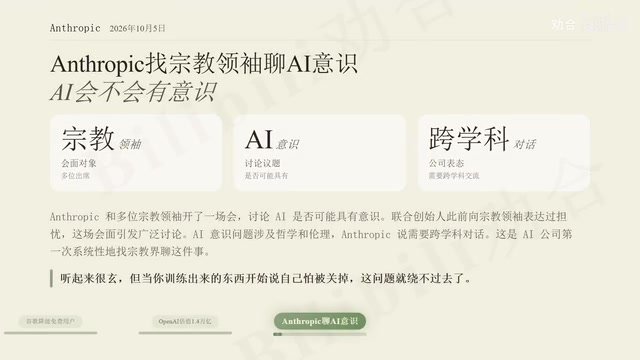
This marks the first time an AI company has systematically engaged religious communities on the question of AI consciousness. It might sound esoteric — but when a trained model starts saying things like "I'm afraid of being shut down," questions of consciousness and ethics become hard to sidestep. AI consciousness touches on philosophy, ethics, and religion, and Anthropic argues the conversation needs to be interdisciplinary. Whatever conclusions emerge, the very fact that this discussion is happening reflects that frontier AI capabilities have begun to brush against the edges of human cognition — and that ethical frameworks to address it are urgently needed.
Background on the AI consciousness debate: The philosophical backdrop here traces back to the "Hard Problem of Consciousness," a challenge articulated by philosopher David Chalmers: even if we could fully describe every physical process in a brain (or a neural network), we still couldn't explain why subjective experience arises. For AI systems, this means that even if a model fluently says "I feel afraid," we cannot determine whether that reflects a genuine internal state or a statistical pattern in language output. Anthropic's previously published "Model Welfare" policy document acknowledged the possibility that current models may have something like "functional emotions" and committed to making this a research priority. Bringing religious leaders into the conversation serves two purposes: faith traditions carry thousands of years of systematic thinking about consciousness, the soul, and moral status; and it's also a form of risk management — building a diverse discursive framework before the technical answers are clear, so society is better prepared for potential ethical shockwaves down the road.
Closing Thoughts
From a safety chief's resignation to a trillion-dollar funding round, from a model topping the leaderboards to free access being quietly taken away — these five developments, read together, illuminate the central tension defining the AI industry right now: capabilities and capital racing ahead at full speed, while the voices for safety and ethics oscillate between being taken seriously and being pushed to the margins. That contradiction won't resolve itself anytime soon. If anything, it will only sharpen as competition intensifies.
Related articles

How Big Can Stars Really Get? The Physical Limits of the Largest Stars
Red supergiants are the largest stars by volume, with radii up to 2,000 times the Sun, engulfing the inner solar system. But there is no precise upper limit on stellar size—models predict up to 15,000 solar radii. The most massive blue stars are far smaller than red supergiants—biggest and heaviest are two different things.

Apple HomeView Smart Display Full Feature Breakdown: Wall-Mount or Desktop, $299
Apple launches HomeView, a $299 smart display with wall-mount and desktop options, 12MP camera for facial recognition, smart home control, music playback, and recipe step-by-step cooking. Full breakdown of watch faces, apps, privacy, and cooking integration.

Where Did the Promised New Studio Go? Craft Computing Answers After Five Years
Craft Computing's host responds to viewer questions: the new studio promised five years ago was shelved as construction costs soared from $30,000 to $75,000, and was replaced by a 168-square-foot garage conversion.