OpenAI SDK v3.26.1 Released: Fix for Custom Voice Creation Parameters

OpenAI SDK v3.26.1 fixes a bug in custom voice creation parameters — low-risk patch, recommended for TTS users.
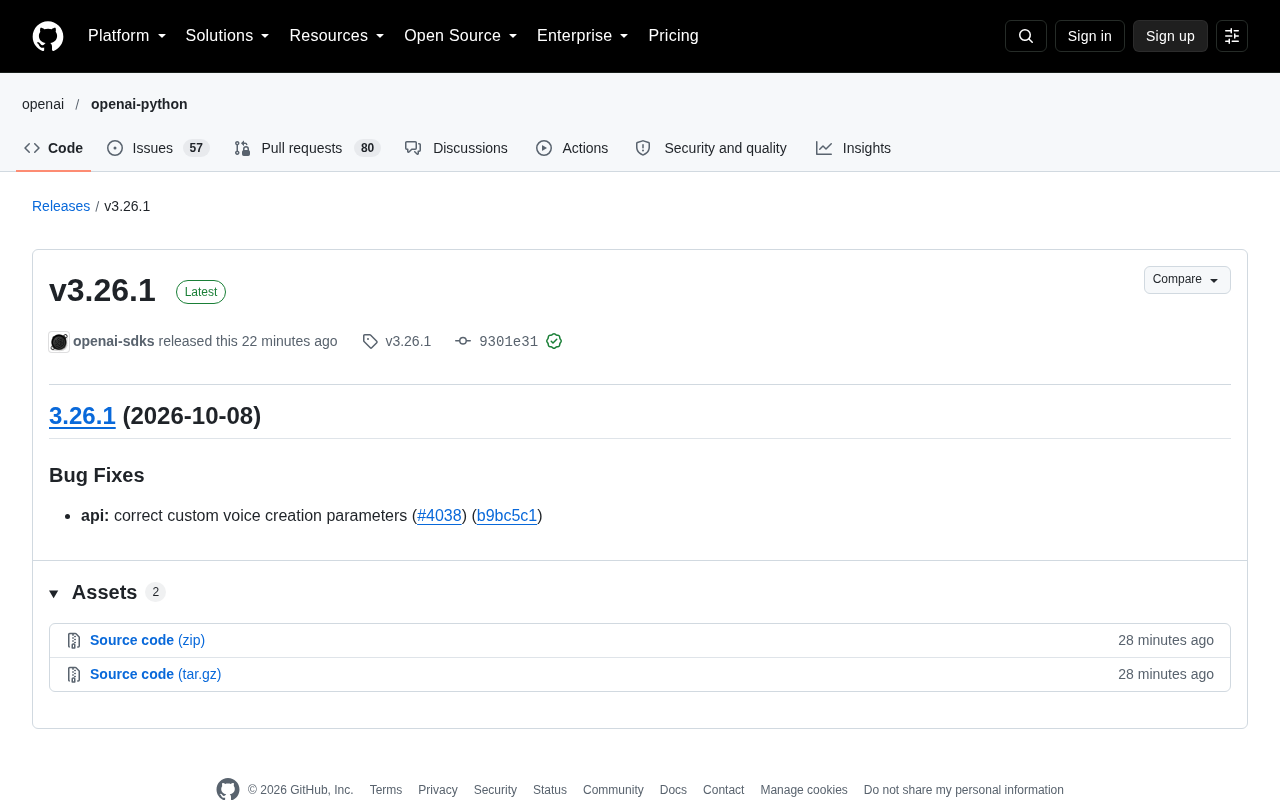
OpenAI has released SDK v3.26.1, a patch update whose sole fix addresses incorrect custom voice creation parameters (PR #4038). The bug could cause failed requests or unexpected behavior when calling TTS custom voice endpoints. As a SemVer patch release with no breaking changes, the upgrade risk is minimal. The release is GPG-verified on GitHub. Projects using speech synthesis features should upgrade promptly; all others can include it in routine dependency maintenance.
Version Overview
OpenAI has released v3.26.1 of its official SDK — a patch update focused primarily on bug fixes. According to the GitHub release record, this version was published by the openai-sdks account with a commit verified through GitHub's trusted signing (GPG key ID: B5690EEEBB952194), ensuring the reliability of the release source.
The version increment signals a patch-level update under Semantic Versioning (SemVer) — meaning only the third digit changed. This typically indicates backward-compatible bug fixes with no breaking changes or major new features. For developers running the OpenAI SDK in production, this type of update is generally safe to apply.
Semantic Versioning (SemVer) is a widely adopted versioning convention in the software industry, following the format MAJOR.MINOR.PATCH. A major version bump signals breaking API changes; a minor bump indicates new backward-compatible functionality; and a patch bump contains only backward-compatible bug fixes. For libraries that follow this convention, developers can assess upgrade risk directly from the version number and configure dependency managers (e.g., npm, pip) to automatically accept patch updates (e.g., ^3.26.0 or ~3.26.0), continuously receiving bug fixes without introducing breaking changes.
Core Fix
This update centers on a single API fix:
Custom Voice Creation Parameters Corrected
The release notes explicitly state that this version fixes an issue with custom voice creation parameters (corresponding to PR #4038). This means that in prior versions, developers calling the custom voice-related endpoints may have encountered incorrectly defined or improperly passed parameters, leading to failed requests or unexpected behavior.
Custom voice functionality is a key capability in text-to-speech (TTS) scenarios, allowing developers to create or configure personalized voice output. The accuracy of parameter definitions directly affects the success rate of API calls — so while this is a single fix, it carries real practical significance for applications that rely on speech synthesis.
Within OpenAI's TTS API ecosystem, the Custom Voice feature lets developers define parameters such as voice tone, speaking rate, and pitch — either based on preset models or uploaded audio samples — to create dedicated voice personas. These endpoints typically involve complex nested parameter structures (e.g., voice_settings, model), and any field type mismatch or missing required field can result in 400/422 errors from the server, or even silent failures. The issue addressed by PR #4038 likely involved incorrect type declarations or serialization handling for certain parameter fields when the SDK built the request body, causing the actual request to deviate from what the API documentation expected. For developers building voice assistants, audiobooks, or multilingual broadcast services on top of this feature, such low-level parameter errors are often difficult to trace through business logs — upgrading the SDK is the most straightforward resolution.
Upgrade Recommendations
For projects that have already integrated the OpenAI SDK and use voice-related functionality, upgrading to v3.26.1 promptly is recommended to avoid call failures caused by parameter definition errors. Since this is a patch release, the upgrade risk is low and unlikely to introduce new compatibility issues.
If your project does not use the custom voice creation feature, the impact of this update is relatively limited — but keeping the SDK on the latest stable version remains a sound engineering practice, ensuring you benefit from accumulated fixes and improvements.
Summary
v3.26.1 is a typical maintenance update: small in scope but precise in intent. It reflects OpenAI's ongoing commitment to SDK quality — even a single parameter fix warrants a formal release with a verifiable signature. For developers, tracking these version notes helps you stay on top of interface changes and maintain the stability of your applications.
Related articles

ChatGPT Space Launches: Team Collaboration and New Pages Features Explained
ChatGPT Space is OpenAI's new team collaboration feature with Pages, real-time collaboration, and Slack/Google Drive sync. We break down its privacy design, multi-platform integration, and the full workflow from conversation to document.

Migrating Apache Spark UDFs to GPU Acceleration with AI Agents
NVIDIA developer blog explains how AI Agents rewrite Apache Spark UDFs for GPU acceleration, covering migration criteria, agent rewriting and verification workflows, plus pitfalls like result consistency and CPU-GPU transfer overhead.

Zed Editor v0.40.4-rc2 Released: Usage Credits Now Available Without Upgrading
Zed editor releases v0.40.4-rc2, allowing users to use usage credits for AI features without upgrading to a paid plan, lowering the trial barrier.