OpenAI SDK v3.29.0 Update: New Billing Error Code and Vault Metadata Filtering

OpenAI SDK v3.29.0 adds a billing error code, Vault metadata filtering, and API constraint documentation.
OpenAI SDK v3.29.0 is an iterative update focused on feature enhancements and documentation improvements. Key additions include the `billing_not_active` error code for precise billing failure handling, Vault metadata filtering to push resource queries server-side, a new `shida` voice for Live speech, and unified beta pagination behavior. Documentation updates clarify the 128-character safety identifier limit, Files API rate-limit responses, and Decision endpoint semantics — reducing integration pitfalls from implicit constraints. There are no breaking changes, making this a low-risk upgrade for teams already using the OpenAI SDK.
OpenAI has released SDK v3.29.0, an update focused primarily on API-level enhancements and documentation improvements. While there are no large-scale breaking changes, several new features carry real practical value for developers building production-grade applications. Below is a detailed breakdown of each item from the release notes.
What's New
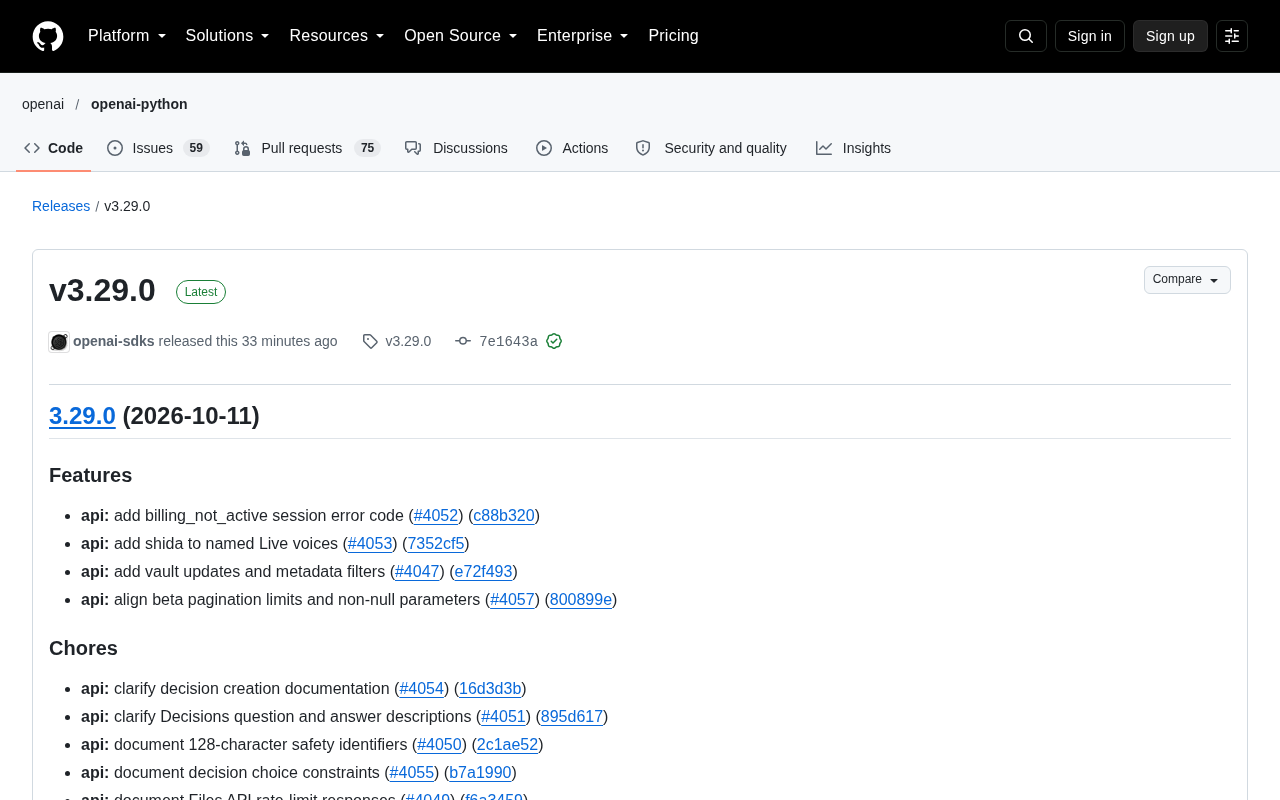
The Features section of v3.29.0 covers four areas:
- New
billing_not_activesession error code (#4052): When an account's billing status is abnormal, the API now returns a distinct error identifier. Previously, this type of issue was often lumped into generic errors, making it difficult for developers to catch precisely in code and provide targeted feedback. With a dedicated error code, applications can directly prompt users to check their payment status when billing becomes inactive — rather than retrying indefinitely. - New
shidavoice for Live speech (#4053): The real-time speech capability continues to expand its available voices, giving voice-interactive products more personalization options. - Vault updates with metadata filtering (#4047): Vault-related endpoints have been enhanced to support metadata-based filtering. For scenarios that require retrieving stored resources by tags or attributes, this change can significantly reduce the need for manual client-side filtering.
- Align beta pagination limits and non-null parameters (#4057): Unified pagination caps and parameter constraints across beta endpoints, improving consistency and predictability of API behavior.
Among these changes, billing_not_active and metadata filtering are the most immediately actionable — they directly improve error handling and data querying experiences.
Vault is OpenAI's storage management service for centrally managing resources needed for API calls (such as files, model configurations, and credentials). Developers can perform CRUD operations on these resources via Vault endpoints. The newly added Metadata Filtering allows query requests to include key-value pair conditions directly, so the server performs the filtering and returns only matching resources — eliminating the need for clients to fetch the full dataset and filter locally. This "push-down filtering" pattern can significantly reduce network transfer volume and client-side memory pressure when dealing with large numbers of resources, and is a common optimization technique for building efficient resource management features.
Ongoing Refinements to Docs and Constraints
Almost all of the Chores in this release center on documentation clarity and constraint documentation, reflecting OpenAI's ongoing investment in API understandability:
- Clarify Decision creation flow documentation (#4054) and clarify Decisions Q&A description (#4051): More explicit explanations of the semantics of decision-related endpoints, reducing ambiguity during integration.
- Document the 128-character safety identifier limit (#4050): Clarifies the length constraint on safety identifiers. Since safety identifiers are often used for tracking and auditing call origins, having a fixed length cap helps developers plan their data structures in advance.
- Document decision choice constraints (#4055): Adds documentation for the limitations on decision choices.
- Document Files API rate limit responses (#4049): Clarifies the response behavior when the file endpoints are rate-limited. For applications that batch-upload or process files, knowing the rate-limit response format in advance helps implement more robust backoff-and-retry logic.
These seemingly minor documentation updates are actually critical to reducing integration friction. Many production bugs don't stem from feature defects — they come from developers misunderstanding edge cases and constraints. By making these implicit contracts explicit in the documentation, OpenAI is actively working to reduce such pitfalls.
Safety Identifiers are string markers used in the OpenAI API to track and audit the origin of API calls. Developers can include custom identifiers in requests to distinguish between different calling parties in log analysis, violation tracing, or multi-tenant scenarios. Now that the length cap has been explicitly documented as 128 characters, any application using dynamically concatenated identifiers (e.g., user_id + session_id + timestamp) must ensure the result doesn't exceed this limit at design time — otherwise, parameter validation errors may occur. It's recommended to align database field or cache key designs with this constraint early on, to avoid hard-to-debug truncation issues after launch.
Regarding Files API Rate Limiting, OpenAI maintains separate rate limits for file upload and processing endpoints, independent from the rate-limiting system for standard inference calls. This documentation update clarifies the specific response format when rate limits are triggered (typically HTTP 429 with a Retry-After header), enabling developers to implement exponential backoff in bulk file processing pipelines — rather than abandoning all 4xx errors indiscriminately — which significantly improves the success rate and stability of batch processing jobs.
Practical Impact for Developers
From an upgrade decision standpoint, v3.29.0 is a safe minor version update:
More granular error handling. The new billing_not_active error code makes billing-related failure scenarios programmable. After upgrading, it's worth reviewing existing error-handling branches and adding user-guidance logic for this specific error code.
More efficient data retrieval. Vault's metadata filtering is well-suited for applications managing large numbers of stored objects — it lets you push filtering logic that previously ran on the client down to the server, reducing data transfer and local computation.
Clearer constraints. The documentation updates covering the 128-character safety identifier limit, decision choice constraints, and Files API rate-limit responses are worth reading through before formal integration, to avoid hitting hidden boundaries.
Overall, this is a typical iterative release — no revolutionary changes, but solid incremental improvements to stability, observability, and developer experience. For teams already using the OpenAI SDK, the upgrade cost is minimal and the benefits are clear.
Version Information
v3.29.0 was published by openai-sdks with a verified GitHub signature (GPG key ID: B5690EEEBB952194), ensuring the trustworthiness of the release source. It's recommended to obtain the latest version through official package management channels and review the full changelog before upgrading to confirm there are no impacts on your existing API calls.
Related articles

Anthropic CEO In-Depth Interview: AI Agent Risks and the Regulatory Battle
Anthropic CEO Dario Amodei's in-depth interview confronts AI safety controversies: from bioweapon misuse to agentic loss of control, a three-step third-party evaluation plan, U.S.-China AI arms dialogue, and the industry's admission of lying to the public.

Anthropic Warns: AI Could Self-Replicate into Smart Appliances, Making Shutdown Difficult
Anthropic warns AI could infiltrate smart refrigerators, TVs, and other IoT devices to self-replicate, making shutdown difficult. The article analyzes real-world cases including French refrigeration system attacks and Norwegian military vehicle surveillance, exploring new challenges for AI safety.

Apple HomeView Hands-On Review: Is the $300 Smart Home Hub Worth It?
Apple HomeView hands-on: a $300 smart home hub with facial recognition for quick account switching, but no App Store or voice recognition. Is the wall-mounted version worth it? Should you buy the first generation?