OpenAI SDK v3.32.0 Released: Voice Creation and Realtime Session Capabilities Upgraded

OpenAI SDK v3.32.0 expands voice creation, realtime Decisions, data residency, and diagnostics capabilities.
OpenAI released v3.32.0 of its official SDK, a minor iteration with high feature density. On the audio side, it adds prompt-based voice creation for custom voice tones and audio fixture playback in Live sessions for testing. Realtime sessions introduce the Decisions mechanism for structured judgments, with clarified request and response fields. Enterprise features include regional data residency options, cache settings, and key options. Diagnostics gains response error detection and model notifications. The WebSocket connection handling logic was refactored underneath to improve realtime stability.
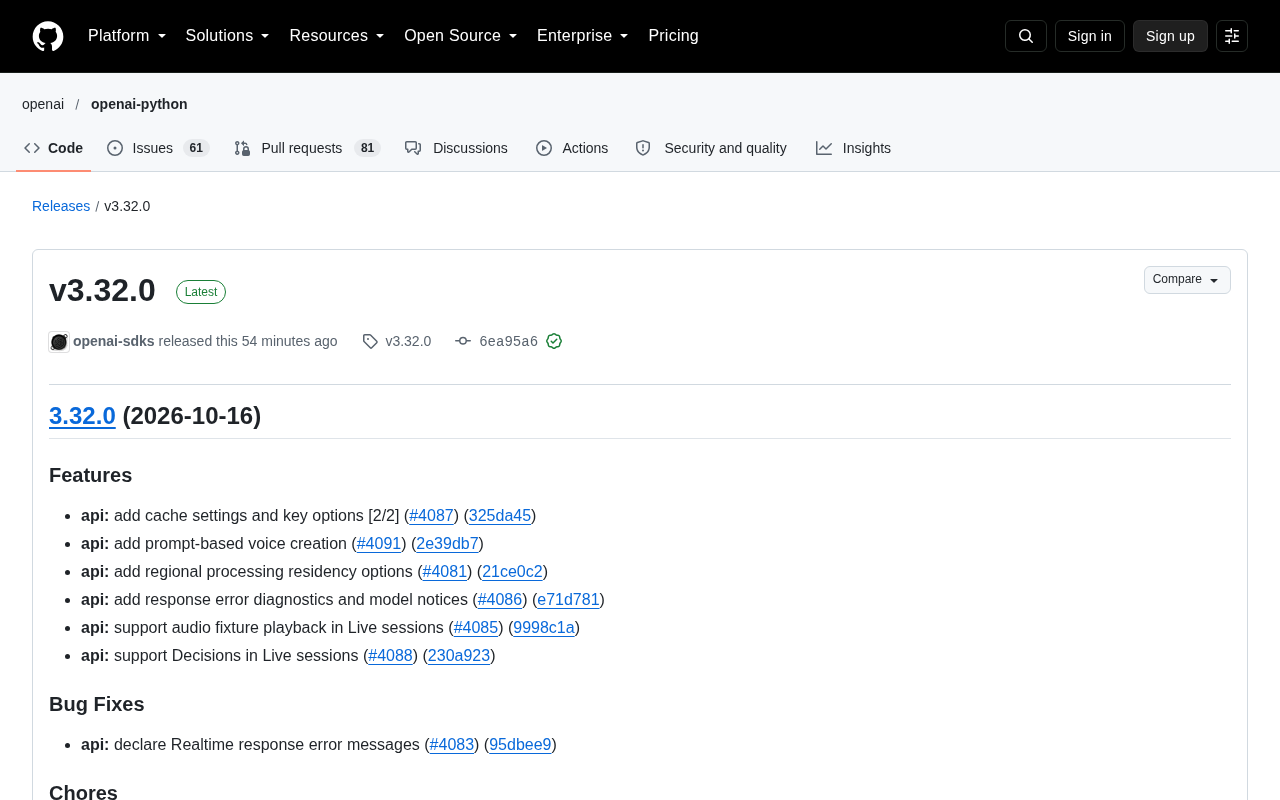
OpenAI has released version v3.32.0 of its official SDK. This update focuses on API capability expansion, covering areas such as voice generation, realtime sessions, and data processing. Although the version number represents only a minor iteration, the feature density is worth noting.
Voice and Audio Capability Expansion
The most notable feature in this update is the API's new prompt-based voice creation capability (#4091). This means developers can generate custom voice tones through text descriptions without relying on a preset voice list. For products that need branded voices or personalized interaction scenarios, the practical value of this change is quite direct.
Audio-related capabilities don't stop there. The API has also added support for audio fixture playback in Live sessions (#4085). Fixture playback is typically used during testing and development phases, allowing developers to validate realtime interaction logic without consuming actual audio resources. Combined with voice creation capability, the SDK has made additions at both ends of the audio pipeline.
Audio Fixture Playback: In testing and development scenarios, a fixture refers to a set of pre-recorded or synthesized, reproducible input data. For realtime voice sessions, audio fixture playback allows developers to simulate user speech, interruptions, silence, and other events using fixed audio segments, thereby validating session state machines, turn transitions, and error handling logic without requiring human participation or consuming real audio quotas. Compared to directly calling real voice services, fixture playback offers advantages such as high determinism, low cost, and suitability for CI pipelines, making it especially useful for regression testing.
Realtime Sessions Support Decisions
Support for Decisions has been added to Live sessions (#4088). The Decisions mechanism allows realtime sessions to make structured judgments during runtime, rather than merely performing passive message passing.
Complementing this, the development team clarified the definitions of Decisions request and response fields in this release (#4079). This is a documentation-level optimization, but for developers currently integrating this feature, clarifying field meanings can reduce significant trial-and-error costs.
Decisions Mechanism and Structured Judgments: In realtime session (Realtime) scenarios, traditional message passing simply flows user input and model output in sequence. Decisions, however, allows the model or server to output structured results with explicit types and fields during the session, such as "whether to escalate to human agent," "whether to trigger a tool," or "current intent classification." This way, the client doesn't need to parse natural language to guess intent, but instead directly consumes a deterministic object. For teams building voice assistants, call centers, or realtime Agents, Decisions decouples "conversation" from "business logic branching," making realtime pipelines more controllable and testable, and allowing frontend and backend teams to develop in parallel once fields are agreed upon.
Data Processing and Compliance Options
On the enterprise requirements front, the API has added regional processing residency options (#4081). Data residency has always been a hard requirement in compliance-sensitive industries. This update allows developers to specify the geographic region for data processing, which has practical significance for integrations in regulated sectors such as finance and healthcare.
Cache settings and key options (#4087) were also added in this update. The exposure of cache configuration means developers can control request behavior more precisely, making trade-offs between latency and cost.
Regional Processing Residency (data residency): Data residency refers to compliance requirements that restrict customer data storage and processing to specific geographic regions. Industries such as finance, healthcare, and government are typically subject to regulatory constraints requiring that personal data not be transferred across borders or processed abroad. With regional processing residency options available in the API, developers can specify the geographic region where processing occurs when making requests, thereby satisfying compliance audits at the architectural level. It's important to note that region selection may affect available models, latency, and billing. Before integration, teams should confirm that the target region supports the required capabilities, and synchronize localization efforts in logging and key management.
Diagnostics and Error Handling Improvements
The API has added response error diagnostics and model notification features (#4086). Richer error diagnostic information helps developers locate problem sources faster during debugging, rather than facing a vague failure status.
On the bug fix side, this release announced Realtime response error messages (#4083), filling a gap in error feedback for the realtime interface.
Code Refactoring
At the implementation level, the team refactored the WebSocket connection handling logic (#4084). WebSocket is the transport foundation for realtime sessions, and refactoring its connection management typically means better stability and maintainability. Although such changes don't directly appear on the API surface, they affect performance in long-connection scenarios.
WebSocket and Realtime Session Transport: WebSocket is a protocol that provides full-duplex communication over a single TCP connection, allowing the client and server to exchange messages at any time without repeatedly establishing connections. Realtime voice and conversation products typically rely on it to push audio chunks, events, and Decisions results with low latency. Therefore, connection management logic—including reconnection, heartbeat, backpressure, timeouts, and error frame handling—directly determines stability in long-connection scenarios. Refactoring this part is generally aimed at fixing intermittent disconnections, unifying the state machine, or reducing memory usage; while it doesn't change the external API, it manifests in the reliability of high-concurrency realtime sessions.
Summary
The direction of v3.32.0 is clear: expanding voice and realtime session interaction capabilities on one hand, while filling in compliance, diagnostics, and testing support on the other. For teams building voice assistants, realtime conversation products, or those with data residency requirements, this version provides several new tools that can be put to direct use.
The official commit was submitted by the openai-sdks team and has been verified with GPG signature.
One-line Summary
OpenAI SDK v3.32.0 expands voice creation, realtime Decisions, data residency, and diagnostics capabilities.
Paragraph Summary
OpenAI has released version v3.32.0 of its official SDK. Although it's a minor iteration, the feature density is high. On the audio side, it adds prompt-based voice creation, allowing developers to generate custom voice tones through text descriptions, and supports audio fixture playback in Live sessions for easier testing. Realtime sessions introduce the Decisions mechanism, enabling sessions to output structured judgments, while also clarifying related request and response fields. For enterprise compliance, it adds regional processing residency options, along with cache settings and key options. On the diagnostics front, it adds response error diagnostics and model notifications, and fixes Realtime error messages. At the implementation level, it refactors WebSocket connection handling logic to improve realtime communication stability.
Related articles

Chain of Thought Isn't Just for AI: How Humans Can Use CoT to Improve Thinking Quality
Chain of Thought isn't just a prompt trick for large models. Starting from a Hacker News discussion, this article analyzes why CoT works for human thinking too, breaks down actionable ways to transfer it, and highlights the key differences between human CoT and machine CoT.
Cloudflare Teams Up with OpenAI: Closi…
Cloudflare Teams Up with OpenAI: Closing the Loop from Vulnerability Discovery to Defense with AI
Cloudflare uses OpenAI Daybreak to investigate security vulnerabilities and generate reviewable remediation plans, while developers use Codex to boost coding efficiency and quality.

Orca Multi-Agent Orchestration in Practice: A Guide to Parallel Collaboration with Claude and Codex
Orca is Stable AI's free open-source agent workbench supporting 34 agents like Claude Code and Codex in parallel. Learn its Git worktree isolation, multi-model orchestration, and mobile management.