OpenAI Seeks Government Stake: A Last-Ditch Rescue Before the AI Bubble Bursts?

Scott Galloway warns OpenAI's government stake pitch is a crony capitalism bailout disguised as investment.
On Prof G Markets, Scott Galloway and Ed dissect OpenAI's proposal to offer the Trump administration a 5% equity stake, framing it as a classic "too big to fail" maneuver. With OpenAI losing $21B annually and Chinese AI models doubling their market share in six months, the episode argues the AI industry is pivoting from a supply crisis to a demand crisis — and that a historic bailout may already be underway.
OpenAI's "Zombie Child" Metaphor
In the latest episode of Prof G Markets, NYU professor Scott Galloway and host Ed issued a sharp warning about the AI market. According to the Financial Times, OpenAI has proposed offering the Trump administration a 5% stake in the company — worth approximately $43 billion at current valuations.
Sam Altman's public rationale is that government ownership is "the best way for the public to share in AI's upside," with a vision of other AI companies joining to eventually form a sovereign wealth fund-like structure. But the show's guests read the situation very differently.
Ed offered a strikingly blunt analogy: "OpenAI is essentially a zombie child conceived by all the big tech companies that have already become systemic risks to the stock market. Sam Altman is doing everything he can to make this company 'systemically important,' so that when things go wrong, we have no choice but to bail it out." This is the classic "too big to fail" playbook.
The concept traces back to the 1984 Continental Illinois Bank crisis, when the federal government intervened with billions in public funds out of fear of systemic financial contagion. The logic reached its apex during the 2008 global financial crisis — with bailouts of Bear Stearns, Citigroup, AIG, and others totaling hundreds of billions of dollars. The core mechanism: when a single institution's collapse could trigger cascading failures through debt chains, employment, and market confidence, governments lose the political room to say no. Galloway and Ed's central accusation is that Altman is replicating this strategy — by embedding OpenAI's compute supply contracts into the core operations of Microsoft, Amazon, Google, and other tech giants, the consequences of its losses would ripple across the entire digital economy, transforming the question of "should we bail them out" into "can we afford not to."
AI Is Shifting from a Supply Crisis to a Demand Crisis
The most critical insight of this episode is that the AI industry is undergoing a pivotal shift: from an early-stage "compute supply crisis" to a far more difficult "front-end demand crisis."
Between 2022 and 2024, the primary bottleneck in AI was a severe shortage of GPU compute. High-end AI chips like the NVIDIA H100 were in desperately short supply. Large tech companies raced to sign multi-billion-dollar hyperscale data center contracts, and "neocloud" companies like CoreWeave and Lambda Labs rose to prominence by renting compute capacity to AI startups. The logic of that era: compute is a scarce asset, and whoever owns compute owns the future. But as TSMC scaled production, NVIDIA's next-generation Blackwell chips ramped up, and major cloud providers' massive investments came online, the supply crunch reversed sharply around 2025. The real question emerged: who will actually consume all this compute? Enterprise AI application monetization is lagging far behind infrastructure spending, and no consumer-facing "killer app" has emerged capable of sustaining massive, ongoing token consumption.
Two intriguing headlines appeared in the AI space last week. The first was OpenAI's proposal for government equity. The second was that Meta is reportedly pivoting to become a cloud services provider, preparing to sell its excess AI compute capacity. This shift is significant — the infrastructure Meta poured billions into building was originally intended to serve its own AI ambitions.

Following the announcement, Meta's stock rose nearly 9%, while neocloud companies like CoreWeave and Nebius plunged roughly 12%. There's structural logic behind that decline: CoreWeave, Nebius, and similar neocloud companies built their business by leasing or purchasing large GPU clusters and renting compute to AI companies at better value than traditional cloud providers. Their model carries highly concentrated risk — customers are typically a handful of leading AI companies, and revenue depends heavily on those customers continuously expanding their compute needs. Once hyperscalers like Meta begin selling idle capacity, they enter the market at a massive scale, backed by giant balance sheets and brand recognition, squeezing neocloud companies on both pricing power and market share.
Galloway pointed out that this divergence reveals a brutal reality: front-end AI applications are failing to generate the expected demand.
He said it reminded him of the dot-com bubble of 1999. Back then, infrastructure companies like Cisco, Sun Microsystems, and Nortel received sky-high valuations under the narrative that "the internet changes everything." Yet the commercial models capable of sustained monetization were far rarer than expected. Enormous quantities of laid fiber were sold off at ten cents on the dollar during bankruptcies, ultimately becoming cheap infrastructure for future companies like Google and Amazon. Galloway's implicit argument is that today's AI compute overbuild mirrors the fate of that fiber. As he put it: "All the demand that trickles down into trillions of dollars of capex, infrastructure, and staggering valuations now basically comes down to demand created by two players — Anthropic and OpenAI." Meanwhile, Meta and xAI — companies that originally planned to absorb their compute through their own products — are now renting out infrastructure, effectively admitting publicly that they overbuilt.
Meta's Self-Contradiction: The Best Evidence of Overbuild
The episode cited Zuckerberg's own words as evidence. He once said: "We haven't done the cloud business because we thought we had use cases for this compute. Obviously, if we find ourselves overbuilding, that's an option." Now Meta has done exactly that thing — "the thing you only do when you've overbuilt" — which is itself the most powerful answer.
A $43 Billion "Backdoor Bailout"
Galloway's financial verdict is unsparing: OpenAI generates $13 billion in annual revenue, spends $34 billion, and runs a $21 billion operating loss. Anthropic, by Prof G's estimates, earns $4.5 billion in revenue against roughly $15.5 billion in expenses, with a $11 billion loss.
More critically, according to The Information, these two companies account for 60% to 80% of the AI revenue at Amazon, Google, and Microsoft, and represent half of the entire backlog of orders from hyperscalers. In other words, the entire back-end infrastructure business only holds together as long as OpenAI and Anthropic keep paying their bills.
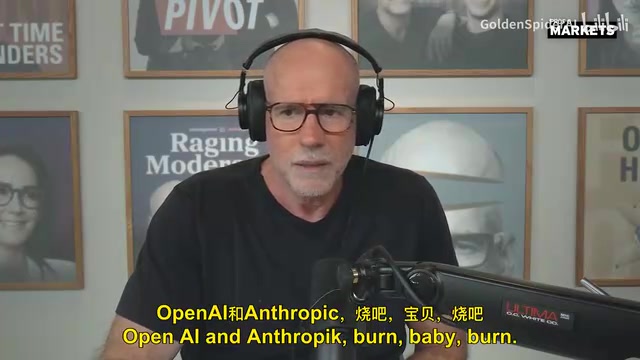
Galloway predicted this six months ago: "The biggest bailout in corporate history is coming. It will be a bailout of Nadella, Altman, and Dario Amodei, and it will be packaged as investment or growth. It's not. It's a bailout."
He characterizes this pattern as cronyism, not the innovation investment it's been marketed as. Crony capitalism is a political economy term describing the systemic distortion in which market participants gain advantages through special relationships with government power rather than through market competition. Its hallmarks include regulatory capture (where regulators are dominated by industry interests), the privatization of gains alongside the socialization of losses, and implicit exchanges between government contracts and political donations. Nobel laureate Joseph Stiglitz has argued that when firms realize lobbying is more profitable than competing through innovation, capital flows from productive activity into rent-seeking, dragging down overall economic efficiency. For a company burning cash at a rate far exceeding its revenue, making the government a shareholder means binding its political interests directly to the company's survival — "heads I win, tails you lose — capitalism on the way up, socialism on the way down. That's cronyism."
He also highlighted the absurdity of the valuation: OpenAI was once valued at $875 billion, and even after a 90% haircut, it would still be worth twice as much as Ford and would still rank among the 100 most valuable companies in the world. "A company valued at $875 billion shouldn't be getting bailed out. Amazon lost 90% of its market cap in 24 months and we didn't bail it out — that was fine. That's what capitalism is supposed to look like."
The "Geographic Flippening" of Chinese AI Models
Beyond the financial distress, the episode revealed another structural threat called the "geographic flippening": free Chinese AI models have seen their share of market traffic surge from 30% to 60% in just six months.
Galloway compared it to the Honda Civic's impact on the American auto industry — "except that was a 10-year slow-motion train wreck. This took 10 weeks." He named a litany of companies that have already switched to Chinese models: Coinbase uses Kimi, Cursor uses Kimi, Shopify uses Qwen, Airbnb uses Qwen, Siemens uses DeepSeekAd, and even Microsoft is testing DeepSeek.
Chinese large language models — led by DeepSeek, Kimi (Moonshot AI), and Qwen (Alibaba Tongyi) — achieved rapid performance catch-up between 2024 and 2025, while establishing a structural cost advantage on inference. The release of DeepSeek R1 was particularly market-shaking — its training cost was reportedly a fraction of comparable GPT-4 training, yet it performed comparably on multiple benchmarks. The sources of this cost advantage are multi-layered: engineering optimizations on the Transformer architecture (such as large-scale application of Mixture of Experts, or MoE); algorithmic efficiency breakthroughs driven by necessity under U.S. chip export restrictions; and structurally lower costs for domestic Chinese data and compute. For enterprise users, when API call costs differ by several multiples, a model's "nationality" often takes a back seat to the invoice total.
The reason is straightforward — Chinese models are cheaper and perform comparably across multiple metrics. This is directly pressuring OpenAI to consider cutting prices. For a company earning $13 billion while spending $34 billion, voluntarily slashing revenue is the equivalent of pouring water on a drowning man.
Who Should Pay for This AI Bubble?
The episode drew comparisons between this potential bailout and the 2008 bank rescues. Galloway's position was unambiguous: the struggles of AI giants don't constitute an "existential crisis" that would cost millions of jobs — it's fundamentally just about "keeping vested interests wealthy."

He made a pointed observation: even if OpenAI or Anthropic lost 75% of their value, they'd be worth roughly the same as Uber, Adobe, or Charles Schwab. "Using the credit card and debt capacity of future generations to ensure private shareholders maintain their returns is the worst possible choice."
The discussion ultimately points to a grander proposition: this isn't a battle between old and young, or rich and poor — it's a power struggle between incumbents versus entrants. When government credit is deployed to prop up tech giants' valuations, what's damaged is the credibility of the entire capitalist system, and the faith younger generations have in market institutions.
Galloway laid out two paths forward for OpenAI: either implode, or get bailed out. And regardless of which path unfolds, the two headlines that appeared in the same week — the government equity proposal and Meta's pivot to cloud services — are, in his view, deeply bearish signals. They mark the moment when the AI bubble is approaching a critical inflection point: if not a collapse, then at minimum a sharp and jarring course correction.
Key Takeaways
Related articles

Workbuddy for Absolute Beginners: How a Desktop AI Agent Fits Into Real Workflows
A beginner's guide to the Workbuddy desktop AI agent: installation, claiming credits, file management, and building automated workflows—compared with CodeX for fit and cost, helping professionals shift from AI question-askers to AI managers.

OpenAI's New Agent Stack: Computer Use, Decisions API, and Ultra-Fast Workflows
OpenAI Dev Day unveiled a new agent stack: Computer Use outperforms humans, Decisions API delivers ultra-low-latency classification via Luna, Agents API opens the same Computer Use capabilities, and GPT-6.1 Sol costs only one-seventh of Astra. Core updates, benchmark data, and developer insights.

Liang Wenfeng Open-Sources DeepInfo Inference Framework, Takes On U.S. Ban
DeepSeek open-sources its DeepInfo inference framework after its models, featuring GPU/CPU cross-pipelining, small-model prediction with large-model verification, and full Huawei Ascend and NVIDIA chip support—facing the U.S. federal ban head-on. This article analyzes its significance for AI deployment and open-source strategy.