OpenAI Showcases New Codex Workflows at AIE Code Summit: Voice, Cloud, and dots

OpenAI showcases new Codex workflows: voice steering, cloud handoff, and dots context layer.
On day one of the AI Engineer Code Summit, OpenAI presented a new Codex-centered workflow focused on human-AI collaboration rather than model capability: steering coding agents by voice, handing long-running codebase-level tasks to the cloud for asynchronous execution, and using dots to organize working context. Developers shift from writing line by line to defining goals, designing boundaries, and reviewing results.
On day one of the AI Engineer Code Summit, OpenAI demonstrated a set of new development workflows built around Codex: steering coding agents by voice, handing tasks off to the cloud for execution, and using dots to organize working context. The focus of this session was not on model parameters, but on how the interaction between developers and AI is changing.
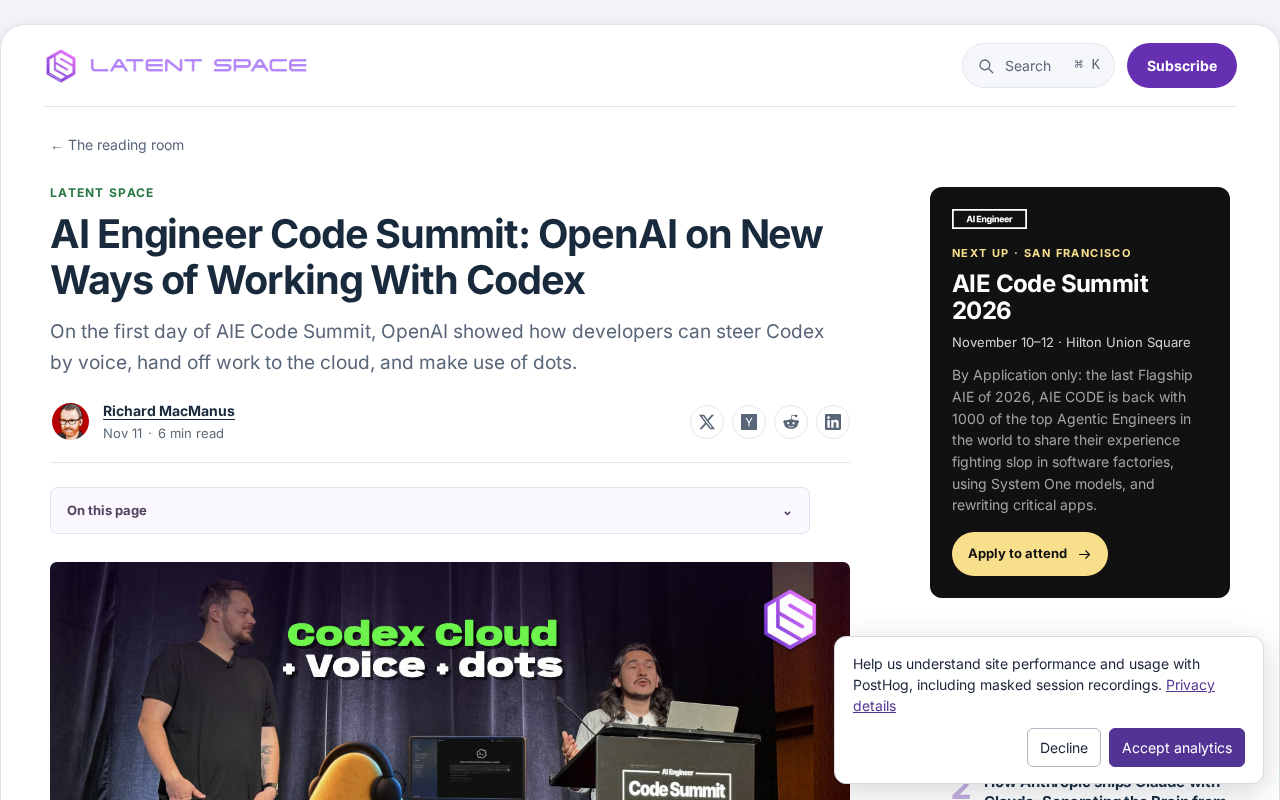
From keyboard to voice: Codex's interaction boundary is expanding
One of the core demos at this Summit was letting developers directly "steer" Codex by voice. This means communication with the coding agent is no longer confined to a text input box—developers can speak their thoughts aloud while the agent understands intent and pushes the task forward.
The value of voice interaction isn't just input efficiency. A large amount of coding time is spent describing requirements, clarifying context, and correcting direction, and voice lets this communication weave more naturally into the thinking process. OpenAI calls this mode "steer Codex by voice," emphasizing a continuous guiding relationship rather than one-off command dispatch.
From a product evolution standpoint, this continues the trajectory of coding agents from "code completion" to "collaborative execution." The developer's role is shifting from writing line by line to steering direction and reviewing results.
Coding agent refers to an AI system that can understand natural language instructions, autonomously plan, and execute multi-step coding tasks—fundamentally different from traditional code completion tools (such as early Copilot's inline suggestions). Completion tools only offer snippet suggestions at the cursor, whereas coding agents can read the codebase, modify multiple files, run tests, and iterate based on results. OpenAI Codex was originally known as a code completion model, but its product form has gradually evolved into a development assistant with agentic capabilities. Understanding this distinction helps grasp what the article means by "from code completion to collaborative execution": changes in interaction modes (voice, cloud handoff) are essentially a redesign of the collaboration interface as agent capabilities grow, rather than mere innovation in input methods.
Cloud handoff: freeing work from the local window
The second direction mentioned in the session was "hand off work to the cloud." Developers can hand tasks to the cloud for execution rather than confining all work to a local editor session.
This handoff model is especially meaningful for long-running tasks. Codebase-level refactoring, batch modifications, or tasks that need continuous running are better suited to asynchronous execution in the cloud, while developers move on to other things. The workflow shifts from "sitting in front of the editor waiting for results" to "dispatch a task and review later."
This also imposes new requirements on collaboration: how to track task status, how to review results, and how to handle failures all need supporting mechanisms. OpenAI discussed this at the Summit as part of the way of working, rather than a mere migration of execution environment.
Asynchronous task execution is the key mechanism here. Local editor sessions are synchronous—after initiating an operation, the developer must wait for results—whereas cloud agent tasks are typically asynchronous: tasks are queued, executed in a remote sandbox, and the developer is notified to review upon completion. This model already has analogues in the industry; for example, GitHub Copilot's coding agent allows issues to be assigned directly to the agent, which creates branches and submits PRs in the cloud. The core challenge brought by asynchrony is observability: developers need to know where a task stands, why it failed, and what diffs it produced. Therefore, cloud handoff is not just a migration of execution environment but also requires supporting task status tracking, logs, and review interfaces—this is the technical background behind the article's mention of "new requirements on collaboration."
dots: giving coding agents a context organization layer
The third concept mentioned was dots. The original information did not elaborate on its technical details, but from the context of the session, it serves to organize and leverage working context—enabling Codex to rely on structured information as it advances tasks, rather than on scattered one-off prompts.
For developers collaborating with AI over the long term, context management is often the real dividing line in experience. The same set of agent capabilities, paired with good context organization, will produce noticeably different stability and reusability. The emergence of dots points precisely to this previously overlooked layer of infrastructure.
Given limited public information, the specific form and capability boundaries of dots remain to be disclosed further, and excessive speculation is not warranted here.
Context engineering is the background concept for understanding dots' positioning. Large language models can process only limited context in a single call, while real coding tasks often involve many files, historical decisions, and project conventions. Context engineering refers to deliberately designing, filtering, and organizing the information fed to the model so that it has the most relevant basis within a limited window. Common approaches include retrieval-augmented generation (RAG), structured project description files (such as AGENTS.md), and distilling long-term knowledge into reusable context units. Judging from its name and context, dots may be a set of composable context units or knowledge nodes used to reuse working background across multiple tasks. This layer is critical because the ceiling of agent capability often depends not on the model itself but on whether it can consistently obtain the correct project context.
What these changes mean for developers
Taken together—voice steering, cloud handoff, and context organization—OpenAI is describing an agent-centric workflow: developers define goals and provide judgment, while the agent executes and iterates.
This shift does not lower the demands on engineering skill; rather, it moves the threshold elsewhere—clearly expressing intent, designing verifiable task boundaries, and reviewing agent output become more critical than remembering API details. For developers accustomed to typing every line themselves, the adjustment may not be easy.
This session on day one of the Summit was more a statement of direction than a complete product description. How voice, cloud, and dots will actually connect in practice remains to be verified with more information.
One-line Summary
OpenAI showcases new Codex workflows: voice steering, cloud handoff, and the dots context layer.
Paragraph Summary
On day one of the AI Engineer Code Summit, OpenAI demonstrated a new development workflow around Codex, with the focus on human-AI collaboration rather than model capability. Three directions: continuously steering coding agents by voice instead of one-off text commands; handing long-running, codebase-level tasks to the cloud for asynchronous execution, shifting the workflow from "watching the editor" to "dispatch and review later"; and using dots to organize working context so agents advance tasks based on structured information rather than scattered prompts. The article notes that these changes collectively point to an agent-centric workflow, with developers shifting from line-by-line writing to goal definition, boundary design, and result review. As the session leaned toward a statement of direction, how voice, cloud, and dots actually connect remains to be disclosed.
Related articles

RePlan-VLA: Progress-Aware Replanning Breakthrough for Long-Horizon Robotic Manipulation
The RePlan-VLA framework converts VLA models' short-horizon capabilities into reliable long-horizon execution through progress-aware adaptive replanning, improving success rates by 21.9% and 10.4% on RoboCasa365 and CALVIN, and validating real-world deployment on a Franka Research 3 robot.

Geometric Bridge Flow Matching: A New Breakthrough in Blind Rigid Motion Correction
Geometric bridge flow matching enables blind rigid motion correction in head CBCT, achieving 37.1 dB PSNR and 0.27 mm RPE on simulated data in ~9.1 minutes, outperforming existing methods.

Google Releases Gemini 4 Hydrogen: 2.5x Faster Without Sacrificing Intelligence
Google releases the lightweight Gemini 4 Hydrogen: 2.5x faster task completion, AA Intelligence Index of 54 beating its flagship sibling, 7.3s single-step on Agent Arena faster than Claude and GPT rivals, four thinking levels with pay-as-you-need pricing, now available across AI Studio and more.