OpenAI Terminates Partnership with Cursor: Model Access Cut Off November 12 — How Developers Should Respond

OpenAI ends Cursor partnership over SpaceX acquisition; model access cut off November 12.
OpenAI announced it will terminate model access for AI code editor Cursor on November 12, triggered by Cursor's acquisition by SpaceX. The move reflects deepening tensions between Musk and OpenAI. Developers are advised to explore alternatives like Claude and Gemini, and adopt multi-model abstraction layers to avoid single-vendor lock-in risks.
OpenAI Announces Termination of Partnership with Cursor
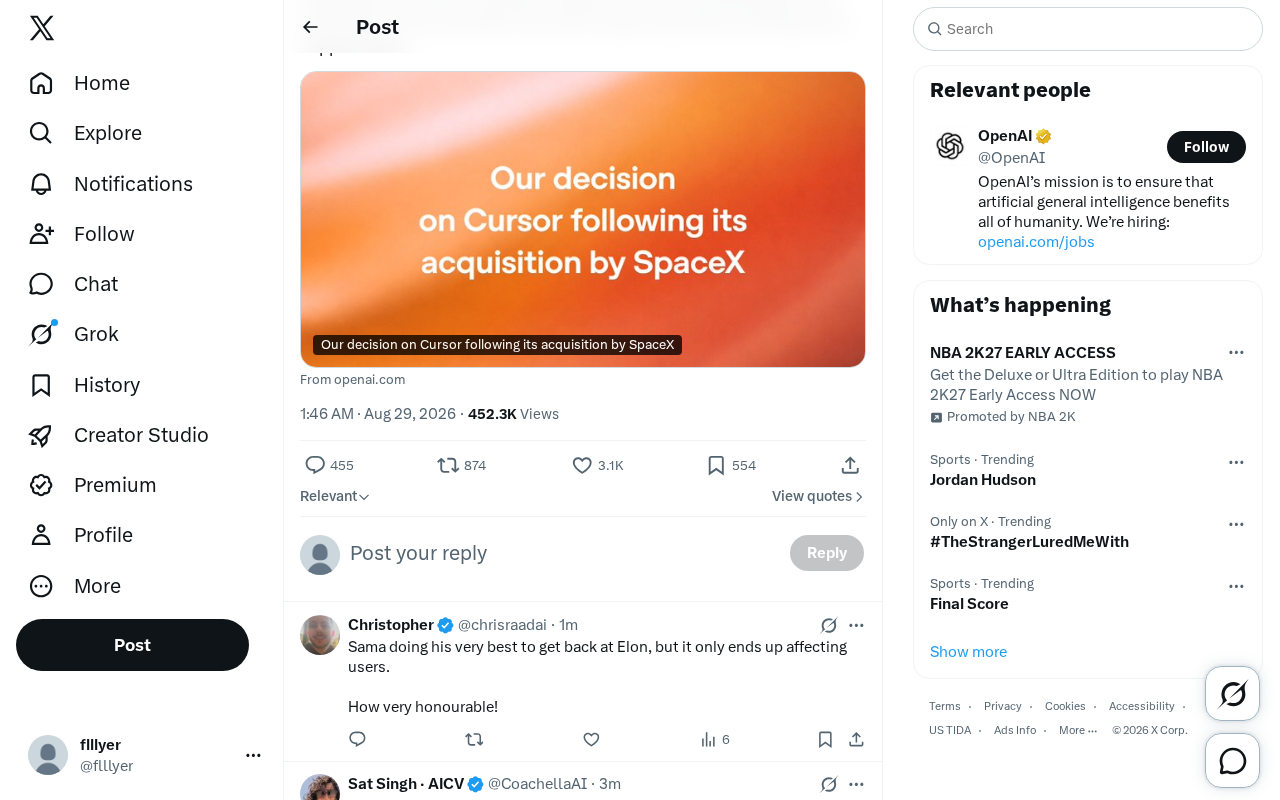
Recently, OpenAI published a statement on social media announcing the termination of its partnership with AI coding tool Cursor. According to OpenAI's plan, Cursor's direct access to its models will be officially terminated on November 12.
Cursor is an AI-native code editor developed by Anysphere, built on Microsoft's open-source VS Code core but with deep integration of large language model capabilities. Unlike traditional IDEs that simply embed AI plugins, Cursor makes the large model the core interaction paradigm of the editor — users can generate code, refactor projects, debug errors, and even have the AI understand the context of an entire codebase through natural language conversation. Since its launch in 2023, Cursor has rapidly built a massive developer user base, earning exceptionally high praise in the GitHub community and tech forums, with many developers viewing it as the prototype of the "next-generation programming environment." It's precisely because of its significant influence that OpenAI's decision to terminate the partnership has attracted so much attention.
The direct trigger for this decision, according to OpenAI, is Cursor's acquisition by SpaceX. In its statement, OpenAI emphasized that it clearly recognizes that the people most deeply affected by this decision are the developer community that relies on OpenAI models for their development work in Cursor.
"We know that the people most affected by this decision are the developers who rely on OpenAI models in Cursor."
OpenAI also stated it would "go above and beyond" to support these developers in smoothly transitioning to alternative solutions.
Why Would an Acquisition Trigger a Partnership Termination?
The Deeper Logic of Commercial Competition and Ecosystem Power Plays
On the surface, this appears to be a partnership adjustment triggered by a change in ownership, but it reflects the increasingly complex competitive dynamics between AI infrastructure and application layers. As one of the most popular AI code editors today, Cursor's core capabilities are highly dependent on underlying large model support. Meanwhile, OpenAI is both a model provider and is gradually extending into the application layer — including rolling out its own coding capabilities and developer tools.
To understand the deeper logic behind this event, we need to trace the complex history between Musk and OpenAI. Musk was one of OpenAI's co-founders, participating in the creation of the organization in 2015 when it was initially positioned as a nonprofit AI research institution. However, the two sides developed fundamental disagreements after OpenAI shifted toward commercial operations. Musk left OpenAI's board in 2018 and has since publicly criticized OpenAI multiple times for straying from its original open-source, nonprofit mission. In late 2023, Musk went further by founding his own AI company, xAI, and launching the Grok large model, putting him in direct competition with OpenAI. In early 2024, Musk even filed a lawsuit against OpenAI, alleging it violated its founding agreement. Against this backdrop, SpaceX — as one of Musk's core enterprises — acquiring Cursor was almost certain to trigger a hostile response from OpenAI. For OpenAI, continuing to provide core model capabilities to a product effectively controlled by a competitor is strategically unacceptable.
With Cursor acquired by SpaceX and its formidable resources, OpenAI clearly reassessed the partnership. This kind of "strategic conflict between supplier and acquired entity" is becoming increasingly common in the AI industry.
Model Access: The Lifeblood and Leverage of AI Applications
For AI-native applications like Cursor, direct access to top-tier model APIs is the lifeblood of product competitiveness. In today's AI application ecosystem, large model APIs have formed a massive economic system. Developers and application vendors call upon the inference capabilities of large models via APIs, paying per token (the smallest unit of text processed by the model). OpenAI's GPT-4, GPT-4o, and other models lead the industry in code comprehension, generation, and debugging, and their API pricing and access policies directly impact the cost structures and product experiences of thousands of downstream AI applications. For applications like Cursor that deeply embed large models into their core product workflows, switching model providers isn't as simple as changing an API endpoint — different models have significant differences in code generation style, accuracy, context window size, response latency, and other dimensions. This means products need to re-tune their Prompt Engineering strategies, adjust interaction flows, and even retrain user habits.
OpenAI's choice to set a clear deadline (November 12) is essentially an exercise of its authority as the model controller. It serves as yet another reminder to the entire developer ecosystem: over-reliance on a single model provider carries significant commercial risk.
Real-World Impact on Developers and Coping Strategies
Short-Term Impact: Finding Transition and Alternative Solutions
For developers who have long used the GPT series models within Cursor, the most immediate impact is that they may no longer be able to call OpenAI models within Cursor after November 12. However, Cursor itself supports a multi-model architecture, so users can switch to the following alternatives:
- Anthropic Claude: Developed by Anthropic, the company founded by former OpenAI VP of Research Dario Amodei. Its latest Claude 3.5 Sonnet model has performed excellently across multiple code benchmarks, demonstrating capabilities comparable to or even surpassing GPT-4o, particularly in code reasoning, bug localization, and complex refactoring tasks. A notable advantage of Claude is its 200K token ultra-long context window, meaning it can comprehend larger codebases in a single pass — particularly beneficial for developing large-scale projects.
- Google Gemini: A multimodal large model from Google DeepMind. Gemini 1.5 Pro supports up to 1 million tokens of context window, offering unique advantages when handling ultra-large-scale code projects. However, in fine-grained code generation tasks, some developers have reported that its performance still lags behind GPT-4o and Claude 3.5 to some degree, especially in the precision of following complex coding instructions.
- Cursor's in-house or partner models: After being acquired by SpaceX, Cursor may accelerate integration of xAI's Grok model, or collaborate with open-source model communities to build customized code generation capabilities based on Meta's Llama series, Mistral, and other open-source large models. The advantage of open-source models is immunity to provider strategy changes, but they typically require more engineering effort to reach the performance levels of commercial closed-source models.
OpenAI has also stated it will "go above and beyond" to support affected developers, which may mean offering some form of compensation, migration tools, or guidance toward alternative products for transitioning users.
Long-Term Trend: Multi-Model Strategy Becomes Essential
This event is an important warning to AI application developers at large. Tying a product's core capabilities to a single vendor's model leaves the product in a passive position during commercial power plays. An increasing number of AI tools are adopting a model abstraction layer design, enabling flexible switching between different providers to mitigate such supply chain risks.
A model abstraction layer is a software architecture design pattern whose core idea is to insert an intermediary layer between application logic and the underlying model APIs. This intermediary layer provides unified encapsulation of API call formats, authentication methods, and response parsing logic across different model providers, allowing the upper-layer application to call different models through a unified interface without writing dedicated integration code for each provider. Several open-source projects are already implementing this approach — for example, LiteLLM provides a unified interface compatible with OpenAI's format to call over 100 different large models, while LangChain achieves vendor-agnostic application development through its model abstraction classes. For enterprise AI applications, this architecture isn't just a technical best practice — it's an essential risk management measure, as this event has proven that model providers may change partnership terms at any time due to strategic considerations.
Industry Observation: The AI Ecosystem Is Being Reshuffled
This incident is a microcosm of the rapidly evolving AI industry landscape. As large model providers extend downstream into applications and application-layer companies seek more stable foundational support, the boundaries between cooperation and competition are becoming increasingly blurred.
This "coopetition" relationship is nothing new in the tech industry, but what makes the AI space unique is that model providers have far greater control over downstream players than in traditional software supply chains. In the cloud computing era, enterprises faced vendor lock-in risks too, but at least their core business logic remained in their own hands. In AI-native applications, however, the product's core intelligence — the quality of code generation, the coherence of conversations, the accuracy of reasoning — is fundamentally determined by the underlying model. This means that when a model provider cuts off supply or adjusts its strategy, application-layer companies face not just migration costs but uncertainty around their core product experience. Similar tensions have already surfaced in multiple scenarios: Microsoft is both OpenAI's largest investor and simultaneously offers competitors' models on Azure cloud services; Google both opens up the Gemini model via API and directly competes with downstream AI applications through its own products.
One notable detail: OpenAI specifically emphasized its focus on developer experience in the statement, reflecting that in fierce competition, winning developer trust and reputation has become a critical factor that no party dares to overlook. After all, developers are the ultimate users and evangelists of these tools and models.
In the future, we'll likely see more similar partnership adjustments, provider switches, and ecosystem alignment choices. For developers and enterprises, maintaining flexibility in technology choices and avoiding lock-in to a single ecosystem will be the core strategy for navigating this wave of change.
Summary and Recommendations
While the news of OpenAI terminating its partnership with Cursor appears on the surface to be the end of a business collaboration, it reveals the increasingly tense coopetition dynamics across the AI value chain. For developers who depend on these tools, understanding alternative solutions early and building diversified technology dependencies is the wise course of action. Specifically, developers can prepare along several dimensions: first, test and familiarize yourself with at least one alternative model's performance in your workflow before November 12; second, follow Cursor's official migration guides and subsequent model integration plans; third, introduce a model abstraction layer design in your own projects to ensure you can quickly respond to similar provider changes in the future. The November 12 deadline will also serve as an important window for observing subsequent chain reactions across the industry.
Key Takeaways
Related articles

Python 3.15 New Feature: Is the sentinel Type Better Than None?
Python 3.15 adds the sentinel type, using named unique sentinel objects to replace None and bare object(), resolving confusion among missing values, explicit emptiness, and invalid input while avoiding type hint failures.

Deep Learning's Three Architectures and the Universal Approximation Theorem: A Complete Guide to MLPs, CNNs, and Transformers
Explaining the inductive bias differences among MLP, CNN, and Transformer, the existence meaning of the Universal Approximation Theorem (UAT), and the role of Taylor expansion in approximation analysis, while clearing up common misconceptions.

GitLab Emergency Patch Release: Analysis of Critical Security Fixes
GitLab releases critical patch 19.5.1, sparking 355 points of discussion on Hacker News. This article analyzes the background, upgrade steps for self-hosted instances, and verification points to help DevOps teams respond quickly to security updates.