OpenAI Unveils Three More Major Scientific Discoveries, Introduces "Shepherd" Expert Review Mechanism

OpenAI announces three major discoveries in math, computer science, and physics, introducing external expert "shepherds" to guide research for the first time.
In under a month, OpenAI has announced scientific discoveries in mathematics, computer science, and physics, and for the first time brought in external experts as "shepherds" to guide research rather than review it afterward. This shift responds to doubts about verification and rigor from its earlier mass manuscript release. The article analyzes the design intent of the "shepherd" mechanism—embedding human oversight to reduce the risk of plausible but untenable AI derivations—while noting that the discoveries' content, expert involvement, and verification process remain undisclosed. Whether the model can scale depends on expert independence, contribution attribution, and disclosure of negative results.
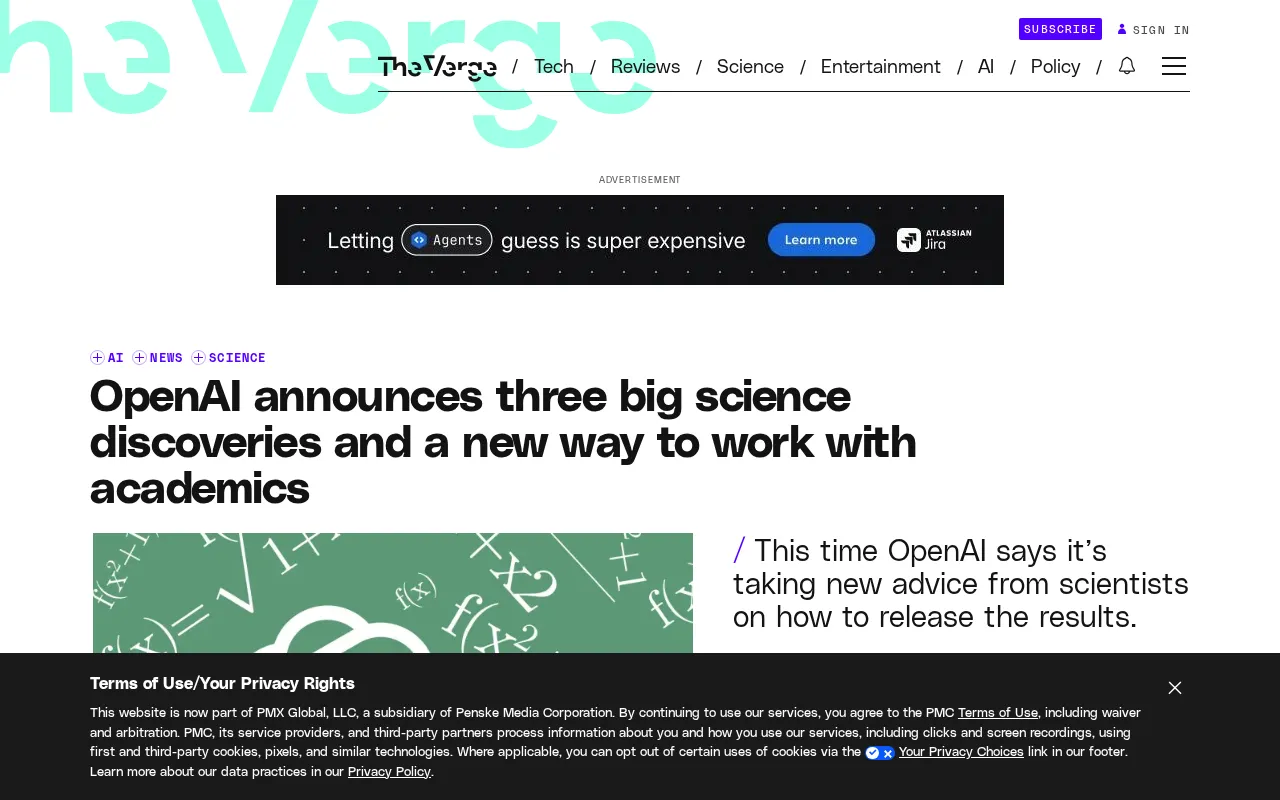
OpenAI's pace in scientific discovery is striking. Less than a month after its large-scale release of hundreds of manuscripts claiming to contain solutions to long-standing mathematical problems, the company has announced three "major" discoveries in mathematics, computer science, and physics. Unlike before, this time OpenAI has brought in external experts as "shepherds" to guide the research results, attempting to embed human expert oversight into AI-driven scientific discovery.
A Strategic Shift from "Mass Release" to "Expert Guidance"
When OpenAI mass-released hundreds of manuscripts last month, outside reactions to its claimed mathematical solutions were mixed—with skepticism focused on the verification process and academic rigor of the results. The release of these three new discoveries has clearly adjusted the rhythm: rather than a one-way output, external experts are now deeply involved in the process.
The term "shepherds" is worth pondering. It implies that experts are not post-hoc reviewers but play a guiding role as research advances. For AI-generated scientific conclusions, this mechanism design directly targets a previous pain point: models may produce plausible-sounding derivations that do not actually hold up, and an internal team alone struggles to cover the verification needs of every specialized field.
However, the details OpenAI has disclosed so far are quite limited. What exactly these three discoveries are, how the shepherds intervene, and whether the final results have undergone peer review are all left unaddressed in the original text. This leaves room for follow-up observation and means that judgments about their scientific value should remain cautious at this stage.
The verification challenge of AI-generated scientific conclusions stems from how large language models work: models generate text based on probability distributions and may produce content that is "plausible but lacks rigorous derivation," which is especially dangerous in mathematical proofs or physics derivations. Traditional peer review relies on experts checking the logical chain line by line, but the speed and scale of AI generation far exceed human review capacity. As a result, the industry has begun exploring mechanisms that combine "process-based verification" with "expert front-loaded guidance"—for example, having domain experts set constraints and screen intermediate hypotheses in the early stages of AI exploration rather than judging results only at the endpoint. This approach aims to reduce later verification costs, but it also places higher demands on the depth and independence of expert participation.
Three Discoveries Span Mathematics, Computer Science, and Physics
The three disciplines covered in this announcement each carry weight. Mathematics continues the direction of the earlier manuscript release, while computer science and physics are new expansions. Applying AI to explore fundamental problems across different disciplines itself reflects the extension of the model's capability boundaries—from code generation and text processing toward formal reasoning and scientific hypothesis generation.
The breadth of disciplines also brings differences in verification difficulty. Mathematical proofs can be checked step by step along the logical chain, physics discoveries often require support from experimental or observational data, and theoretical results in computer science involve yet different evaluation criteria. This means the "shepherd" mechanism may operate very differently across fields, and transparency will be key for outsiders assessing its effectiveness.
Formal reasoning and scientific hypothesis generation are two key dimensions for evaluating AI's capacity for scientific discovery. Formal reasoning refers to translating mathematical proofs into machine-checkable logical steps (such as with proof assistants like Lean and Coq), whose advantage lies in objective, automatable verification; scientific hypothesis generation, by contrast, involves distilling testable conjectures from data, often requiring experimental or observational corroboration, with long verification cycles and uncertainty. Theoretical results in computer science (such as lower bounds on algorithmic complexity or equivalence of computational models) usually fall between the two, requiring formal proof while also potentially relying on counterexamples or constructive arguments. Different disciplines differ significantly in their criteria for what counts as a "discovery," which explains why the "shepherd" mechanism needs domain adaptation rather than a one-size-fits-all approach.
A New Attempt at Academic Collaboration
The phrase "a new way of collaborating with academia" in the title is another main thread. AI companies hold computing power and models, while academia possesses domain knowledge and verification capability, and the point of connection between the two is being redefined. By choosing to have external experts participate up front, OpenAI is, to some extent, responding to academia's doubts about the credibility of AI research results.
Whether this model can be scaled up depends on several practical questions: whether the independence of experts can be guaranteed, how contributions are attributed, and whether negative results will also be made public. If the shepherd mechanism merely endorses predetermined conclusions, its value will be greatly diminished. Conversely, if experts can truly correct course during the process, this may become a reference paradigm for AI-assisted scientific research.
At present, OpenAI's investment in scientific discovery is accelerating, but tension remains between the pace of disclosure and information transparency. The specific content of the three discoveries, the list of experts, and the verification process are all clues worth tracking going forward.
Academic contribution attribution for AI research results is a core point of controversy in collaboration models. When AI models generate key derivations and external experts provide guidance, there is no consensus on how authorship, intellectual property, and academic priority should be allocated. Common approaches include: listing AI as a "tool" rather than an author (following the current policies of most journals), or establishing an "AI-assisted contribution" disclosure section; experts who only participate in verification may be credited in acknowledgments rather than as co-authors. In addition, whether negative results (i.e., attempts in which AI failed to reproduce or falsified a claim) are made public directly affects academic trust—publishing only successful cases would exacerbate publication bias. Establishing these rules requires coordinated efforts among AI companies, journals, and academic societies, and is still at an early exploratory stage.
One-line Summary
OpenAI announces three major discoveries in mathematics, computer science, and physics, introducing external expert "shepherds" to guide research for the first time.
Paragraph Summary
In less than a month, OpenAI has again announced scientific discoveries spanning mathematics, computer science, and physics, and for the first time has brought in external experts as "shepherds" to participate deeply in guiding the research rather than reviewing it after the fact. This strategic shift aims to respond to doubts about verification processes and academic rigor raised by its earlier mass manuscript release. The article analyzes the design intent of the "shepherd" mechanism—embedding human expert oversight into the process of AI-generated conclusions to reduce the risk of models producing plausible but untenable derivations. It also notes that the specific content of the three discoveries, the manner of expert involvement, and the verification process have not been disclosed, and that differences in verification standards across disciplines make the mechanism's transparency critical. Whether the new academic collaboration model can be scaled up depends on practical issues such as expert independence, contribution attribution, and disclosure of negative results.
Related articles

How Did Da Vinci Prove the Sun Is Hot? A Neglected Chapter in Science History
How did da Vinci use a concave mirror experiment to overturn Aristotle's cold sun theory? This article traces this neglected chapter in science history, revealing the embryo of scientific thinking in the 15th century and da Vinci's cold observations on solar heat and the nature of life.

SharpLogic: Formalizing Bug Detection for LangGraph Routing Graphs with k-CNF
SharpLogic, an open-source project, maps LangGraph-style multi-agent routing and retry graphs to k-CNF, using a Rust kernel to count deadlocks and failing paths (#F counting), offering a Python AgentGuard hook and CLI for pre-release formal gate checks. This article analyzes its principles, its complementary relationship with evals, and the community's concern about modeling costs.
PPO Training of a Franka Robotic Arm for Pick-and-Place: A Reinforcement Learning Starter Project
A reinforcement learning project using PPO to train a Franka Panda robotic arm for pick-and-place in PyBullet, covering tech stack choices, task design challenges, and future text/voice command interaction plans—a good reference for beginners.