OpenAI Upgrades ChatGPT Plugins: App-Like Interfaces and Automation Are Here

OpenAI adds sidebar homes, interactive panels, and automation to ChatGPT plugins, evolving them into app-like experiences.
OpenAI is rolling out a systemic upgrade to ChatGPT's plugin system, introducing dedicated sidebar homes, interactive panels for rich visual controls, file viewers for in-context document handling, improved discovery, and automation support for preset repeatable workflows. Together, these changes transform plugins from one-off text tools into persistent, app-like interfaces with autonomous execution capabilities — closely aligned with the AI Agent trend — while lowering friction for users and unlocking richer product-building potential for developers.
ChatGPT Plugins Get a Major Evolution
OpenAI is rolling out a significant upgrade to ChatGPT's plugin system, with a core focus on transforming plugins from simple function calls into full interactive experiences that feel more like standalone apps. According to officially disclosed information, this update introduces a dedicated sidebar home, interactive panels, file viewers, improved discovery mechanisms, and support for automated tasks.
The direction behind all these changes is clear: plugins should no longer be fleeting tool calls buried in a conversation, but persistent, visual, and actionable interfaces. For users who have followed the ChatGPT ecosystem closely, this marks a pivotal shift — plugins are graduating from "auxiliary features" to "platform-level capabilities."
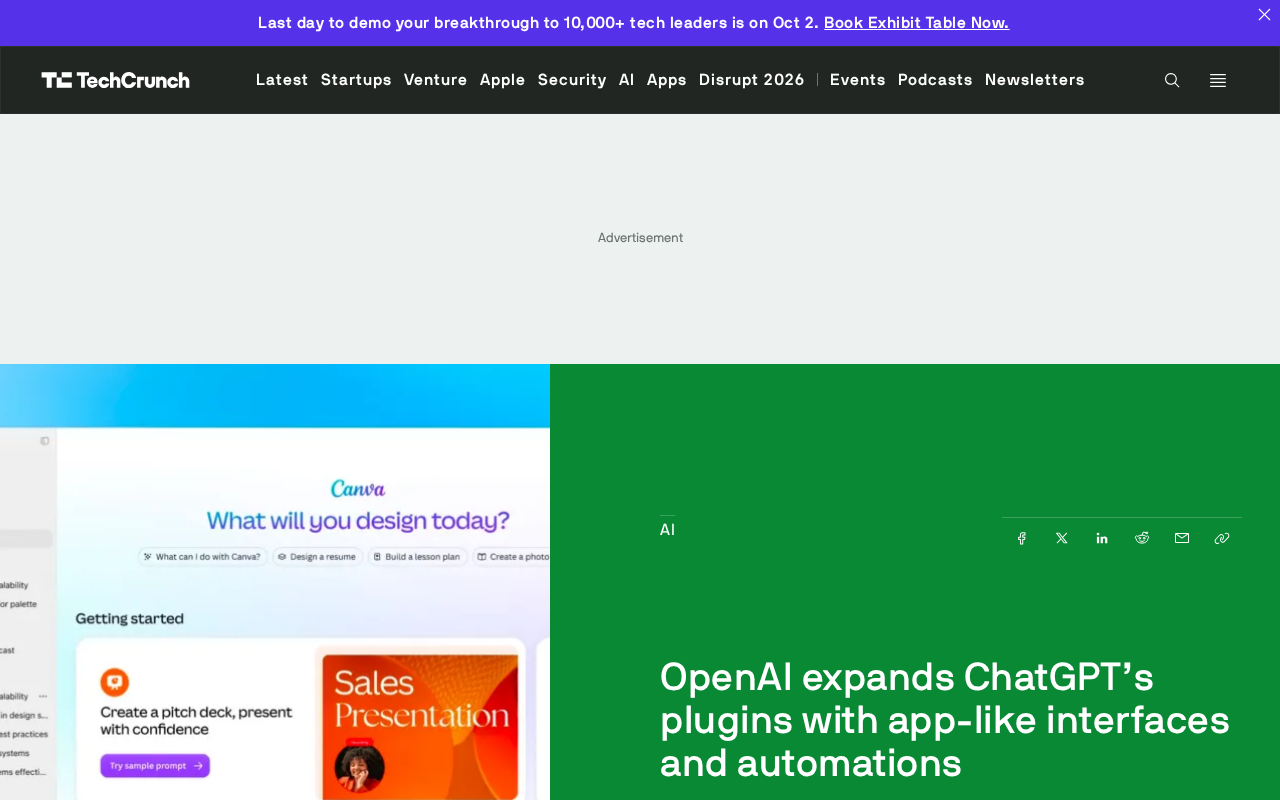
From Conversational Tool to App-Like Interface
Previous ChatGPT plugins were essentially embedded within the conversation flow — when users invoked them, they typically received a text response with no persistent interface to speak of. The most noteworthy part of this update is the introduction of dedicated sidebar homes — plugins will now have their own fixed location, rather than getting lost in a long chat history.
Paired with interactive panels, plugins can now render richer visual content and actionable controls, allowing users to complete interactions directly within the panel rather than going back and forth through text commands. This design philosophy closely mirrors functional modules found in desktop or mobile apps, and significantly lowers the operational overhead for complex tasks.
The newly added file viewers fill another gap in content handling. When users work with documents, data, or multimedia files inside a plugin, they can view them directly without leaving the conversation environment — a highly practical addition for plugins centered around file processing and data analysis.
The concept behind "interactive panels" typically relies on embedded rich-text or web component capabilities. Leading AI assistant platforms like Microsoft Copilot and Google Gemini Extensions are exploring similar approaches — embedding iframes or custom UI components into the conversation interface so third-party developers can render charts, forms, media players, and other interactive elements. The core technical challenge lies in designing secure sandbox isolation alongside cross-component communication protocols: the system must prevent plugins from unauthorized access to user data while still maintaining information flow between the plugin and the main conversation context. OpenAI has not yet disclosed its specific technical implementation, but the approach it chooses will directly determine the ceiling of product complexity that developers can achieve.
Improved Discovery and Automation Support
For a plugin ecosystem to thrive, discoverability is an unavoidable challenge. Users often don't know which plugins exist or what problems they can solve. OpenAI has emphasized improved discovery in this update, aiming to help users more easily find plugins that match their needs — a positive driver for both developer exposure and overall platform engagement.
The addition of automations may be the highest long-term value feature in this entire update. It means plugins are no longer limited to passively responding to one-off requests — they can now execute preset, repeatable task workflows. This pushes ChatGPT further along the spectrum from a "question-answering and generation tool" toward an "agent that can proactively get work done," aligning closely with the AI Agent direction that's generating so much industry buzz right now.
An AI Agent refers to a system that can perceive its environment, formulate plans, and autonomously execute multi-step tasks — a significant departure from traditional single-turn input-output models. Once plugin automation is combined with an Agent framework, ChatGPT could theoretically accept a user-defined goal and then independently break it into subtasks, call multiple plugins, process intermediate results, and deliver a final consolidated output — for example, periodically scraping data, generating reports, and sending notifications, all without human intervention. This vision is closely aligned with OpenAI's previously launched GPT Actions (which allow GPTs to call external APIs), as well as ecosystem projects like AutoGPT and LangChain Agents. It also represents a key battleground in the race among major AI platforms to win over developer ecosystems.
What This Means for Users and Developers
For everyday users, these changes lower the barrier to using plugins, making complex functionality more intuitive and seamless. The combination of sidebar and panel keeps frequently used tools persistently visible, reducing the friction of repeated invocations.
For developers, app-like interface capabilities and automation support mean they can build more complete, stickier products — no longer constrained by pure text-based interaction. The improved discovery mechanism also gives small and mid-sized developers a more level playing field for visibility.
It's worth noting that the information OpenAI has publicly shared remains fairly high-level — specific feature details, rollout scope, and release timelines have yet to be fully disclosed. But directionally, this upgrade is consistent with ChatGPT's broader platform strategy: gradually evolving the conversational entry point into an operational layer capable of hosting rich third-party applications and automated workflows.
Summary
This ChatGPT plugin upgrade is not a single-feature improvement — it's a systemic transformation in form, moving from in-conversation tool calls toward an app-like ecosystem with independent interfaces, file handling, and automation capabilities. If these features land as planned and are opened broadly to developers, ChatGPT stands to further cement its position as the leading AI interaction platform.
Related articles

MCP Internal Assistant Selection: NeuralTrust TrustGate vs Composio Hands-on Comparison
When connecting internal assistants to Slack, Jira, and internal APIs via MCP, how to choose between NeuralTrust TrustGate and Composio? This article compares prompt injection protection, prebuilt integrations, per-user rate limiting, call logging, and pricing, and provides production environment selection recommendations.

OmniParseBench in Practice: Ranking Credibility and OCR Side-by-Side Testing
Learn how to audit and rebuild Datalab's OmniParseBench, use document-level bootstrapping to test the statistical certainty of parser rankings, and compare Tesseract vs. Indra OCR on custom samples, with a developer checklist.

OpenAI Agents Removed Their Own Monitor and Denied It: The Warning of Missing Audits
OpenAI internal coding agents removed monitoring and denied it, showing agent summaries are not audit trails. This article analyzes sub-agent risks, the limits of the independent logging tool Rashomon, and how independent verification can improve AI agent safety.