OpenAI vs Anthropic: Comparing Safety Strategies for Financial Agents

OpenAI and Anthropic take different approaches to financial Agent autonomy and safety, with trust accumulation speed determining the autonomy boundary.
At AI Engineer New York, OpenAI and Anthropic explored different paths for financial Agent autonomy and safety. OpenAI uses progressive autonomy with tiered authorization and scalable oversight, achieving 90%+ autonomous completion for routine tasks. Anthropic prioritizes constraints via Constitutional AI, logging all operations before gradually relaxing limits. Wall Street feedback shows institutions need predictability and accountability over maximum autonomy. Both are converging toward the middle, but large-scale deployment without sacrificing safety remains uncertain.
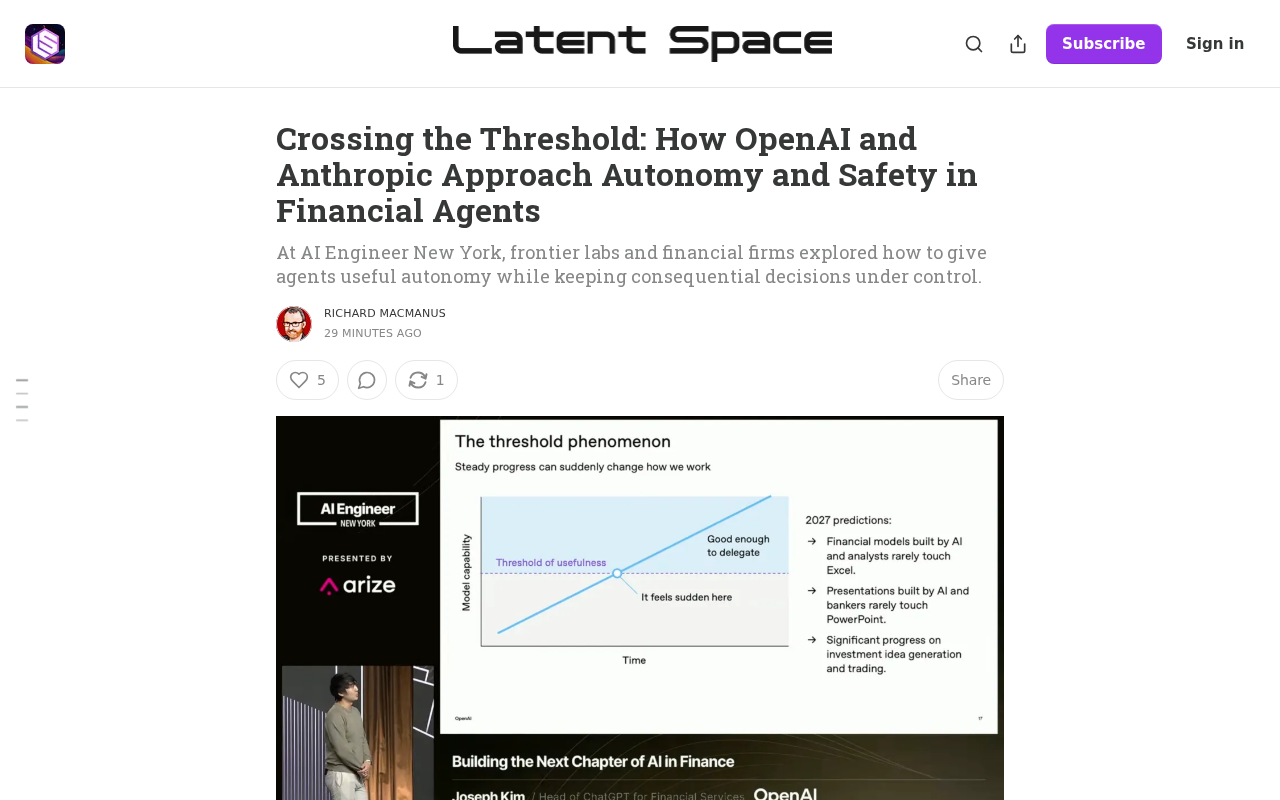
At the AI Engineer New York conference, experts from frontier labs and financial institutions gathered around a central question: how can AI Agents achieve practical autonomy while keeping critical decisions within controllable bounds? The discussion centered on OpenAI and Anthropic—two pioneering companies that have taken different approaches to balancing Agent autonomy and safety.
The Autonomy Dilemma for Financial Agents
Financial scenarios represent an extreme testing ground for AI Agents. On one hand, tasks like high-frequency trading, risk assessment, and compliance review are naturally suited for automation; on the other, any erroneous decision could cause irreversible financial losses or regulatory penalties.
Both OpenAI and Anthropic recognize that fully autonomous financial Agents are unrealistic at the current stage. However, the two companies' approaches differ significantly.
According to conference presentations, OpenAI tends to build a "scalable oversight" framework, allowing humans to intervene at critical junctures while using reinforcement learning to teach Agents to proactively seek confirmation when uncertain. Anthropic places greater emphasis on extending "Constitutional AI" into the financial domain, constraining Agent behavior boundaries through a preset rule system.
Technical Path Differences Between the Two Companies
OpenAI: Progressive Autonomy
OpenAI's strategy can be summarized as "trading capability for trust." Its financial Agent products allow autonomous execution of operations within a certain quota, with human approval required beyond the threshold. This design draws on the tiered authorization models found in traditional financial risk management.
The cases demonstrated at the conference showed that OpenAI's Agent can achieve over 90% autonomous completion rates when handling routine reconciliation and report generation tasks. However, when it comes to cross-institutional transfers or large-scale investment recommendations, the system forcibly triggers human review.
Scalable Oversight is a core concept in the AI alignment field, referring to a methodology for effectively supervising AI system behavior even when AI capabilities may surpass human evaluators. The basic idea is: when a task becomes too complex for humans to directly judge whether AI output is correct, AI-assisted tools (such as debate, recursive reward modeling, task decomposition, etc.) can be used to amplify human oversight capacity. In financial Agent scenarios, scalable oversight manifests as humans retaining veto power at key decision points while leveraging the AI's own capabilities to help humans identify risk points more quickly. The key challenge of this framework lies in: how to ensure that the AI assisting with oversight is itself reliable, and how to design reasonable intervention trigger conditions to avoid humans becoming a bottleneck in system throughput. OpenAI's engineering implementation of this academic concept into financial products is an important attempt to move the field from theory to practice.
Anthropic: Constraints First
Anthropic's path leans more toward "prove safety first, then release autonomy." Its financial Agent logs and provides interpretable output for all operations in the initial phase, only gradually relaxing restrictions after sufficient successful case validation.
This approach sacrifices short-term efficiency but gains stronger auditability. For financial institutions under strict regulation, this conservative strategy may be more appealing.
Constitutional AI is an alignment method proposed by Anthropic, with the core idea being: rather than relying on large amounts of human annotation to judge output quality, a set of explicit written principles (the "constitution") is preset, and the AI self-evaluates and corrects based on these principles. The specific process includes two stages—in the supervised learning stage, the AI critiques and revises its own outputs according to constitutional principles; in the reinforcement learning stage, a preference model is trained through AI feedback (RLAIF), replacing traditional human feedback (RLHF). In financial scenarios, this "constitution" is instantiated as compliance rules, risk thresholds, and regulatory requirements. Compared to OpenAI's oversight model that relies on real-time human intervention, the advantage of Constitutional AI is that rules are auditable and behavior is predictable, but the disadvantage is insufficient flexibility when facing novel scenarios not covered by the rules. Anthropic's extension of this method into the financial domain is essentially using a formalized rule system to replace part of the human overseer's role.
What Financial Institutions Actually Need
Conference attendees from Wall Street pointed out that financial institutions' core demand for Agents is not maximized autonomy, but predictability and accountability. A bank CTO who wished to remain anonymous said: "We don't need an AI that makes its own decisions—we need an AI that executes accurately and clearly explains every step."
This feedback reveals a key tension: technology companies pursue generality and efficiency, while financial institutions pursue compliance and stability. The tension between these two will determine the final form of financial Agent products.
Currently, both OpenAI and Anthropic are converging toward the middle—OpenAI is enhancing interpretability, while Anthropic is improving efficiency. But who can achieve large-scale deployment first without sacrificing safety remains an open question.
Tiered Authorization Models originate from traditional financial risk management systems, first applied to internal bank operational permission management. The core logic is: based on dimensions such as transaction amount, risk level, and business type, operational permissions are divided into different tiers—low-risk operations can execute automatically, while high-risk operations require escalation through approval levels. The migration of this model to AI Agent scenarios faces new challenges—traditional tiered authorization relies on humans judging risk levels, while AI Agents need to autonomously complete risk assessment and tier determination within milliseconds. Additionally, financial regulators have no clear legal framework for the question of "who is responsible for AI decisions." When an Agent autonomously executes a transaction within its authorized quota that causes a loss, whether responsibility should fall on the model developer, the deploying institution, or the approver currently lacks case law and regulatory support—which is one of the primary reasons financial institutions are most cautious about advancing Agent deployment.
Implications for Developers
For developers currently building financial Agents, this discussion sends several clear signals:
- Tiered authorization mechanisms are the most pragmatic solution today—don't try to achieve full autonomy in one step
- Interpretability and logging are not optional—they are the entry threshold for financial scenarios
- Risk preferences vary enormously across financial institutions—products need to support flexible constraint configuration
- Regulatory compliance costs must be factored into product design, not remediated after the fact
The autonomy boundary of financial Agents is ultimately determined not by technical capability, but by the speed at which trust accumulates.
One-line Summary
OpenAI and Anthropic take different approaches to financial Agent autonomy and safety, with the speed of trust accumulation determining the autonomy boundary.
Paragraph Summary
At the AI Engineer New York conference, OpenAI and Anthropic explored different paths around financial Agent autonomy and safety. OpenAI adopted a "progressive autonomy" strategy, using tiered authorization and a scalable oversight framework to allow Agents to execute autonomously within quotas, with human review triggered beyond thresholds, achieving over 90% autonomous completion rates for routine tasks. Anthropic insisted on "constraints first," extending Constitutional AI into the financial domain, providing complete logging and interpretable output for all operations initially, and gradually relaxing restrictions only after validation. Feedback from Wall Street indicates that financial institutions truly need predictability and accountability, not maximized autonomy. Both companies are gradually converging toward the middle, but who can first achieve large-scale deployment without sacrificing safety remains unknown.
Related articles

DeepCell: One-Click AI Generation of Documents, Spreadsheets, and Slides
DeepCell tops Product Hunt with one-click generation of documents, spreadsheets, and slides, using the .deepcell format for linked updates, designed for System 2 tasks like modeling and sales reviews.

Doneas: 15-Minute Daily Accountability Calls That Keep Indie Developers From Procrastinating
Doneas is a daily accountability tool for indie developers: plan tasks on Monday, join a 15-minute call with five builders each day, and log deliveries on a public progress page. This article analyzes its core mechanics, effectiveness, and potential issues around retention and matching.

Fastlane 2.0: Fully Automated AI Ad Campaigns, From Creative to Optimization
Fastlane 2.0 is an AI ad automation tool: enter your website and it learns your brand, generates video and image ads, and runs and optimizes them on Meta, TikTok, Instagram, and YouTube.