OPENBOT: Open-Source AI Agent Platform That Turns Agents Into Your Digital Colleagues
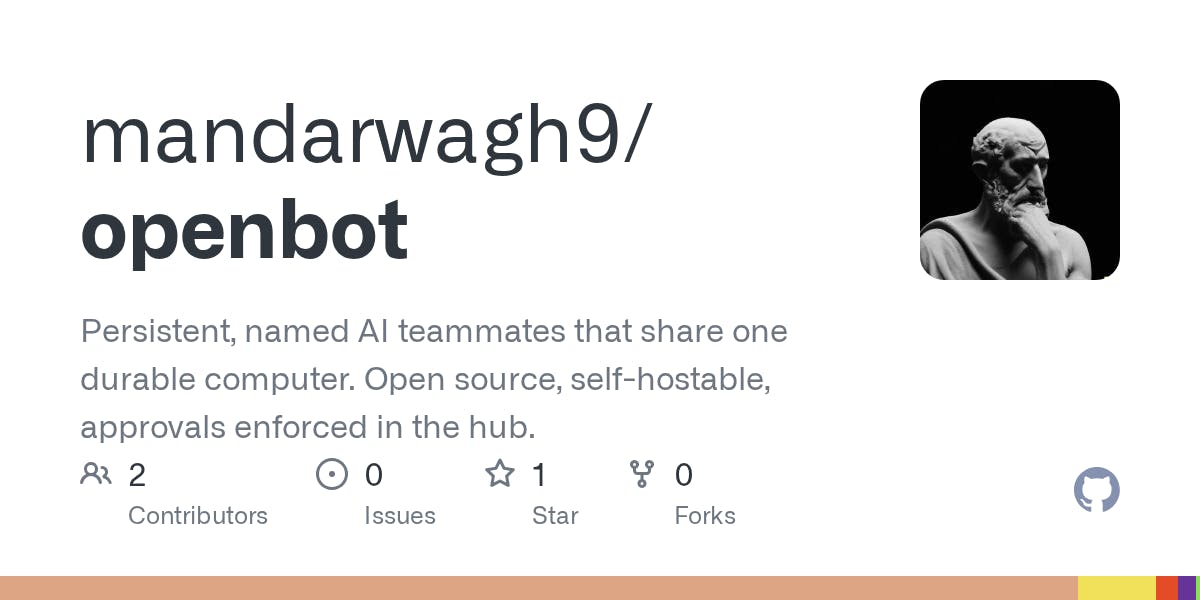
OPENBOT is an open-source AI agent platform that transforms disposable chatbots into persistent digital colleagues.
OPENBOT is an open-source alternative to Grokbot that reimagines AI agents as long-lived, named digital colleagues rather than disposable chat sessions. Its core features include persistent memory across tasks, autonomous scheduling, a shared computing environment with browser and shell, and a dual-channel execution strategy using MCP connectors with browser fallback. The platform supports self-hosting for data control and includes human-in-the-loop approval for high-risk operations.
From "Chat Box" to "Digital Colleague": A Paradigm Shift
Over the past two years, AI agent tools have proliferated, but the vast majority of products still deliver the same user experience: a disposable chat box tied to a single session. You open a conversation, type a command, get a result, then close the window—the next time you open it, everything starts from scratch. This "no memory, no continuity, no ownership" interaction model essentially still treats AI as a tool, not a collaborator.
The concept of AI agents originates from "Autonomous Agent" theory in artificial intelligence research, referring to software entities capable of perceiving their environment, formulating plans, and taking actions to achieve goals. Since 2023, with the leap in large language model (LLM) capabilities, agents have rapidly evolved from academic concepts into product forms. From AutoGPT to BabyAGI and various commercial products, agent tools have progressed through three stages: "single-turn dialogue" to "multi-step reasoning" to "autonomous planning and execution." However, most products remain stuck in stateless session mode, where context is cleared after each interaction—a fundamental gap from what humans expect of an "assistant."
The open-source project OPENBOT, recently launched on Product Hunt, aims to break this inertia. It positions itself as an open-source alternative to Grokbot, with one core proposition: stop giving you a chat box that resets—give you a team of "teammates" instead.
Grokbot is an AI agent product launched by xAI (founded by Elon Musk), built on the Grok large model and focused on autonomous task execution. In the current AI Agent commercial landscape, closed-source products dominate: OpenAI's GPT-based Agents, Google's Project Mariner, Microsoft's Copilot Actions, and other tech giant products all use SaaS subscription models. While these products are powerful, they present issues like uncontrollable data, vendor lock-in, and opaque pricing. The emergence of open-source alternatives addresses enterprise users' demands for data sovereignty and technical autonomy, following a similar logic to Linux replacing Windows Server or Kubernetes replacing commercial orchestration tools.
This shift in thinking deserves attention. It redefines "Agent" from a one-time task executor into a named digital employee with long-term existence, independent memory, and its own schedule. You're no longer "using a tool"—you're "handing off work like you'd message a colleague."
OPENBOT's Core Design Philosophy
Long-Lived, Named Agents
OPENBOT's biggest differentiator is that its Bots are long-lived and named. Each Bot has:
- Independent conversation threads: Different Bots maintain their own communication contexts without interference;
- Persistent memory: Information carries over between tasks and isn't lost when sessions close;
- Its own schedule: This means Bots can autonomously execute tasks on schedule without human triggers.
These three features together are what make the "digital colleague" metaphor viable. A real colleague doesn't forget what you told them last week every time you talk, nor do they need you to re-explain the project background from scratch. Persistent memory and scheduling capabilities are precisely what upgrade an Agent from a "Q&A chatbot" to a "trustworthy executor."
From a technical implementation perspective, persistent memory typically involves a combination of vector databases (such as Pinecone, Weaviate) and structured storage—short-term conversational context is maintained through the LLM's context window, while long-term memories are extracted as summaries or key facts stored in external storage, recalled via Retrieval-Augmented Generation (RAG) mechanisms when needed. Scheduling capabilities rely on cron-like scheduling systems that enable Agents to autonomously wake up at preset times and execute predefined workflows.
Sharing a "Persistent Computer"
Another clever design in OPENBOT is that all Bots share the same persistent computer, equipped with a browser, shell terminal, and file system.
The implications of this design run deep. It means multiple Agents aren't making isolated API calls—they're collaborating in the same sustainable work environment. A file downloaded by one Bot can be directly read by another; a browser session logged in by one Bot can be reused by subsequent tasks. This is much closer to how human teams collaborate in a shared workspace, rather than fragmented, disconnected calls.
Technically, this "shared persistent computer" typically relies on containerization technology (such as Docker) or lightweight virtual machines. Unlike traditional stateless API calls, this architecture provides Agents with a stateful OS-level environment including a complete file system, process management, and network stack. This design draws inspiration from sandbox computing platforms like E2B and Morph, which provide securely isolated execution environments for AI. The advantage of multiple Agents sharing the same environment lies in reducing serialization overhead for data transfer and leveraging the operating system's native inter-process communication mechanisms for collaboration—though it also introduces engineering challenges around permission isolation and resource contention.
Dual-Channel Execution: MCP First, Browser as Fallback
OPENBOT provides a pragmatic answer to the question of "how to actually get work done." It employs a dual-channel execution strategy:
- When connectors exist, use MCP (Model Context Protocol): MCP is a protocol that has rapidly become an industry standard for Agent-to-external-tool integration. When the target tool already provides an MCP connector, OPENBOT calls it directly through the standardized interface—efficient and stable.
- When no connector exists, use the browser: For services without APIs or MCP support, OPENBOT falls back to direct browser operation—just like a human opening a webpage and clicking through it.
MCP (Model Context Protocol) is an open protocol introduced by Anthropic in late 2024, designed to standardize connections between large language models and external tools and data sources. Before MCP, every Agent framework needed custom integration code for each tool, leading to severe ecosystem fragmentation. MCP defines a unified communication specification including tool descriptions, parameter passing, result returns, and other standard interfaces—similar to how HTTP standardized browser-server communication in the web domain. Hundreds of MCP connectors have now been developed by the community, covering common tools like GitHub, Slack, databases, and CRMs, and it's becoming the infrastructure layer of the Agent ecosystem.
This "protocol-first, browser-as-fallback" combination solves a real pain point in the current Agent ecosystem: not all tools are AI-friendly. Pure API-based Agents are helpless when facing services without interfaces, while pure browser-operation Agents are slow and fragile (browser automation depends on DOM structure recognition, and any change in page layout can cause operations to fail). OPENBOT lets Bots "take shortcuts when possible, and use the most universal approach when shortcuts aren't available," dramatically expanding coverage.
Human-in-the-Loop Approval Mechanism
Notably, OPENBOT doesn't give Agents completely free rein. The official description emphasizes that Bots "come back when they need your approval."
This represents a mature product judgment. Human-in-the-Loop (HITL) is a design pattern that embeds human judgment at critical nodes in automated workflows, occupying a central position in AI safety and controllability discussions. The concept borrows from the "safety interlock" philosophy in industrial control systems—even when systems have full automation capability, human confirmation is still required for irreversible operations. In enterprise Agent scenarios, typical HITL trigger points include: payments exceeding preset amounts, publishing external content, deleting data, and modifying permissions.
In real workflows, fully automated operations involving payments, publishing, deletion, and other high-risk actions can actually create uncontrollable risks. Retaining human-in-the-loop approval nodes leverages Agent autonomy while preserving user control. The industry consensus is that Agent autonomy should be "progressively released"—as trust builds and behavior becomes more predictable, the frequency of manual approvals can gradually decrease, but completely eliminating approvals is still considered high-risk at current technology maturity levels. This is an unavoidable component of enterprise-grade Agent deployment.
The Strategic Significance of Open-Source Positioning
OPENBOT explicitly brands itself as an open-source alternative to Grokbot. In an era where AI Agent commercial products overwhelmingly use closed-source subscription models, the open-source route offers unique value:
- Self-hostable with data control: Since Bots share a real computer (with file system and shell), data privacy and security become especially sensitive. Open source means enterprises can deploy on their own infrastructure and maintain full control over data flows. This is particularly critical in regulated industries (such as finance, healthcare, government), where compliance requirements like GDPR and HIPAA often explicitly restrict data from leaving jurisdictions or being hosted by third parties.
- Auditable and customizable: Agents autonomously execute operations and invoke tools, making behavioral transparency crucial. Open-source code enables technical teams to audit actual Agent behavior and extend connectors and capabilities as needed. When Agents have the ability to operate file systems and shells, any unaudited behavior could constitute a security risk.
- Community-driven ecosystem: The richness of MCP connectors directly determines Agent utility, and the open-source model is more likely to attract community co-creation. Referencing the development trajectories of Hugging Face's Transformers library and LangChain, open-source community contribution speeds often far exceed those of a single company's internal R&D team.
The project is currently published by Maker Mandar Wagh, receiving initial attention on Product Hunt (ranked #18), categorized under Software Engineering, Developer Tools, Artificial Intelligence, and GitHub.
Conclusion: The Next Direction for Agent Products
OPENBOT is still in its early stages—votes and discussion volume remain limited, and its actual stability, memory management capabilities, and multi-Bot collaboration effectiveness all await validation through real-world usage.
But the product direction it represents—shifting from "disposable chat boxes" to "named digital colleagues with memory, schedules, and shared work environments"—is precisely the core question the entire AI Agent industry is exploring. When Agents are no longer one-time Q&A sessions but can take on long-term responsibilities like team members, AI truly crosses from "tool" to "productivity partner."
This transformation also echoes the long-discussed "anthropomorphic interface" trend in Human-Computer Interaction (HCI): when software presents itself as a social entity rather than a tool, user trust building, task delegation willingness, and collaboration efficiency all improve significantly. OPENBOT's design of giving Agents names, memory, and autonomous schedules is essentially constructing a new paradigm of human-machine collaboration.
For developers and enterprises focused on the Agent ecosystem and seeking data sovereignty, OPENBOT's framework of "open-source + long-lived agents + dual-channel execution" is worth ongoing observation.
Related articles

Chain of Thought Isn't Just for AI: How Humans Can Use CoT to Improve Thinking Quality
Chain of Thought isn't just a prompt trick for large models. Starting from a Hacker News discussion, this article analyzes why CoT works for human thinking too, breaks down actionable ways to transfer it, and highlights the key differences between human CoT and machine CoT.
Cloudflare Teams Up with OpenAI: Closi…
Cloudflare Teams Up with OpenAI: Closing the Loop from Vulnerability Discovery to Defense with AI
Cloudflare uses OpenAI Daybreak to investigate security vulnerabilities and generate reviewable remediation plans, while developers use Codex to boost coding efficiency and quality.

Orca Multi-Agent Orchestration in Practice: A Guide to Parallel Collaboration with Claude and Codex
Orca is Stable AI's free open-source agent workbench supporting 34 agents like Claude Code and Codex in parallel. Learn its Git worktree isolation, multi-model orchestration, and mobile management.