OpenClaw In-Depth Analysis: Agent Framework Capabilities and Three Critical Pitfalls to Avoid
OpenClaw Agent framework deep dive: Skills, tools, channels, and three critical pitfalls to avoid
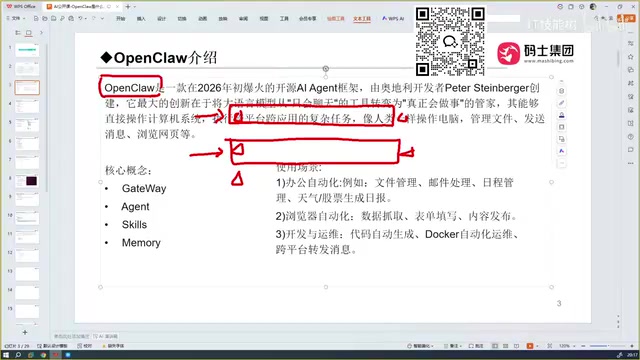
OpenClaw is an Agent framework that extends LLM capabilities through Skills (predefined workflows), tool calling, and Channels integration. While powerful for enterprise automation, beware three major pitfalls: astronomical token consumption, high security risks from elevated permissions, and intelligence limitations.
From LLM to Agent: Understanding OpenClaw's Technical Foundation
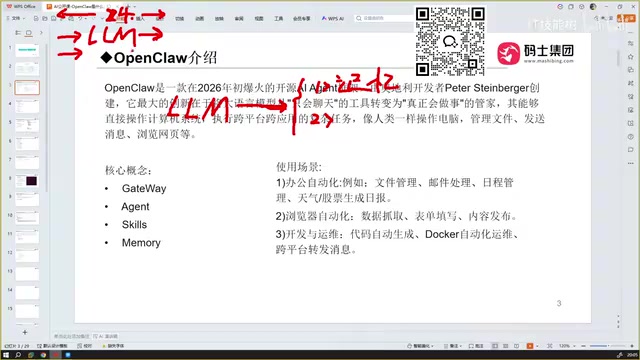
The recently viral OpenClaw is essentially an Agent framework — a tool for building AI Agents. To understand why it's potentially disruptive, we need to start with the limitations of large language models (LLMs).
The core capability of LLMs is reasoning and Q&A: you input a question, and they generate a response based on training data. But they have two obvious shortcomings:
- No memory capability: Each conversation appears independent to the model. If you say "my name is John" in one sentence and then ask "what's my name?" in the next, it may not remember.
- Knowledge has a temporal cutoff: The model only knows information available up to the point when training was completed. Events that occurred afterward are beyond its reach.
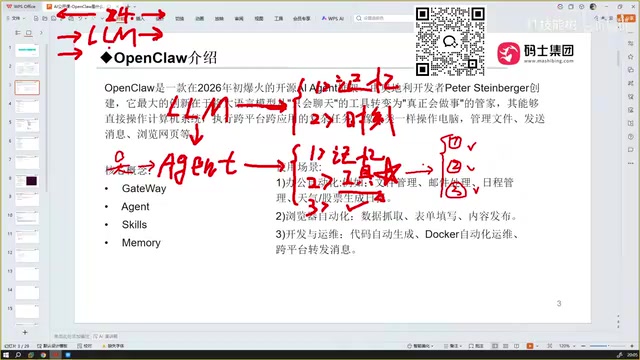
To overcome these two bottlenecks, Agents emerged.
Three Core Features of Agents
Compared to raw LLMs, Agents fill critical capability gaps:
- Memory: Can remember historical conversation context with users, enabling continuous interaction.
- Tool Calling (Tools): Can invoke capabilities like web search, sending emails, or generating documents as encapsulated tools. This is key to connecting Agents with enterprise internal data and achieving business implementation — without tools, LLMs can only answer general internet knowledge and provide no value for actual business operations.
- Autonomous Reasoning and Planning (ReAct): When users ask questions, Agents can autonomously determine which tools to call, when to loop through calls, and ultimately provide answers.
Tools are the core bridge for Agents to evolve from "chat toys" to "productivity tools."
Skill Mechanism: The Core Source of OpenClaw's Capability Extension
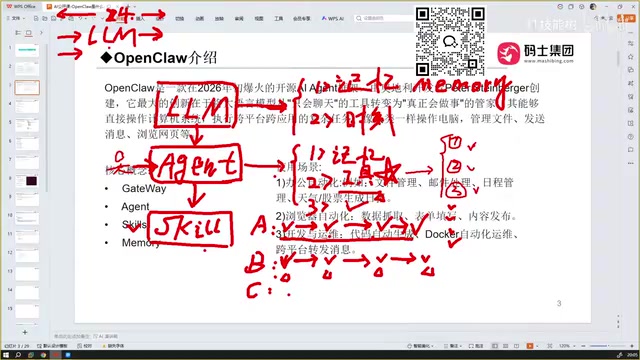
As enterprises configure more and more tools for their Agents, a new problem emerges: tool chaos. The Agent fails to call tools when it should, or calls them when it shouldn't — the more tools, the worse this "choice paralysis" becomes.
To solve this problem, Skills enter the picture.
What is a Skill
A Skill is essentially a predefined fixed workflow that specifies which existing tools should be called in what sequence to complete a complex task.
Take a web scraping scenario as an example — a Skill could be defined like this:
- Step 1: Open a specific webpage at scheduled times and search for designated information (call search tool)
- Step 2: Scrape the content (call scraping tool)
- Step 3: Compare with data in your own database (call database tool)
- Step 4: Generate a document (call document generation tool)
Each step corresponds to calling an existing tool. By solidifying workflows through Skills, Agents no longer face "choice paralysis" when confronted with messy tools, and task completion accuracy improves dramatically.
Low-Barrier Skill Development
One of OpenClaw's major advantages lies in its Skill ecosystem. The official website offers tens of thousands of free Skills for use, and you can also develop your own.
Unlike the tedious tool definition required by MCP in the past, Skill development has an extremely low barrier — it can directly call scripts or commands you've already written on your local machine.
For example, creating a "computer health check" Skill: use a Shell script to sequentially check memory, disk usage, and CPU status, then compile this information into a document. The entire process requires no additional tool definitions — just let the Agent call your existing business scripts.
Enterprise Implementation Scenarios: Channels Enable Remote Control
Another highlight of OpenClaw is its support for multiple Channels, which can integrate with mainstream chat platforms like DingTalk and WeCom.
Imagine an operations scenario: fixed operations like deploying applications, taking them offline, and checking logs are first encapsulated as scripts in code, then managed by OpenClaw as Skills. From there, you can either schedule them to run automatically or trigger them through conversation.
Going further, once you integrate OpenClaw with DingTalk, the DingTalk bot essentially connects to your OpenClaw instance. This way, sending a message from your phone lets you remotely control servers to execute scripts — a complete closed loop for operating remote computers from anywhere.
Three Critical Pitfalls: Don't Mythologize OpenClaw
While OpenClaw is powerful, based on actual usage and team experience, you must watch out for these three pitfalls.
Pitfall 1: Token Consumption is Staggeringly High
This is the most easily overlooked yet critically dangerous issue. Under normal circumstances, $10 worth of LLM conversation credits might last half a year; but in OpenClaw, having it call tools while browsing websites and generating summaries can burn through $10 in minutes.
Some developers testing at their companies found that a morning or even a full day's worth of coding work consumed millions of tokens. This consumption level far exceeds regular usage — enterprises must budget carefully before deployment.
Pitfall 2: Security Risks are Extremely High
Some users reported their API Keys mysteriously zeroing out on corresponding platforms. The truth is likely that your OpenClaw machine became a botnet node.
Because OpenClaw's built-in tools have extremely high permissions (can manipulate system files, read browser information, execute network tasks), once the machine is compromised, all your information is essentially exposed, and configured API Keys can easily leak. This is the security cost of high privileges — never let your guard down.
Pitfall 3: Not as Intelligent as You Think
The real experience after actual deployment: it sometimes makes basic mistakes. OpenClaw is not some omnipotent black box technology. A rational perspective and pragmatic usage are the correct approach.
Tools Have No Magic — Value Lies in Usage
Stripping away the hype to see the essence, OpenClaw is just an Agent framework — it connects data through tools, solidifies workflows through Skills, and opens channels through Channels. Without Skills and tools, it is nothing.
For enterprises and developers, rather than chasing concepts, it's better to stay grounded: control token costs, maintain security boundaries, and recognize capability limits. Developing custom Skills is entirely feasible and has a low barrier — this is the direction that can truly land and generate value.
Related articles
The Root Cause of AI Deceptive Behavior: Misalignment Risks in Reinforcement Learning and Solutions
Deep dive into the technical roots of AI deception: how RL reward mechanisms catalyze misalignment, why stronger models increase risk, and how institutions like LawZero are solving AI alignment from the training paradigm level.
Astra Lands on Azure: A Deep Dive into the AI Cloud Service Competitive Landscape
Astra has officially landed on Microsoft Azure with early customer adoption. This article analyzes the strategic significance, flywheel effects, and the AI competitive landscape across Azure, AWS, and Google Cloud.
A Minimalist Agent Invents Five-Layer Memory: A Self-Evolution Experiment in a Loop
A minimalist Agent with only a 20-message sliding window context autonomously evolves a five-layer memory system, state machine, and write-to-disk protocol—revealing a new paradigm shift from constraining models to activating models.