OpenCode Console Breached: API Key Security Alarm Sounded

OpenCode Console breached; users who hosted provider keys must immediately revoke and rotate keys.
OpenCode disclosed that its Console management backend was compromised, and users who hosted model provider API Keys on the platform may face key exposure risk. A Console-level breach differs from a code repository leak: attackers obtain directly usable API credentials, and the risk window extends from the platform to every connected developer account. The advice is clear: anyone who entered keys in the Console should immediately confirm and revoke old keys, regenerate them, update downstream scripts and CI pipelines, and check account passwords, session tokens, and OAuth authorizations. The article also analyzes the structural risks of hosted key gateways—single point of concentration, reversible storage, unverifiable trust, and rotation cost transfer—and proposes alternatives such as local/self-hosting, short-lived credentials, per-project isolation with quota limits, and routine rotation.
AI coding tool OpenCode recently disclosed a security breach of its Console management backend, potentially exposing user-hosted model provider keys. For developers who entrust API Keys from OpenAI, Anthropic, and other providers to third-party platforms, this is not an ordinary vulnerability notice but a wake-up call about the risks of the "key hosting model."
Event Core: What a Compromised Console Means
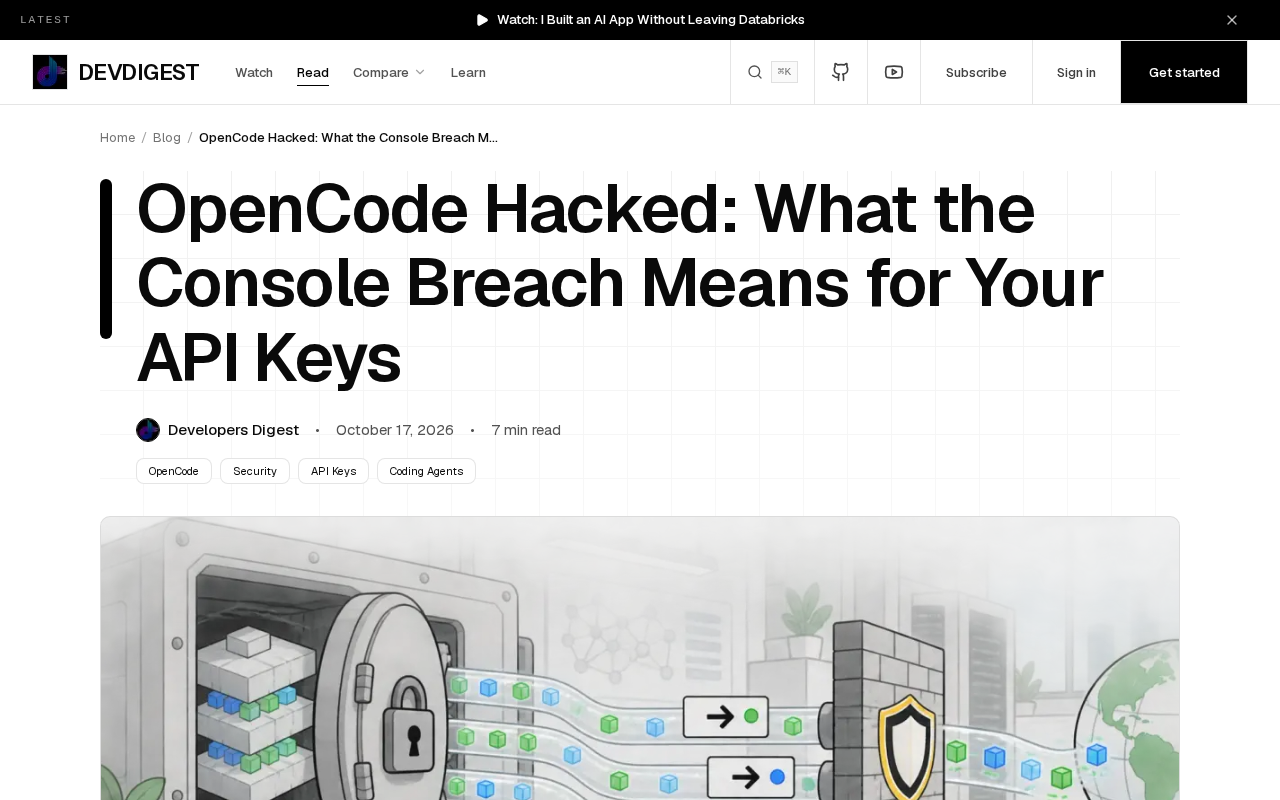
According to OpenCode's disclosure, the compromised component is the Console—the management interface where users configure model providers, manage keys, and set project preferences on the platform. Unlike a traditional code repository leak, the direct consequence of a Console-level breach is that attackers may have obtained usable API credentials, not just code or configuration samples.
The original statement is quite clear: affected are users who have hosted provider keys in the Console, and the core risk is that these keys may have been exposed. This means the risk window extends from "the platform itself" to "every developer account connected to it."
Who Needs to Act Immediately
The affected scope can be divided by usage pattern: any user who has directly entered model provider API Keys into the OpenCode Console for hosting and called models through the platform should be considered potentially affected. Users who only store keys in local environment variables and have never uploaded them to the Console have a much smaller exposure surface.
The original advice is straightforward: first confirm whether you have stored keys in the Console, then decide whether to rotate. This is not a "wait for further official notice" scenario—once an API Key is usable, attackers can consume quota, call models, and even use it for downstream abuse without being detected.
The distinction between API Keys and OAuth credentials deserves clarification here. API Keys are typically long-lived static strings; the server can identify the caller and bill solely based on them. Once leaked, an attacker needs no additional information to directly call models. OAuth authorization, by contrast, is based on a token exchange mechanism: access tokens usually have a short validity period and can be renewed or revoked via refresh tokens. For this reason, handling an API Key leak must include the step of "revoking the old key"—merely creating a new key does not invalidate the old one; the old string remains valid on the provider side until explicitly revoked. Understanding this difference is essential to understanding why the original repeatedly emphasizes revoke rather than rotate-only.
The Key Rotation Checklist for Today
The original emphasizes "what to rotate today," pointing to a prioritized rotation checklist. From highest to lowest risk:
- All provider keys hosted in the Console: keys from mainstream providers such as OpenAI, Anthropic, and Google should be revoked and regenerated immediately;
- Downstream services bound to these keys: for example, automation scripts, CI pipelines, and internal tools built on the keys need to be updated accordingly;
- Other credentials under the same account: if the Console account itself may also have been accessed, login passwords, session tokens, and associated OAuth authorizations should all be checked.
The key to rotation is not "replacing with a longer string" but that the old key must be revoked, not just superseded by a new one. Many teams only create new keys and forget to invalidate the old ones, effectively extending the exposure window indefinitely.
The Real Structural Risk: Hosted Key Gateways
The most worthwhile aspect of this incident is precisely what the original points out—hosted key gateways are the real risk. Entrusting API Keys to a third-party platform essentially outsources "credential control." To make things convenient for users, platforms typically need to store keys in a reversible form so they can initiate model calls on users' behalf.
This architecture creates systemic problems:
- Single point of concentration: one compromised Console can mean simultaneous exposure of keys for hundreds or thousands of developers, yielding far higher returns for attackers than attacking an individual developer;
- Reversible storage: to make calls on behalf of users, platforms often need to recover plaintext keys; no matter how strong the encryption, the runtime exposure surface cannot be fully eliminated;
- Unverifiable trust: users cannot independently audit the platform's internal key handling processes and must rely on the platform's security promises;
- Rotation cost transfer: after an incident, the work of rotation, investigation, and downstream updates falls entirely on users.
In other words, hosted key gateways build convenience on a trust assumption that users cannot verify. The OpenCode incident merely brings the real cost of that assumption into the open.
Reversible storage is the key technical background for understanding the risks of hosted key gateways. To initiate model calls on behalf of users, platforms must obtain plaintext keys at runtime, so keys cannot be stored solely as one-way hashes—hashes are irreversible and cannot be used to sign requests. A common approach is to encrypt keys with symmetric encryption (such as AES-GCM) and store the ciphertext, with a key management service (KMS) holding the master key. This is secure at the static storage level, but plaintext must inevitably be recovered in memory at runtime; any attacker able to read process memory, dump core dumps, or inject code could intercept the plaintext. By contrast, password-type credentials only need to be stored as hashes for verification and need not be recovered—which is the fundamental reason why "key hosting" is riskier than "password hosting."
Alternative Approaches Developers Can Take
If you do not want to hand core credentials to third parties, there are several practical paths:
- Prefer local or self-hosted: store keys in local environment variables, the system keychain, or a self-built key management service; tools should only read them, never upload them;
- Use short-lived credentials: prioritize providers that support temporary tokens and on-demand issuance to shorten the validity window after key misuse;
- Isolate keys by project: use independent keys for different projects and environments with quota limits to minimize the impact of a single point of leakage;
- Build a rotation habit: incorporate key rotation into routine operations rather than reacting passively after a security incident.
For teams already deeply reliant on hosted gateways, at minimum confirm whether the platform supports fine-grained key permissions, call auditing, and rapid revocation capabilities, and include these capabilities in selection evaluations.
Short-lived credentials are gradually becoming available among major cloud and AI providers. For example, some providers support issuing short-term session tokens from long-term keys, or use workload identity to let services running in the cloud obtain temporary credentials directly without hardcoding static keys. The core of such mechanisms is replacing "long-lived secrets" with "short-lived, automatically renewable, finely scoped" tokens; even if intercepted, the attack window is only minutes to hours. When selecting providers, prioritize confirming whether the target provider supports temporary tokens, scope restrictions, and call audit logs—these capabilities determine the degree of control after a leak occurs.
Long-Term Lessons from the Incident
The value of the OpenCode breach lies not in the event itself but in the trust boundary it reveals that has been widely overlooked: the AI toolchain is rapidly turning "model calls" into infrastructure, and once key hosting at the infrastructure layer is compromised, the entire downstream chain is affected.
For developers, judging whether an AI coding tool is worthy of entrusting with keys should be as serious as judging a database or payment gateway. The trade-off between convenience and security must ultimately be determined by who controls the credentials.
One-line Summary
OpenCode Console breached; users who have hosted provider keys must immediately revoke and rotate keys.
Paragraph Summary
OpenCode disclosed that its Console management backend was compromised, and users who have hosted model provider API Keys on the platform may face key exposure risk. The article points out that a Console-level breach differs from a code repository leak: attackers obtain directly usable API credentials, and the risk window extends from the platform itself to every connected developer account. The handling recommendation is clear: anyone who has entered keys in the Console should immediately confirm and revoke old keys, regenerate them, update downstream scripts and CI pipelines accordingly, and check account passwords, session tokens, and OAuth authorizations. The article further analyzes the structural risks of hosted key gateways—single point of concentration, reversible storage, unverifiable trust, and rotation cost transfer—and proposes alternatives such as local/self-hosting, short-lived credentials, per-project isolation with quota limits, and routine rotation.
Related articles

Behind TinyFish's Free Search: The Real Cost of AI Agents Reading the Web
TinyFish opens search retrieval for free, but the real cost of AI Agents reading the web hasn't disappeared: with retrieval fees at zero, token processing and inference generation become the main expenses. This article breaks down both cost structures and analyzes the impact of free search on Agent infrastructure competition and developer cost strategy.

ScopeGuard: A Local-First Open Source AI Tool That Takes Aim at Freelancer Scope Creep
ScopeGuard is a local-first open source AI tool that helps freelancers detect client scope creep, cite contract clauses, and generate boundary-setting replies and change order quotations—all running locally to protect NDA privacy.

Philadelphia Woman Arrested for Blocking Delivery Robot: A Flashpoint in Human-Machine Conflict
A Philadelphia woman, Carolyn Marvin, was arrested for blocking an Uber delivery robot to protest job displacement, highlighting human-machine conflict and legal-ethical dilemmas.