Philadelphia Woman Arrested for Blocking Delivery Robot: A Flashpoint in Human-Machine Conflict

Philadelphia woman arrested for blocking an Uber delivery robot, exposing the deep tension between tech progress and job fairness.
Carolyn Marvin was arrested in Philadelphia for deliberately blocking an Uber delivery robot, charged with disorderly conduct. She said it was a protest against robots replacing human delivery workers. As automated delivery robots spread across cities, similar human-machine standoffs are increasing. Supporters cite lower costs and efficiency; critics worry about job loss and public safety. The law remains unclear on whether blocking automated devices is protected protest, reflecting a deeper conflict between technological progress and social fairness.
Incident Review: A Deliberate Protest
According to a report by Philadelphia's ABC13, a woman named Carolyn Marvin was arrested by police in Philadelphia and charged with disorderly conduct. The reason: she deliberately stood in the path of an Uber delivery robot and refused to move out of the way. Marvin told reporters candidly that she did so to protest robots replacing human delivery workers.
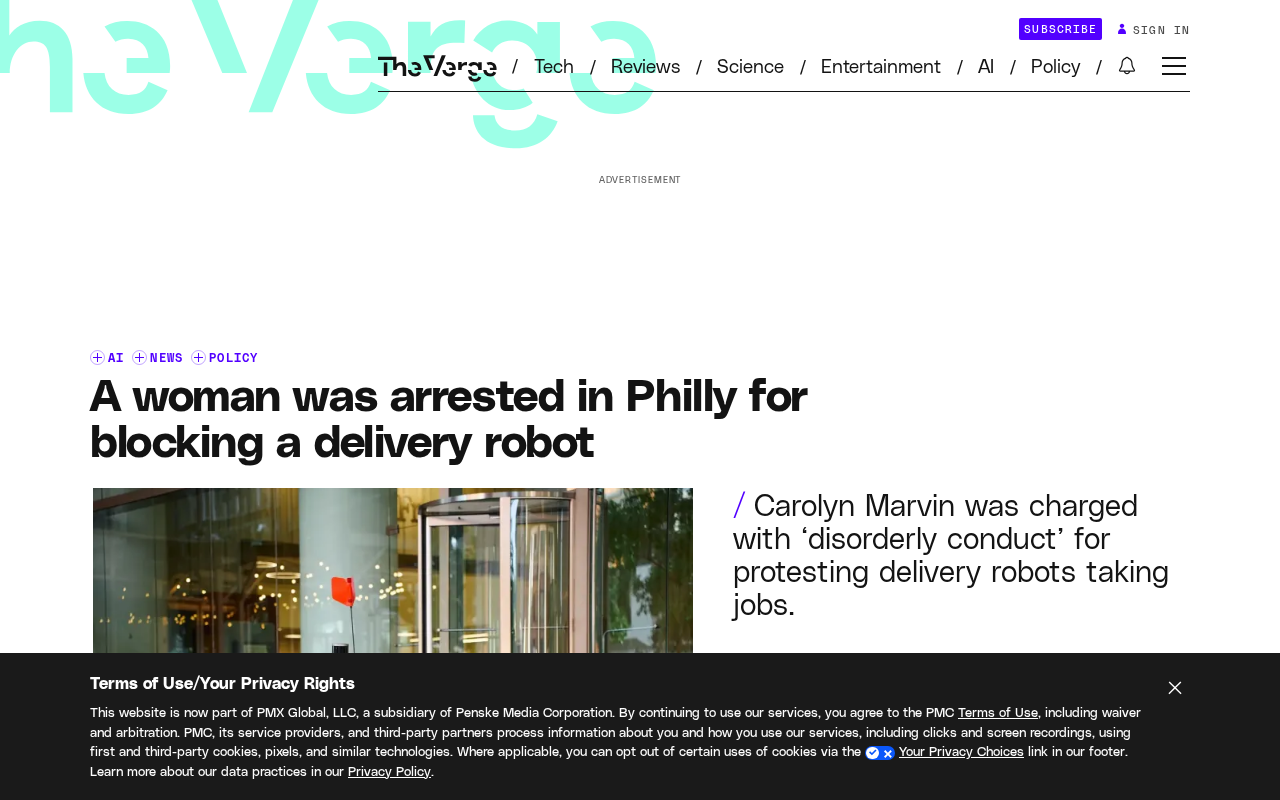
This is not an isolated case. As automated delivery robots become increasingly common on city streets, similar human-machine standoffs are on the rise. Although Marvin's action was extreme, it reflects an increasingly acute social problem: when machines begin taking over jobs that once belonged to humans, how should those who have been "optimized out" find their place?
The Expansion of Robot Delivery and Its Controversy
In recent years, companies such as Uber have deployed automated delivery robots in multiple cities. These small wheeled devices weave through sidewalks and streets, handling last-mile delivery tasks. Supporters argue that robot delivery can lower labor costs, improve efficiency, and reduce traffic congestion and carbon emissions.
But opposition is equally strong. Critics point out that robot delivery directly threatens the livelihoods of delivery drivers, and that these devices, when traveling on sidewalks, may also cause inconvenience or safety hazards for pedestrians—especially the elderly and people with disabilities. Marvin's protest is a concentrated eruption of this sentiment.
Last-mile delivery is the segment of the logistics chain from the distribution center to the end user's hands. It usually covers the shortest distance but carries the highest cost, accounting for more than 50% of total delivery costs. Traditionally it relies heavily on manual labor, and automated delivery robots are precisely the solution designed for this segment. Such robots typically weigh about 20–50 kg, have a top speed of about 6–10 km/h, are equipped with cameras, radar, and GPS, and can navigate autonomously on sidewalks and low-speed roads. Multiple U.S. states have passed legislation permitting such devices on roads, but regulations on weight, speed, and right-of-way vary from state to state, creating a fragmented regulatory landscape.
The Gray Zone of Law and Ethics
Marvin was charged with disorderly conduct, but her action has sparked broader discussion: do citizens have the right to engage in peaceful protest by blocking robots and similar means? Current law has no clear answer. On the one hand, deliberately obstructing automated equipment may be seen as disrupting public order; on the other hand, this is a non-violent act of expression, and whether it should be protected by freedom of speech is disputed.
The deeper question is: when technological progress conflicts with individual livelihoods, how should society balance efficiency and fairness? Should robot delivery companies bear more responsibility—for example, by providing retraining for affected workers?
Disorderly conduct is a broad misdemeanor category in U.S. law, typically referring to behavior in public places that may incite violence or disrupt order, including obstructing traffic, creating disturbances, and inappropriate noise. Definitions vary considerably by state, and law enforcement discretion is broad. In scenarios involving automated equipment, existing laws do not specifically address whether "blocking a robot" constitutes disorderly conduct, and enforcers often invoke general provisions. This means the same behavior may face vastly different treatment in different jurisdictions, and protesters find it difficult to predict the legal consequences of their actions.
Freedom of speech and symbolic protest are among the core rights protected by the First Amendment of the U.S. Constitution. Historically, non-violent obstruction such as sit-ins and blocking entrances has been recognized by courts as protected expression, provided it does not constitute a substantial infringement on the rights of others. But when applying this principle to blocking automated delivery robots, the controversy is: robots are not human—does blocking one constitute "expression"? Does obstructing a company's equipment operation exceed the boundaries of free speech? No precedent directly addresses this question, and legal uncertainty is precisely why such incidents repeatedly spark debate.
Conclusion: The Challenge of Human-Machine Coexistence
Carolyn Marvin's arrest is a symbolic event. It reminds us that technological progress is never neutral. Behind the convenience brought by delivery robots are real anxieties about people's livelihoods. If tech companies and society cannot properly address these anxieties, similar human-machine conflicts will only increase. Perhaps the real solution is not to arrest protesters, but to establish a fairer transition mechanism—one that lets the dividends of technology benefit everyone, not just a handful of shareholders.
One-line Summary
A Philadelphia woman was arrested for blocking an Uber delivery robot, reflecting the deep tension between technological progress and employment fairness.
Paragraph Summary
Carolyn Marvin, a Philadelphia woman, was arrested and charged with disorderly conduct for deliberately standing in the path of an Uber automated delivery robot. She stated candidly that the act was a protest against robots replacing human delivery workers. This is not an isolated case: as automated delivery robots become more widespread in cities, similar human-machine standoffs are increasing. Supporters argue robot delivery lowers costs and improves efficiency, while critics worry about job displacement and public safety. The law has no clear definition of protest actions that block automated devices, raising questions about the balance between free speech and public order. Behind the incident lies a deeper conflict between technological progress and social fairness, and the article calls for a fairer transition mechanism.
Related articles

Amphibious Transforming Drone: Beyond 100x Power Savings, What Are the Real Needs?
Is the amphibious transforming drone just a gimmick? Starting from the 100x power difference of the M4 Morphobot, explore real application scenarios and thesis topic ideas, analyzing boundary conditions where pure drones and pure ground robots both fail.

Warhound Raises $200 Million: Genetically Engineered "War Dogs" Paired with Anduril Gear
Warhound raises $200M, backed by Ben Lamm and Palmer Luckey, to genetically engineer dogs for military and law enforcement use and equip them with Anduril gear. This article analyzes its technology direction, funding logic, and ethical controversy.

Claude API Comes to Google Cloud: IAM Integration and SDK Access Guide
Anthropic hosts the full Claude API on Google Cloud with IAM-controlled permissions and unified billing. This guide covers the Vertex AI and Anthropic-hosted entry points, IAM role configuration, and SDK access.