opencode-mystatus: Check All AI Platform Subscription Quotas with a Single Command

opencode-mystatus: Check quotas across multiple AI platforms with one command
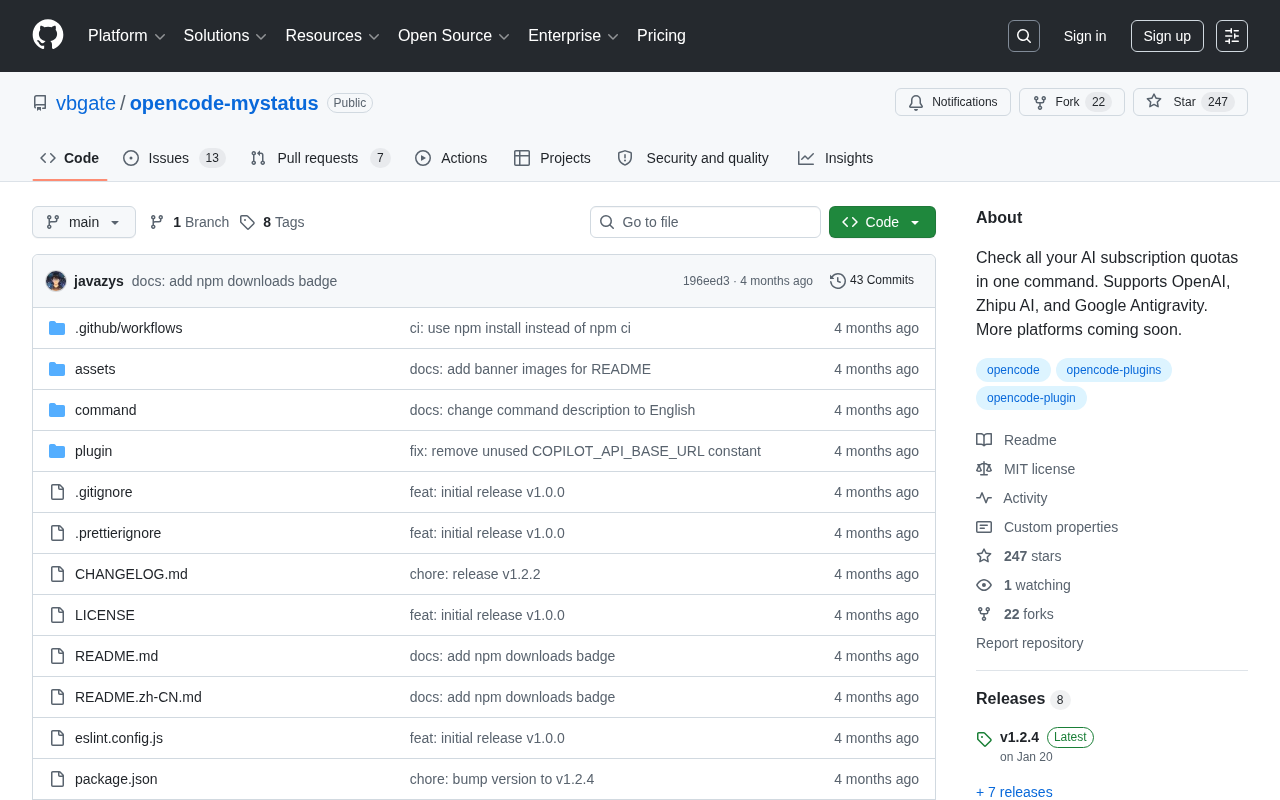
opencode-mystatus is an open-source CLI tool built with TypeScript that lets you view subscription quota status across OpenAI, Zhipu AI, Google, and other AI platforms with a single command. It eliminates the pain of switching between multiple platform consoles to check usage, and is ideal for individual cost control, team usage monitoring, and CI/CD pipeline integration. With 247 GitHub stars already, more platform support is actively under development.
Why You Need Unified AI Quota Management
As AI services become increasingly widespread, more and more developers find themselves juggling multiple AI platforms simultaneously — OpenAI, Zhipu AI, Google, and others. Managing subscription quotas across these platforms has become a real headache: each platform has its own console, its own API, and its own billing model. Switching back and forth wastes time and makes it easy to miss important details.
This challenge has deep roots in the industry landscape. As large language model (LLM) commercialization accelerates, API quota management has become a critical part of developers' daily operations. Major AI platforms generally adopt token-based billing — OpenAI charges per thousand tokens, while Zhipu AI measures usage by both API calls and tokens. Quota systems vary significantly across platforms: some reset monthly, some deduct from a prepaid balance, and others distinguish between free-tier and paid-tier rate limits. For teams integrating multiple platforms, manually managing these heterogeneous quota systems is not only time-consuming but also carries the risk of service degradation in production when quotas are unexpectedly exhausted.
opencode-mystatus is an open-source tool built specifically to solve this pain point. With a single command, you can view subscription quota usage across all your AI platforms simultaneously. It currently supports OpenAI, Zhipu AI, and Google Antigravity, with more platforms being added.
Core Features of opencode-mystatus
Unified Quota Query
For developers using multiple AI services, the biggest hassle is having to log into each platform's console separately to check usage. opencode-mystatus aggregates all this information into a single command-line interface — one execution shows you the quota status across all platforms, instantly doubling your management efficiency.
Supported AI Platforms
Currently supported platforms include:
- OpenAI: View API call quotas and account balances for models like GPT-4 and GPT-3.5
- Zhipu AI: Quota queries for one of China's leading LLM platforms
- Google Antigravity: Usage monitoring for Google AI services
The project maintainers have indicated that more platform support is coming soon, potentially covering major AI service providers like Anthropic, Mistral, and Cohere.
Tech Stack and Extensibility
The project is built with TypeScript, offering the following advantages:
- Type safety ensures code quality
- Cross-platform compatibility, running in any Node.js environment
- Clean architecture that makes it easy for community contributors to add new platform support
TypeScript is a superset of JavaScript developed by Microsoft that catches potential errors at compile time through its static type system. In CLI tool development, strong typing makes data structure definitions for multi-platform API responses much clearer, and IDE autocompletion significantly lowers the barrier to entry for community contributors. Whether running via ts-node or compiled to CommonJS modules, the tool works in any environment with Node.js (v14+) installed. This is also why mainstream CLI tools like Vercel CLI and AWS CDK commonly choose TypeScript — opencode-mystatus's technology choice lays a solid foundation for future community collaboration.
Typical Use Cases
Personal Developers Controlling API Costs
For individual developers, controlling AI API expenses is crucial. With opencode-mystatus, you can quickly check remaining balances across platforms, avoid service interruptions caused by exhausted quotas, and plan budget allocation more effectively.
Usage Monitoring for Shared Team API Keys
In team environments, multiple members often share the same set of API keys. A unified quota monitoring tool helps team leads spot abnormal usage in time, prevent overspending, and provide data-driven insights for cost optimization.
CI/CD Pipeline Integration
As a command-line tool, opencode-mystatus is naturally suited for integration into automated workflows. You can automatically check whether quotas are sufficient before deployment, or set up scheduled monitoring alerts to ensure production services aren't interrupted by insufficient credits.
CI/CD (Continuous Integration/Continuous Delivery) pipelines are core infrastructure in modern software engineering. Integrating AI quota checks into them typically follows two patterns: first, setting up a pre-deployment gate during the release stage that blocks deployment when quotas fall below a threshold, preventing post-launch failures due to exhausted credits; second, using cron jobs to trigger monitoring scripts that push quota data to alerting channels like Slack or PagerDuty. opencode-mystatus's exit code mechanism naturally fits both patterns — non-zero exit codes can directly trigger pipeline failure logic in GitHub Actions or Jenkins without any additional integration work, enabling truly zero-cost adoption.
Project Activity and Community Feedback
The project has already earned 247 stars and 22 forks on GitHub. While still in its early stages, the growth momentum is promising. This signals genuine demand in the developer community for unified AI quota management tools — after all, nobody wants to open five or six web pages every day just to check balances.
From a market perspective, AI quota aggregation management is a niche segment that's rapidly taking shape. Several types of solutions currently exist: commercial AI gateway products (such as Portkey and LiteLLM) provide a unified API proxy layer that records usage while routing requests; cloud provider cost management tools can track expenses for hosted models; and lightweight open-source CLI tools like opencode-mystatus focus specifically on "read-only query" scenarios, requiring no additional proxy nodes in the request chain and zero intrusion into existing architecture. This differentiated positioning gives it unique appeal among individual developers and small teams, and 247 GitHub stars at this early stage is already a solid market validation signal.
Future Direction
As the AI services ecosystem continues to expand, aggregation management tools like this will become increasingly important. If opencode-mystatus can continue expanding platform support, adding visual reporting, and enabling alert notifications, it has the potential to become a standard component in every AI developer's toolchain.
For developers currently using multiple AI platforms, this project is worth keeping an eye on. Grasping your complete quota status across all platforms with a single command — that kind of simple, efficient experience is exactly what a great tool should deliver.
Key Takeaways
- opencode-mystatus lets you check AI subscription quotas across OpenAI, Zhipu AI, Google, and more with a single command
- Built with TypeScript, offering excellent cross-platform compatibility and extensibility
- Ideal for individual developer cost control, team quota monitoring, and CI/CD automation integration
- With 247 stars already earned, the project reflects genuine market demand for unified AI quota management
- More AI platform support is under active development, aiming to cover an even broader AI services ecosystem
Related articles
 Product Reviews
The Programmer's Desk Setup Guide: Building a Workspace That Feels Like Home
Discover how programmers build productive, comfortable workspaces. From multi-monitor setups to ergonomic design, explore the desk philosophy that drives focus and flow.
 Product Reviews
Qoder vs Cursor Real-World Comparison: Which $20/Month AI IDE Is Better?
Hands-on comparison of Qoder vs Cursor AI IDEs: Agent autonomy, human interaction count, and architecture decisions. Qoder needed only 2 interactions vs Cursor's 8.
 Product Reviews
Cursor Cloud Agent Demo: Eliminating Bottlenecks Across the Entire Software Development Lifecycle
Deep analysis of Cursor's Cloud Agent demo showing how cloud VMs, automated test artifacts, and a full-chain control plane systematically eliminate human bottlenecks across the software development lifecycle.