OpenCode Quota: Zero-Pollution Monitoring for Multi-Platform AI Coding Tool Quota Usage

OpenCode Quota: Zero-pollution open-source solution for multi-platform AI coding tool quota monitoring
OpenCode Quota is an open-source tool that monitors quota and token usage across 9 major AI coding platforms—including Cursor, GitHub Copilot, and OpenAI—without polluting the context window. Built with TypeScript and already earning 490 GitHub stars, it helps developers achieve multi-platform usage visualization and cost control, representing the emerging industry trend of AI tool observability.
Project Overview
In today's flourishing landscape of AI coding tools, developers often use multiple AI coding assistants simultaneously—Cursor, GitHub Copilot, OpenCode Go, and more. But a common pain point persists: How can you efficiently monitor quota and token usage across these tools without compromising the quality of your context window?
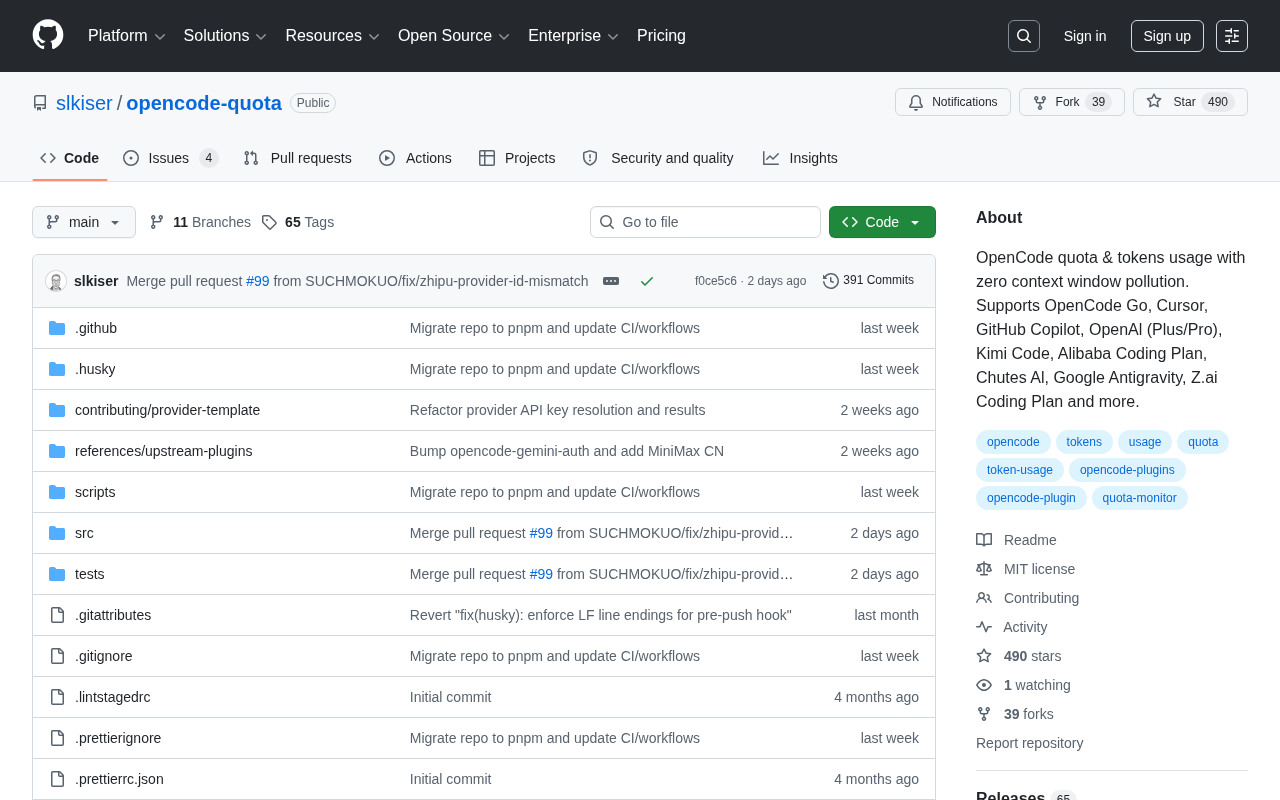
OpenCode Quota (GitHub: slkiser/opencode-quota) is an open-source tool built to solve exactly this problem. It tracks and displays quota and token consumption across multiple AI coding tools with zero context window pollution.
Core Features Breakdown
Zero Context Window Pollution Design
This is OpenCode Quota's most distinctive design philosophy. To understand its value, you first need to grasp the nature of context windows and tokens: a Context Window is the maximum text length a large language model can "see" during a single inference pass, measured in tokens. Tokens aren't simply equivalent to characters or words—in English, one token corresponds to roughly 4 characters; in Chinese, one character typically maps to 1-2 tokens. Context windows for mainstream AI coding models range from 32K to 200K tokens—for example, Claude 3.5 Sonnet supports 200K tokens, while GPT-4o supports 128K tokens.
Traditional usage monitoring solutions often require injecting additional system prompts or tracking code into conversations, which consumes precious context window space. When this "noise" crowds the window, the effective space available for the model to understand code logic is compressed accordingly, directly impacting code completion accuracy and long-file processing capabilities. OpenCode Quota employs a non-invasive monitoring architecture, ensuring the tracking process never affects the quality of interaction between you and your AI assistant.
For developers who heavily rely on AI coding, every token in the context window is precious. Zero-pollution design means you can confidently enable monitoring without worrying about degraded model performance.
Support for 9 Major AI Coding Platforms
OpenCode Quota covers an impressively wide range of AI coding tools:
- OpenCode Go - Core supported platform
- Cursor - Currently the hottest AI IDE
- GitHub Copilot - Microsoft/GitHub's AI coding assistant
- OpenAI (Plus/Pro) - ChatGPT paid versions
- Kimi Code - Moonshot AI's coding tool
- Alibaba Coding Plan - Alibaba's AI coding solution
- Chutes AI - AI inference platform
- Google Antigravity - Google's AI coding tool
- Z.ai Coding Plan - Z.ai coding solution
This unified multi-platform monitoring capability eliminates the need for developers to switch between different tools to check usage—a single dashboard gives you the full picture.
Technical Implementation and Community Activity
The project is built with TypeScript. TypeScript is a JavaScript superset developed by Microsoft that catches potential errors at compile time through its static type system—in the developer tools space, mainstream tools like VS Code, ESLint, and Prettier are all built with TypeScript. For a tool like OpenCode Quota that needs to interface with multiple APIs and handle complex data structures, TypeScript's type safety effectively prevents runtime crashes caused by API response format changes, while naturally being compatible with the Node.js ecosystem for seamless operation on macOS, Windows, and Linux.
Looking at GitHub metrics, the project has earned 490 stars and 39 forks, with community activity growing rapidly—evidence that AI coding tool quota monitoring truly addresses a developer pain point.
Use Case Analysis
Cost Control for Individual Developers
For individual developers subscribed to multiple AI coding services, OpenCode Quota helps you:
- Monitor remaining quota across platforms in real time
- Avoid discovering depleted allowances at critical moments
- Optimize subscription combinations based on usage data, reducing unnecessary expenses
Team-Level Resource Management
In team environments, AI coding tool costs can escalate quickly. Through unified usage monitoring, team leads can better allocate resources, establish usage policies, and maximize the value of AI-assisted programming within budget constraints.
AI Coding Tool Observability: An Emerging Industry Trend
As AI coding tools transition from the "experimentation" phase to the "productivity tool" phase, the ecosystem surrounding these tools is maturing rapidly. OpenCode Quota represents an important trend: AI Tool Observability.
This concept derives from the mature APM (Application Performance Monitoring) frameworks in traditional software engineering—tools like Datadog and New Relic help engineers understand internal system states through three pillars: Logs, Metrics, and Traces. Migrating this philosophy to the AI tools domain means developers need to know not just "how much quota AI consumed," but also understand deeper questions like "which types of tasks consume the most tokens" and "which platform offers the best cost-performance ratio." OpenCode Quota currently focuses on the Metrics layer of quota and token usage, serving as a crucial starting point for the AI tool observability ecosystem. In the future, we'll likely see more similar tools emerge, covering multiple dimensions including usage tracking, quality assessment, and cost optimization.
Summary
OpenCode Quota fills an important gap in the AI coding tool ecosystem. Its zero-pollution design philosophy and broad platform support make it an ideal choice for developers using multiple AI coding tools simultaneously. If you're struggling to manage usage across multiple AI coding subscriptions, this open-source project is worth trying.
Project URL: github.com/slkiser/opencode-quota
Key Takeaways
- OpenCode Quota achieves zero context window pollution for AI coding tool usage monitoring
- Supports 10+ mainstream AI coding platforms including Cursor, GitHub Copilot, OpenAI, and Kimi Code
- Built with TypeScript, the project has earned 490 stars with rapidly growing community activity
- Solves quota management and cost control pain points for multi-AI-tool users
- Represents the emerging industry trend of AI Tool Observability
Related articles
 Product Reviews
The Programmer's Desk Setup Guide: Building a Workspace That Feels Like Home
Discover how programmers build productive, comfortable workspaces. From multi-monitor setups to ergonomic design, explore the desk philosophy that drives focus and flow.
 Product Reviews
Qoder vs Cursor Real-World Comparison: Which $20/Month AI IDE Is Better?
Hands-on comparison of Qoder vs Cursor AI IDEs: Agent autonomy, human interaction count, and architecture decisions. Qoder needed only 2 interactions vs Cursor's 8.
 Product Reviews
Cursor Cloud Agent Demo: Eliminating Bottlenecks Across the Entire Software Development Lifecycle
Deep analysis of Cursor's Cloud Agent demo showing how cloud VMs, automated test artifacts, and a full-chain control plane systematically eliminate human bottlenecks across the software development lifecycle.