OpenController: A Unified Control Plane for Governing All AI Agents

OpenController by Lyzr is a unified control plane for governing enterprise AI Agents via inline policy enforcement.
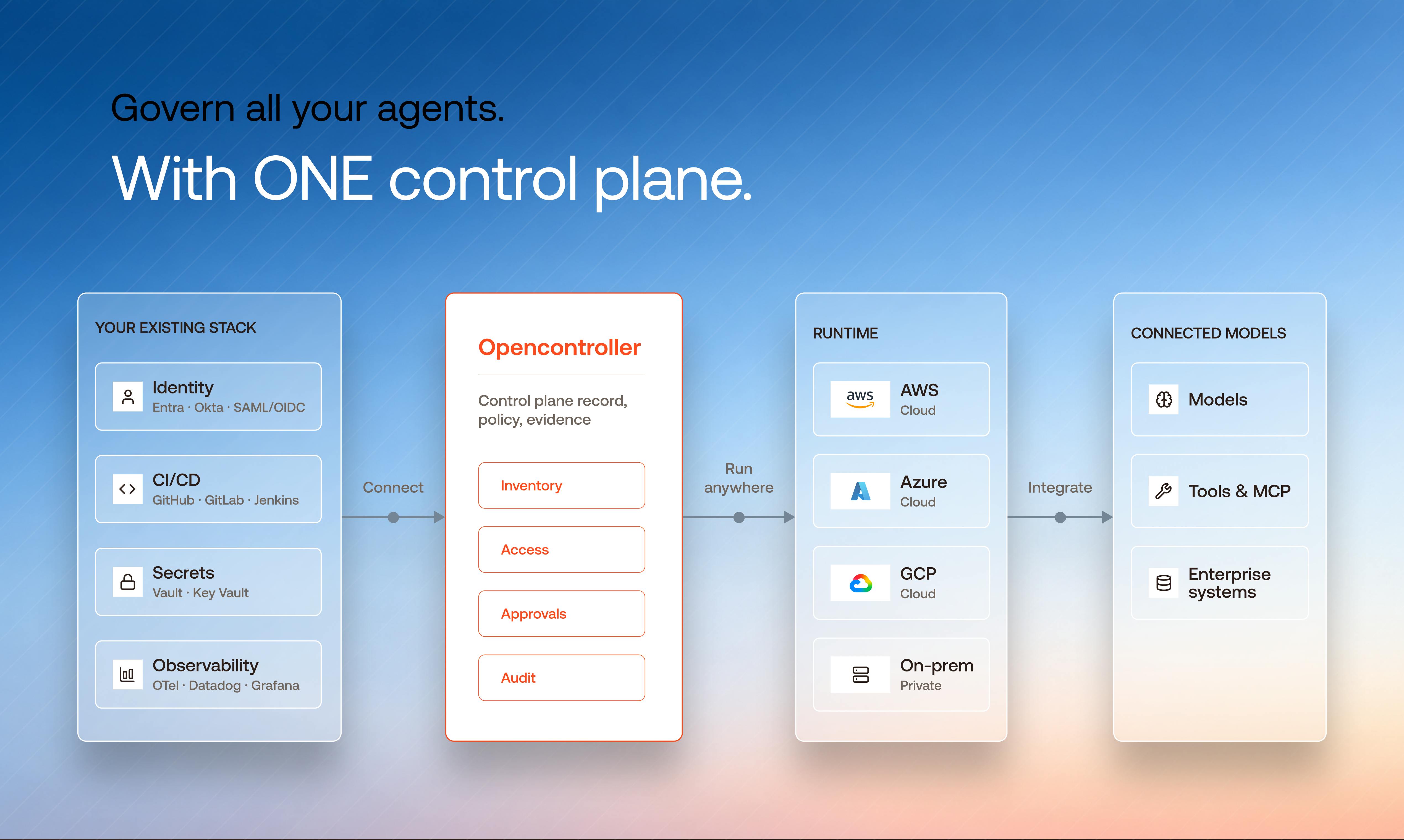
As AI Agents proliferate across enterprises with no unified oversight, Lyzr launched OpenController — an Agent governance platform positioned as a true control plane, not just a registry. It auto-discovers Agents across cloud, SaaS, Kubernetes, and edge environments, covering the full lifecycle from pre-deployment evaluation to runtime monitoring. Its standout differentiator: OpenController deploys in your own cluster with your own keys and enforces policies inline — blocking non-compliant calls directly in the request path rather than auditing after the fact. This upgrades governance from passive logging to active control, filling the gap where traditional IT tools lack Agent semantics and AI platforms lack enterprise-grade management.
When AI Agents Start Spiraling Out of Control
Enterprise AI adoption is running into a new problem: the number of AI Agents is growing out of control. They're scattered across cloud platforms, SaaS tools, Kubernetes clusters, and even edge devices — yet there's no shared governance layer to manage them all. OpenController, built by the Lyzr team, takes direct aim at this "Agent sprawl" problem.
The product launched on Product Hunt, earning 91 upvotes and landing at #11 for the day, categorized under Software Engineering and Artificial Intelligence. Its core positioning is straightforward — a unified control plane for governing all AI Agents, models, and workflows across an organization.
More Than Just a "Registry"
Plenty of tools already claim to manage Agents, but most stop at the "registry" level — simply listing what Agents you have, like a glorified inventory sheet. OpenController explicitly sets itself apart from that category.
Its feature set spans several critical stages of the Agent lifecycle:
- Discover: Automatically surfaces every Agent, model, and workflow in your environment, solving the visibility problem of "not knowing how many Agents are actually running."
- Ship safely: Introduces evaluation and governance mechanisms before deployment, ensuring Agents go through proper checks before going live.
- Monitor: Provides real-time observability into Agents as they run.
- Turn signals into action: Converts usage signals and telemetry data into actionable responses.
The significance of this combination is that it doesn't passively record — it actively intervenes across the full lifecycle from deployment to runtime.
The Key Differentiator: Actually "Blocking" in the Request Path
Two technical characteristics of OpenController stand out most.
First, it deploys inside your own cluster and runs under your own keys. This means data and control always remain within the enterprise, rather than being hosted on a third-party platform. For organizations with compliance and data sovereignty requirements, this is a meaningful advantage.
Second — and more substantively — when a policy says "deny," OpenController rejects the call directly in the request path. This is fundamentally different from solutions that only do after-the-fact auditing or out-of-band monitoring. This is inline enforcement, not retroactive review. Policies become guardrails that can stop an Agent from making a non-compliant action before it ever happens.
This ability to "say no in the path" is the dividing line between governance that merely records and governance that actually controls.
The concept of "inline enforcement" comes from the network security world, where its counterpart is "out-of-band monitoring." Out-of-band monitoring copies traffic to a monitoring system while the original request continues unimpeded — it can only detect problems after the fact, not prevent violations from occurring. Inline deployment inserts a control node directly into the actual request path. Every call must pass through the control plane's inspection; any request that fails a policy check is dropped or returns an error before it ever reaches the target model or tool. This architecture is already widely used in API gateways (such as Kong and NGINX) and service meshes (such as Istio). The tradeoff is added network latency; the benefit is genuine real-time blocking. OpenController ports this proven pattern into the AI Agent call context, meaning policy compliance is no longer dependent on developer self-discipline — it's enforced at the infrastructure layer.
Why This Category Is Timely
As enterprise AI Agent deployments scale up, questions like "who is calling which model," "which Agent accessed sensitive data," and "does this workflow comply with internal policy" are becoming increasingly urgent. Traditional IT governance tools don't understand Agent semantics, while most AI platforms lack enterprise-grade control capabilities.
OpenController is targeting exactly that gap — taking the mature "control plane" concept from the cloud-native era and applying it to AI Agent governance. Similar to how Kubernetes provides a unified control layer for container orchestration, OpenController aims to become that foundational infrastructure layer for the Agent world.
The separation of "control plane" and "data plane" is a core design philosophy of cloud-native architecture. The data plane handles actual traffic forwarding and business execution; the control plane centrally manages policy, configuration, and state. Kubernetes itself is the canonical example: kubelet executes concrete container operations on nodes (data plane), while the API Server, Scheduler, and Controller Manager form the centralized control plane that pushes intent and policy. The service mesh Istio follows the same pattern — Envoy proxies are distributed alongside each Pod (data plane), while Istiod centrally manages certificates, traffic rules, and telemetry configuration (control plane). Bringing this paradigm to AI Agent governance is a logical extension: Agents and workflows are the new "execution units," and they equally need an independent control plane to manage their lifecycle, access permissions, and behavioral policies — rather than letting each Agent operate in isolation.
Takeaway
OpenController represents a pragmatic direction for AI Agent governance: moving from passive inventory management to active, inline policy enforcement. Its emphasis on self-hosted deployment, self-controlled keys, and real-time interception in the request path all point toward serious enterprise use cases.
As a product that just debuted on Product Hunt, its market validation is still early-stage (91 votes, 2 comments). Whether it can truly become the standard governance layer for Agents remains to be proven by real-world deployments. But the problem it raises — Agents are proliferating while the governance layer is absent — is one that no organization scaling AI usage can afford to ignore.
Related articles

Chain of Thought Isn't Just for AI: How Humans Can Use CoT to Improve Thinking Quality
Chain of Thought isn't just a prompt trick for large models. Starting from a Hacker News discussion, this article analyzes why CoT works for human thinking too, breaks down actionable ways to transfer it, and highlights the key differences between human CoT and machine CoT.
Cloudflare Teams Up with OpenAI: Closi…
Cloudflare Teams Up with OpenAI: Closing the Loop from Vulnerability Discovery to Defense with AI
Cloudflare uses OpenAI Daybreak to investigate security vulnerabilities and generate reviewable remediation plans, while developers use Codex to boost coding efficiency and quality.

Orca Multi-Agent Orchestration in Practice: A Guide to Parallel Collaboration with Claude and Codex
Orca is Stable AI's free open-source agent workbench supporting 34 agents like Claude Code and Codex in parallel. Learn its Git worktree isolation, multi-model orchestration, and mobile management.