OpenDocRouter Launches: A Unified API Aggregating 130+ Document Parsing Models
OpenDocRouter unifies 130+ document parsing models under one API with at-cost pricing and planned smart routing.
The document parsing space is overwhelmed by model proliferation. OpenDocRouter addresses this with a unified API that aggregates frontier and open-weight models under one interface, outputting standardized Markdown while handling prompt tuning, rate limits, and deployment. Its at-cost pricing model lowers the barrier for multi-model comparison, while bounding box and layout services add spatial grounding to any model's output. A "evaluate-then-onboard" loop with ParseBench enables continuous updates, and a planned automated routing feature aims to intelligently dispatch requests by document type, accuracy, and cost.
One API to Solve the Document Parsing Model Selection Problem
Document parsing is in the middle of a model explosion. As vision-language models (VLMs) and OCR models continue to improve, developers have more tools to choose from than ever — but that abundance comes with its own pain point: faced with a sea of models, which one should you actually use?
OpenDocRouter was built to answer exactly that question. It positions itself as a "unified document parsing API" that integrates the latest frontier models and open-weight models in one shot, consolidating what was previously a fragmented landscape of parsing capabilities under a single interface.
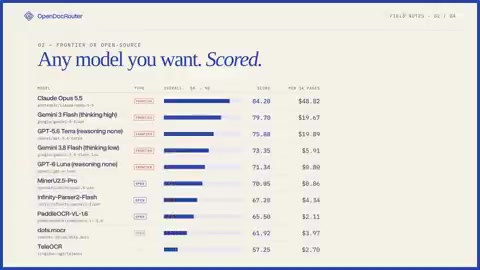
According to data shared by the team, their companion benchmarking platform ParseBench already indexes 130+ models, and searching "ocr" on HuggingFace returns thousands of results. More models is a good thing — and also a burden.

Why Model Selection Is So Painful
For teams that need to process documents at scale, choosing among the many OCR vendors and models is an enormously time-consuming engineering exercise. The OpenDocRouter team directly calls out several core pain points:
- Prompt tuning: Different models require different prompts to perform at their best;
- Rate limits: Each provider's API throttling policy differs, making it easy to get stuck during batch processing;
- Deployment and integration: Open-source models require self-managed deployment; commercial models each have their own SDKs to integrate;
- Continuous benchmarking: New models keep emerging, forcing teams to benchmark constantly just to stay current.
All of this is fundamentally "non-business" infrastructure overhead. For a team that wants to focus on product logic, it's the classic reinventing-the-wheel tax.
OpenDocRouter's Approach
OpenDocRouter consolidates these problems into a transparent model collection covering the price-performance frontier. Its core capabilities can be summarized as follows:
A Unified Transcription Interface
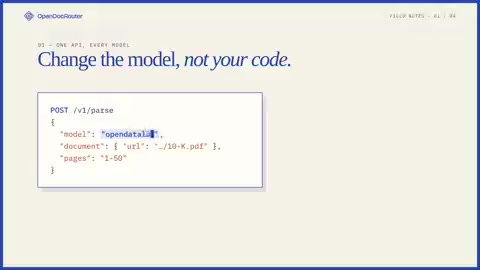
Regardless of whether the underlying model is a frontier commercial model or an open-weight model, OpenDocRouter transcribes documents into Markdown through a single unified API. Developers don't need to know which model is being called under the hood — the interface stays consistent.
Transcribing documents to Markdown is the dominant output paradigm in today's document parsing field. Compared to plain text, Markdown preserves structural information like heading hierarchies, tables, and lists; compared to HTML, it's lightweight enough to be consumed directly by downstream RAG (retrieval-augmented generation) or LLM summarization pipelines. Markdown output quality varies significantly across models: some render tables in pipe format while others degrade to line-by-line text; some correctly handle multi-column layouts while others interleave two columns row by row. The value of a unified interface lies not just in consistent call signatures, but in shielding downstream applications from these fragmented output format differences — so they don't need to write format-fixing logic for every individual model.
"At-Cost" Pricing
One notable commercial design choice: OpenDocRouter provides access to all frontier and open-weight models at cost, taking only a small fee per transaction. This pricing structure lowers the barrier to "bundled trial" access across multiple models — developers don't need to open separate accounts with multiple providers or commit to individual minimum spends just to run a comparison.
Unified Rate Limit Management
The platform handles rate limiting across all models on behalf of users, claiming support for large-scale, high-throughput document processing workloads. For scenarios requiring batch processing of tens of thousands or even millions of documents, this often matters more than any single model's accuracy.
Bounding Boxes and Layout as a Service
OpenDocRouter also offers bounding boxes and layout analysis as standalone services. This means that even if a particular model doesn't natively output positional information, you can use this capability to add "grounding" to its results — mapping parsed output back to spatial positions in the original document. This is especially useful for traceable, locatable scenarios like compliance auditing or table extraction.
A bounding box in document parsing refers to the pixel-coordinate rectangle around each text region, chart, or table cell on a page — typically expressed as
(x1, y1, x2, y2)or normalized proportional coordinates. Many end-to-end VLM-based parsing models output only text sequences without positional information, which becomes a serious obstacle whenever "source localization" is needed — for example, compliance audits that need to flag which page and line contains a sensitive clause, or RPA bots that need field coordinates to drive UI interactions. Layout analysis goes further, segmenting a page into semantic regions such as headings, body text, captions, and headers/footers — a prerequisite step for parsing multi-column PDFs, academic papers, or financial reports. Offering these two capabilities as independent services means they can be orthogonally combined with any text recognition model, compensating for the spatial awareness limitations of pure VLM approaches.
ParseBench and the Continuous Update Mechanism
OpenDocRouter and the ParseBench evaluation platform operate as a linked system: whenever a new OCR candidate model is released, the team first runs it through ParseBench for baseline testing, then immediately adds it to OpenDocRouter.
This "evaluate-then-onboard" workflow attempts to address the "continuous benchmarking" pain point mentioned earlier — outsourcing the work of tracking the frontier and validating quality to the platform, so users simply trust the benchmark results and call the API directly. The team has also stated they are rapidly expanding the model library while simultaneously developing additional features.
Automated Routing: The Exciting Road Ahead
Among the announced upcoming features, automated routing is the most anticipated direction. As the name implies, it would automatically dispatch requests to the most suitable model on the price-performance frontier based on document type, accuracy requirements, and cost budget.
If this feature ships, OpenDocRouter's role would evolve from a "unified interface" to an "intelligent dispatch layer" — analogous to how OpenRouter relates to large language models. For the highly fragmented document parsing space, a middleware layer that can automatically make optimal choices genuinely addresses real engineering friction.
The price-performance frontier is a concept borrowed from the Pareto frontier in economics: among all available models, no other model simultaneously offers lower price and higher performance — the models on the frontier represent the current optimal trade-off set. The core engineering challenge for automated routing is that the best model varies by document type (scanned images, native PDFs, handwriting, table-heavy financial reports), and shifts dynamically as new models are released. In the LLM routing space, projects like RouteLLM and Martian have already explored this territory; their core approach is to train a lightweight classifier that predicts task difficulty and type before inference, then maps that to a model selection strategy. The additional challenge for document parsing routing is that inputs are images rather than text, making feature extraction more expensive. Whether routing judgment can be completed without significantly increasing end-to-end latency is the key technical threshold for this feature to become truly practical.
Summary
The core value of OpenDocRouter lies not in any single model breakthrough, but in infrastructure-level integration: packaging up the tedious yet necessary work of model selection, prompt engineering, rate limiting, deployment, and continuous benchmarking into a unified layer, freeing developers to focus on their actual business logic.
As the number of VLM and OCR models continues to grow, the emergence of "aggregation + routing" products like this is almost inevitable. Whether it succeeds ultimately comes down to the credibility of its benchmarks, the transparency of its pricing, and the real-world effectiveness of its automated routing. Interested developers can follow the team's official blog and product page and share feedback directly with the team.
Related articles

Receipt Forgery Detection Near Random? Real-World Struggles and Solutions in Document Image Forensics
A receipt forgery detection project with ROC-AUC near random reveals the pitfalls of small-sample document forensics. Explores anomaly detection, self-supervised pre-training, and numerical consistency as viable alternatives.

From Workflows to Eval-Driven Development: A Paradigm Shift in How We Solve Problems with AI
AI problem-solving is shifting from deterministic workflows to "define evals + hillclimb." This piece explores how eval-driven development reshapes tasks, data vendors, human roles, and Agent UX.

Tesla Powerwall + Electric Vehicle: A Dual Backup Power Solution for Outages
Tesla Powerwall combined with EV bidirectional charging can provide multi-layer home backup power during outages. We break down runtime, V2H realities, and Supercharger loop feasibility.