OpenHands Drops 11 Versions in Two Months — Three Upgrades Actually Worth Your Time

OpenHands shipped 11 versions in two months across three major upgrade threads: automation, Agent Profiles, and deployment.
OpenHands quietly released 11 versions from V1.12.0 to V1.23.0 over roughly two months — 318 commits, 300 changed files, and over 15,000 lines added. The updates run along three threads: automation evolved from one-off scripts into a full platform with GitSync, scheduling, and team governance; Agent Profiles gained secret key selection and MCP server scope controls; and deployment became dramatically simpler with a Linux installer, Docker workspace, and universal macOS DMG. Architecturally, Agent Canvas now unifies five backend types via ACP, supporting Claude Code, Codex, and Gemini. For users still on V1.12, this is a workflow-architecture migration, not a routine point release.
11 Versions in Two Months — The Feature Boundaries Have Shifted
The update cadence in the AI coding assistant space is relentless, but different players have taken very different approaches. As summarized by Bilibili creator 大叔大, while Hermes pushes high-frequency daily updates and OpenCloud sticks to a weekly rhythm, OpenHands took a different path — quietly building for two months before dropping 11 versions all at once.
The problem? Many users are still running V1.12 as their stable build. But over the past several months, OpenHands' feature boundaries have shifted considerably: local, Docker, and cloud backends have all been unified into a single canvas. In other words, anyone still on V1.12 is missing what amounts to an architecture-level upgrade.
From V1.12.0 to V1.23.0, the span covers roughly a month and a half — 318 merged commits, 300 changed files, 15,349 lines added, and 1,616 lines removed. The numbers look sprawling, but the storyline has exactly three threads: automation platformization, Agent Profile systematization, and deployment experience polish.
Three Phases Across 11 Versions
Slice those 11 versions into three phases and the trajectory becomes clear.
Phase 1 — Framework Solidification (V1.13.0 to V1.15.0) accomplished three things: client-side conversation archiving, real-time Markdown preview with a document index, and the initial GitSync page. GitSync's job is to sync repository changes into the workflow — the foundation everything else is built on.
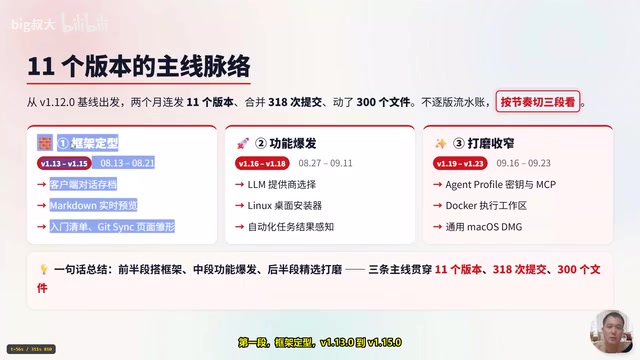
Phase 2 — Feature Explosion (V1.16.0 to V1.18.0) introduced LLM provider selection, a Linux desktop installer, and result-awareness for automated tasks. LLM provider selection means users can switch between model sources directly in settings without touching config files.
Phase 3 — Polish and Consolidation (V1.19.0 to V1.23.0) focused on Agent Profile secrets and MCP capabilities, a Docker execution workspace, and a universal macOS DMG installer. MCP — the standard protocol for letting models call external tools — landing here means Agent extensibility has taken a meaningful step forward.
Build the framework, explode with features, then polish and consolidate — three threads that account for all 11 versions.
The Three Things Actually Worth Doing
Despite the volume of changes, the creator distilled it down to three priorities. Ranked by importance:
P0: Automation System Overhaul
This thread runs through multiple versions: V1.14 introduced the GitSync page, V1.17 added task result awareness, V1.18 restricted enabling automation to creators only, and V1.22 opened it to organization admins. The evolution logic is clear — automation went from one-off scripts to a version-managed, fully governed productivity platform.

Concretely, automation now has five pillars: GitSync version control, scheduled triggers, task result tracking, permission management, and team collaboration. For anyone scaling AI-assisted coding across a team, this is the most impactful upgrade in the entire release.
P1-1: Agent Profile Systematization
Secret key selection and MCP server scope restrictions both landed in V1.19; Cloud LLM round-robin was introduced in V1.17. The core value: different tasks get different configurations without manual environment switching. For developers juggling multiple task types, this significantly reduces configuration overhead.
P1-2: Dramatically Improved Deployment
The Linux desktop installer arrived in V1.16, the Docker execution workspace in V1.21, and the universal macOS DMG in V1.23. One goal across all three: install and run, no environment wrangling required.
Unified Backend and Configuration Details
The most significant architectural change in this update cycle is Agent Canvas's unified management capability. It can manage five backend types — local, Docker, VM, Cloud, and Enterprise — and supports any ACP-compatible Agent, including Claude Code, Codex, and Gemini. ACP serves as the universal interoperability protocol connecting agents from different providers.
LLM provider selection is also available directly in settings, a capability added in V1.16. Qwen, Kimi, Zhipu GLM, DeepSeekAd, and others are all in the list.

Config files typically list providers — OpenAI, Anthropic, DeepSeek, and others — as a Providers array, with the default model set to the GPT series and Agent Profile using the Default configuration. On the model side, three key updates stand out: new model support in V1.19, LLM provider selection in V1.16, and LLM connectivity validation in V1.14 — the latter checks whether your model configuration is working before any actual calls are made.
Installation requires a single command: use the uv tool to install OpenHands pinned to version 1.23.0. Existing users can run a one-line upgrade command to update their installation.
What is ACP? ACP (Agent Communication Protocol) is a universal protocol layer for standardizing how different AI Agents interact — analogous to REST or gRPC in the web services world. It defines standard interfaces for how an Agent receives tasks, returns results, reports status, and communicates with a host platform. Thanks to ACP-compatible design, OpenHands' Agent Canvas doesn't need custom integration logic for each model vendor. Agents from different providers — Claude Code, Codex, Gemini — simply need to follow the ACP spec to be managed under one roof. This "protocol-first" architecture is the underlying reason OpenHands can simultaneously support five backend types and multiple model providers, and is the core extensibility advantage it holds over competing AI coding tools.
Three-Way Agent Comparison
Line up three popular Agents side by side and OpenHands' differentiators become immediately visible.
- Core architecture: OpenHands = Agent Canvas + Agent Server; Hermes = Hermes Protocol + standalone Agent; OpenCloud = OpenCloud + IP character positioning.
- Backend support: OpenHands covers local, Docker, VM, Cloud, and Enterprise; Hermes is primarily local; OpenCloud is local plus sandbox.
- Automation: OpenHands = GitSync + scheduling + full governance; Hermes = basic automation; OpenCloud = skill-triggered automation.
- Model configuration: OpenHands = Agent Profile + MCP scope restrictions; Hermes = model config + learning path; OpenCloud = config file + CLI.
- Update cadence: OpenHands = 11 versions over two months; Hermes = high-frequency daily; OpenCloud = primarily weekly.

Recommendations follow naturally: want unified multi-backend management, go with OpenHands; want the fastest onboarding, go with Hermes; want stronger Chinese-language support, go with OpenCloud. After going through the comparison, it's clear this update carries substantially more weight than the version numbers suggest.
Upgrade Recommendations
To sum up two months of changes: 11 versions, 318 commits, 300 files, 15,349 lines added, 1,616 lines removed, across three main threads — automation platformization, Agent Profile systematization, and deployment experience polish.
Recommendations by user type:
- New users: Install V1.23.0 directly. Use the macOS DMG or Linux installer — ready to run out of the box.
- Existing users: Upgrade to V1.21 or later to unlock the Docker execution workspace.
- Cloud users: Pay attention to the GitSync organization admin collaboration capability introduced in V1.22 — it's built for team scenarios.
For anyone still on V1.12, this isn't a minor release you can skip — it's a migration that touches your workflow architecture.
Background: What is MCP? MCP (Model Context Protocol) is an open-source standardization protocol proposed by Anthropic in late 2024, designed to solve the fragmentation problem in integrating AI models with external tools and data sources. Before MCP, every AI application had to write custom adapter code for file systems, databases, APIs, and other external resources — an expensive maintenance burden. MCP defines a unified client-server communication spec that lets models call external capabilities — code execution, web search, database queries — in a standard way. OpenHands' introduction of MCP server scope restrictions within Agent Profiles means users can precisely control which external tools each Agent configuration can access, balancing flexibility with security.
Related articles

MiniMax H3 Local Deployment Guide: AI Video Generation on 6GB VRAM
A deep dive into a ComfyUI workflow for local MiniMax H3 deployment — covering text-to-video, keyframe, and reference image pipelines, with dual-sampling strategy for 6GB VRAM.

Testing AI Models with Go: One Move Reveals Seven Core Capabilities
CXBench uses Go to evaluate LLMs across 7 core capabilities — from state tracking to error recovery — revealing real adaptability beyond benchmark scores.

PewDiePie's Homemade Local AI Model AJAX: A Privacy Experiment Against Surveillance
PewDiePie fine-tuned a local AI model called AJAX using his Odysseus framework, prioritizing local operation, privacy, and no censorship. We break down knowledge distillation, two OpenAI bans, abliteration, and his small model philosophy.