OpenLogi: A Lightweight Open-Source Alternative to Logitech Drivers — No Account Required

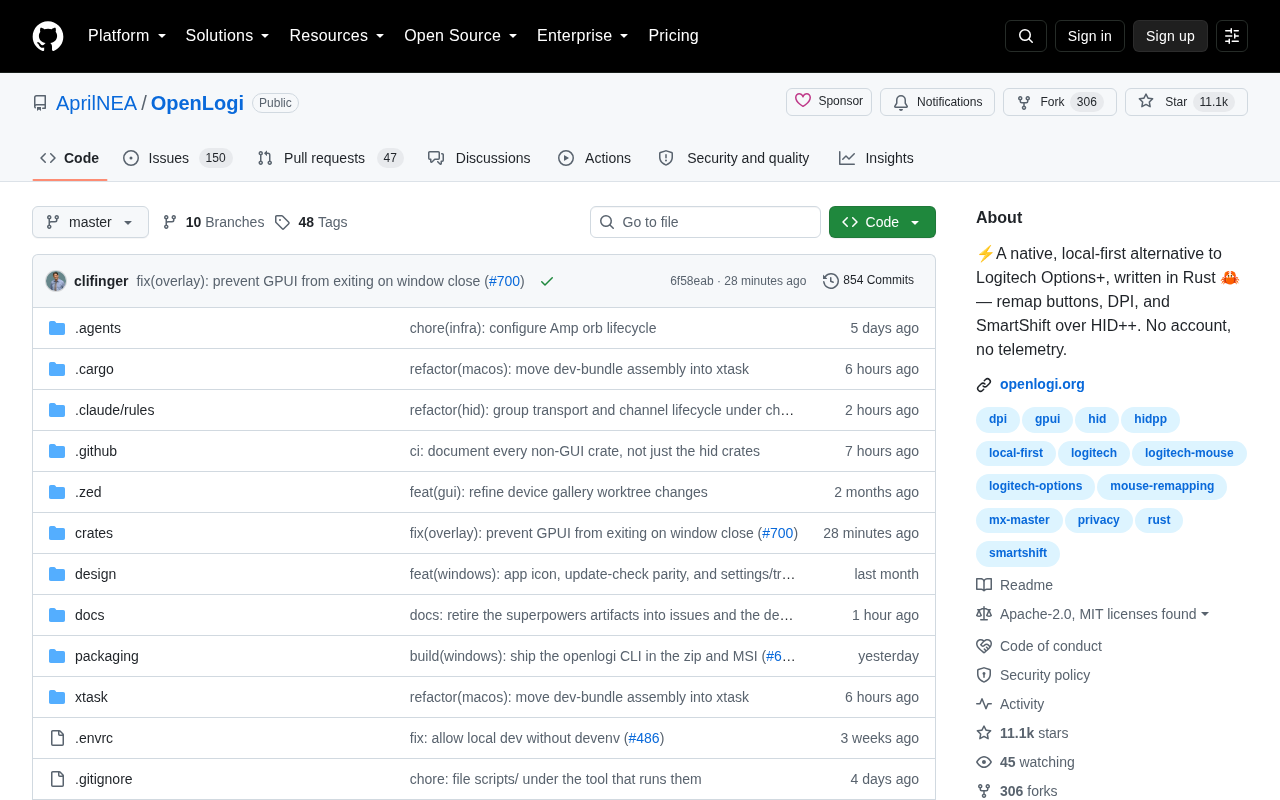
OpenLogi is a lightweight, privacy-first open-source Rust alternative to Logitech Options+ with 11K+ GitHub stars.
OpenLogi is an open-source Logitech Options+ alternative written in Rust that supports button remapping, DPI adjustment, and SmartShift control via the HID++ protocol. It requires no account login, collects no telemetry, and runs entirely locally. With over 11,000 GitHub stars, it addresses widespread frustration with Logitech's bloated Electron-based official software, offering a lightweight, privacy-friendly solution for MX Master and other Logitech mouse users.
An Open-Source Solution for a Long-Standing Pain Point Among Logitech Users
For users of Logitech peripherals — especially high-end mice like the MX Master series — the official Logitech Options+ software is practically a mandatory companion. It handles core functions like button remapping, DPI adjustment, and SmartShift scroll wheel toggling. But the software has long been a source of frustration: it's bloated, constantly runs in the background consuming resources, forces account login, and uploads telemetry data.
The bloat of Options+ is no accident. In 2022, Logitech fully replaced the older Logitech Options with Options+, which adopted an Electron-based architecture — essentially packaging a Chromium browser as a desktop application. This means that even if you just want to tweak your mouse DPI, an entire browser engine has to run in the background. The installer alone exceeds 300MB, and resident memory usage fluctuates between 200-400MB. What frustrates users even more is the mandatory Logitech account login and the continuous background collection of telemetry data, including device usage frequency, button habits, and app-switching patterns. This data is uploaded to Logitech's servers for "product improvement," but users have virtually no way to fully disable this behavior.
The open-source project OpenLogi, which has rapidly gained traction on GitHub recently, takes direct aim at these pain points. Created by developer AprilNEA using the Rust programming language, it positions itself as a "native, local-first" alternative to Logitech Options+. The project's popularity has been remarkable since launch — it has already accumulated over 11,000 Stars, with a single-day increase of 1,225 stars, clearly demonstrating the community's strong desire for a lightweight Logitech driver alternative.
Core Features: No Account, No Telemetry, Purely Local
OpenLogi's product philosophy can be summed up by two keywords from its tagline: No account, no telemetry. This strikes directly at the two most controversial aspects of Options+.
Comprehensive Logitech Mouse Feature Coverage
Despite being an open-source alternative, OpenLogi makes no compromises on core functionality. It communicates directly with devices via Logitech's HID++ protocol, supporting the following features:
- Button remapping (Remap buttons): Customize the function of each mouse button
- DPI adjustment: Flexibly configure mouse sensitivity levels
- SmartShift control: Manage the signature free-spin/ratchet scroll wheel switching mechanism on MX Master series mice
HID++ is a proprietary communication protocol used internally by Logitech devices, built on top of the USB standard HID (Human Interface Device) protocol. The standard HID protocol defines the basic specifications for how input devices like keyboards and mice communicate with computers, and all operating systems have built-in support for it — which is why you can plug in any mouse and immediately use its basic functions. However, Logitech extended a proprietary HID++ layer on top of standard HID to transmit advanced feature commands, such as switching DPI levels, configuring SmartShift thresholds, and managing multi-device pairing. This protocol has never been officially documented by Logitech; the community's understanding of it primarily comes from years of reverse engineering accumulated by the Solaar project on Linux. Solaar is a long-maintained open-source project focused on managing Logitech Unifying and Bolt receivers and their paired devices on Linux. Its team has systematically reverse-engineered and documented numerous HID++ protocol features, laying a crucial technical foundation for later projects including OpenLogi. The fact that OpenLogi can natively interface with this protocol means it's not just a simple key mapping script, but a complete implementation that reaches down to the hardware driver level. This is the technical foundation that enables it to truly replace the official software.
Local-First Design Philosophy
"Local-first" is an important trend in software design in recent years, emphasizing that data and functionality should be handled entirely on the user's local device without relying on cloud services. The systematic articulation of this philosophy can be traced back to the 2019 paper Local-First Software: You Own Your Data published by the Ink & Switch lab. The paper offered an in-depth critique of how users lose data ownership under the SaaS (Software as a Service) model and proposed a set of design principles for local-first software: data should be stored and processed locally, network connectivity should be an optional enhancement rather than a prerequisite, and users should have full control over their own data. This philosophy resonated widely within the developer community, giving rise to a wave of representative projects and technologies including Obsidian (local-first notes), Excalidraw (local-first whiteboard), and CRDTs (Conflict-free Replicated Data Types for serverless collaboration).
All of OpenLogi's configurations are stored locally. It doesn't need to connect to Logitech's servers and never uploads any usage data. This means your mouse configuration remains fully functional even in a completely offline environment — you won't be affected by network issues or Logitech server outages. For users who prioritize privacy protection or are in network-restricted environments, this is a significant advantage.
Why Build a Logitech Driver Alternative in Rust?
OpenLogi's choice of Rust as its development language is no coincidence. As a driver tool that needs to interact directly with the operating system's lower layers and hardware devices, Rust's memory safety and high performance characteristics are critical.
Rust's core technical innovation lies in its Ownership System and Borrow Checker. Traditional systems-level languages like C and C++ give developers the ability to directly manipulate memory, but the trade-off is that memory safety vulnerabilities — null pointer dereferences, buffer overflows, data races — have long plagued the entire industry. Microsoft has disclosed that approximately 70% of security vulnerabilities in its products are related to memory safety issues. Rust enforces memory safety rules at compile time: every piece of memory has exactly one owner, borrowing must follow strict mutability rules, and lifetimes are statically verified by the compiler. These constraints fundamentally eliminate the aforementioned security risks without introducing garbage collection (GC) runtime overhead. For a driver tool that needs to run in the background long-term and directly operate USB devices, this "zero-cost abstraction" safety guarantee is especially critical — it neither leaves security vulnerabilities like C/C++ nor causes response latency from GC pauses like Java/C#.
Compared to the hundreds of megabytes in installation size and resident memory usage typical of heavyweight technology stacks like Electron used by Options+, native binaries compiled from Rust are small, have low runtime overhead, and start quickly. Rust's rise in the systems tools space has been unmistakable in recent years: the command-line tool ripgrep replacing grep, fd replacing find, bat replacing cat, the file manager yazi, terminal emulators Alacritty and Wezterm, and even Microsoft rewriting parts of the Windows kernel in Rust. OpenLogi's technology choice perfectly aligns with this trend. This directly echoes the project's "native" positioning — it's not a web app wrapped in a shell, but a true system-native program.
For driver software that runs in the background long-term, the value of low resource consumption cannot be overstated. Many users complain that Options+ background processes slow down their systems, and OpenLogi's lightweight approach directly addresses this chronic issue.
The Ecosystem Significance of Open-Source Alternatives to Logitech's Official Software
More and more users are seeking open-source alternatives to closed-source commercial software, whether driven by privacy concerns, performance needs, or resistance to vendor lock-in ecosystems. OpenLogi's explosive popularity is a textbook example of this trend.
Similar phenomena play out repeatedly across the software industry: Bitwarden replacing LastPass (password management), Immich replacing Google Photos (photo management), Jellyfin replacing Plex (media server), LibreOffice replacing Microsoft Office (office suite). The same holds true in the hardware driver space — besides Solaar as the Linux counterpart for Logitech drivers, OpenRGB provides a unified open-source control solution for RGB lighting across brands, replacing bloated vendor-specific software like iCUE and Armoury Crate. These projects share a common trait: they focus on core functionality and reject commercial bloat.
Official software from hardware manufacturers often becomes bloated and complex because it must serve commercial objectives such as account systems, cloud sync, and data analytics. There's a deeper business logic behind this: as hardware profit margins continue to decline, manufacturers increasingly rely on software ecosystems to build user stickiness and data assets. Account systems lock in users, telemetry data supports "data-driven" product decisions, and cloud sync features pave the way for subscription models. These commercial requirements layer upon each other, ultimately transforming what should be a lightweight device management tool into a multi-hundred-megabyte behemoth. Community-driven open-source projects, on the other hand, can focus on "doing one thing well" — in this case, purely managing and controlling your Logitech mouse.
That said, it's important to take a clear-eyed view of the limitations when using third-party driver alternatives:
- Device compatibility: Since it relies on reverse-engineered understanding of the HID++ protocol, the level of support may vary across different device models. The HID++ protocol itself has multiple versions (with significant differences between 1.0 and 2.0), and devices from different eras implement different feature sets. It's recommended to check whether your device is on the supported list before use.
- Feature maturity: As a young project in rapid iteration, some features may not yet be as mature as the official software. For example, advanced features supported by Options+ such as application-specific button configurations (automatically switching button schemes across different apps) and Flow cross-device collaboration may not yet be covered by OpenLogi.
- Usage risks: Third-party tools that operate hardware at a low level theoretically carry some risk, which users should evaluate for themselves. However, it's worth noting that operations at the HID++ protocol level typically won't cause permanent hardware damage — the worst-case scenario is usually a configuration anomaly that can be resolved by resetting the device.
Conclusion: A Noteworthy New Option for Logitech Peripheral Management
OpenLogi's achievement of surpassing 10,000 Stars within a week clearly articulates the community's demand: users want a lightweight, privacy-friendly, account-free Logitech peripheral management tool. With Rust's technical advantages and a local-first design philosophy, it offers a highly attractive migration path for users dissatisfied with Options+.
For owners of high-end Logitech mice like the MX Master — especially technically-minded users who prioritize system efficiency and privacy — OpenLogi is worth trying. Given that the project is still in active development, it's advisable to follow updates on its GitHub repository and check the device support list before deciding whether to fully replace the official software.
Related articles

Chain of Thought Isn't Just for AI: How Humans Can Use CoT to Improve Thinking Quality
Chain of Thought isn't just a prompt trick for large models. Starting from a Hacker News discussion, this article analyzes why CoT works for human thinking too, breaks down actionable ways to transfer it, and highlights the key differences between human CoT and machine CoT.
Cloudflare Teams Up with OpenAI: Closi…
Cloudflare Teams Up with OpenAI: Closing the Loop from Vulnerability Discovery to Defense with AI
Cloudflare uses OpenAI Daybreak to investigate security vulnerabilities and generate reviewable remediation plans, while developers use Codex to boost coding efficiency and quality.

Orca Multi-Agent Orchestration in Practice: A Guide to Parallel Collaboration with Claude and Codex
Orca is Stable AI's free open-source agent workbench supporting 34 agents like Claude Code and Codex in parallel. Learn its Git worktree isolation, multi-model orchestration, and mobile management.