OpenMontage: A Deep Dive into the Open-Source Agentic Video Production System

OpenMontage turns AI coding assistants into full video production studios using agents, tools, and knowledge files.
OpenMontage is a viral open-source project on GitHub that positions itself as the world's first agentic video production system. It combines 12 production pipelines, 100+ tools, and 700+ knowledge files to turn AI coding assistants like Cursor and Claude Code into complete video production studios. By leveraging tool calling, RAG-based knowledge injection, and autonomous agent workflows, it aims to automate the entire video creation process from scripting to final output.
When an AI Coding Assistant Becomes a Video Production Studio
Video production has long been a complex workflow with high barriers to entry, multiple stages, and heavy manual labor: from scriptwriting and footage editing to VFX compositing and color grading, every step demands professional software and accumulated expertise. A recently viral open-source project on GitHub, OpenMontage, aims to reinvent this entire process through an "agent-based" approach.
An agent, in this context, refers to an AI system capable of perceiving its environment, making autonomous decisions, and taking actions to achieve specific goals. Unlike traditional single-turn Q&A AI, agents possess the ability to plan, remember, invoke tools, and self-reflect—breaking complex tasks into multiple sub-steps and executing them one by one. Over the past two years, as the capabilities of large language models have advanced rapidly, agents have moved from academic concept to engineering practice, becoming one of the core paradigms for real-world AI applications.
According to its project description, OpenMontage bills itself as the "World's first open-source, agentic video production system." Its core idea is remarkably straightforward: Turn your AI coding assistant into a full video production studio.
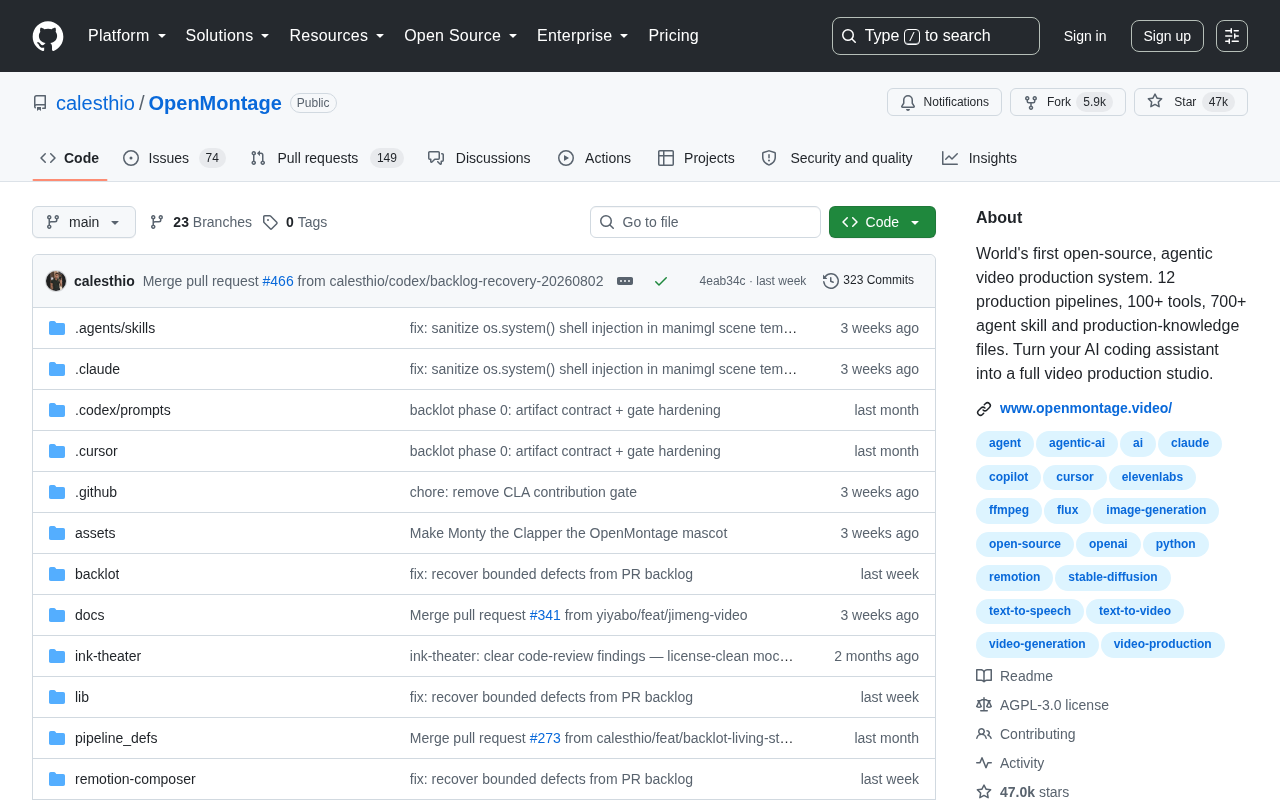
Since its launch, the project has gained extraordinary traction—amassing 46,956 Stars and 5,863 Forks to date, with 436 new stars in a single day. For a Python-based project, this kind of growth curve speaks volumes about the community's intense interest in AI-powered video automation.
Deep Dive into OpenMontage's Technical Architecture
Based on the official data, OpenMontage is not a simple scripting tool—it's a comprehensive agentic video production system. It consists of several core modules:
12 Production Pipelines
Video production is fundamentally a process-driven endeavor. OpenMontage abstracts common production stages into 12 reusable production pipelines, covering everything from pre-production to post-production. This pipeline-based design means users can mix and match different stages as needed, rather than building everything from scratch. The approach borrows from CI/CD pipelines in software engineering—decomposing complex delivery processes into standardized stages, each with clearly defined inputs and outputs, enabling repeatable and debuggable automated workflows.
100+ Video Production Tools
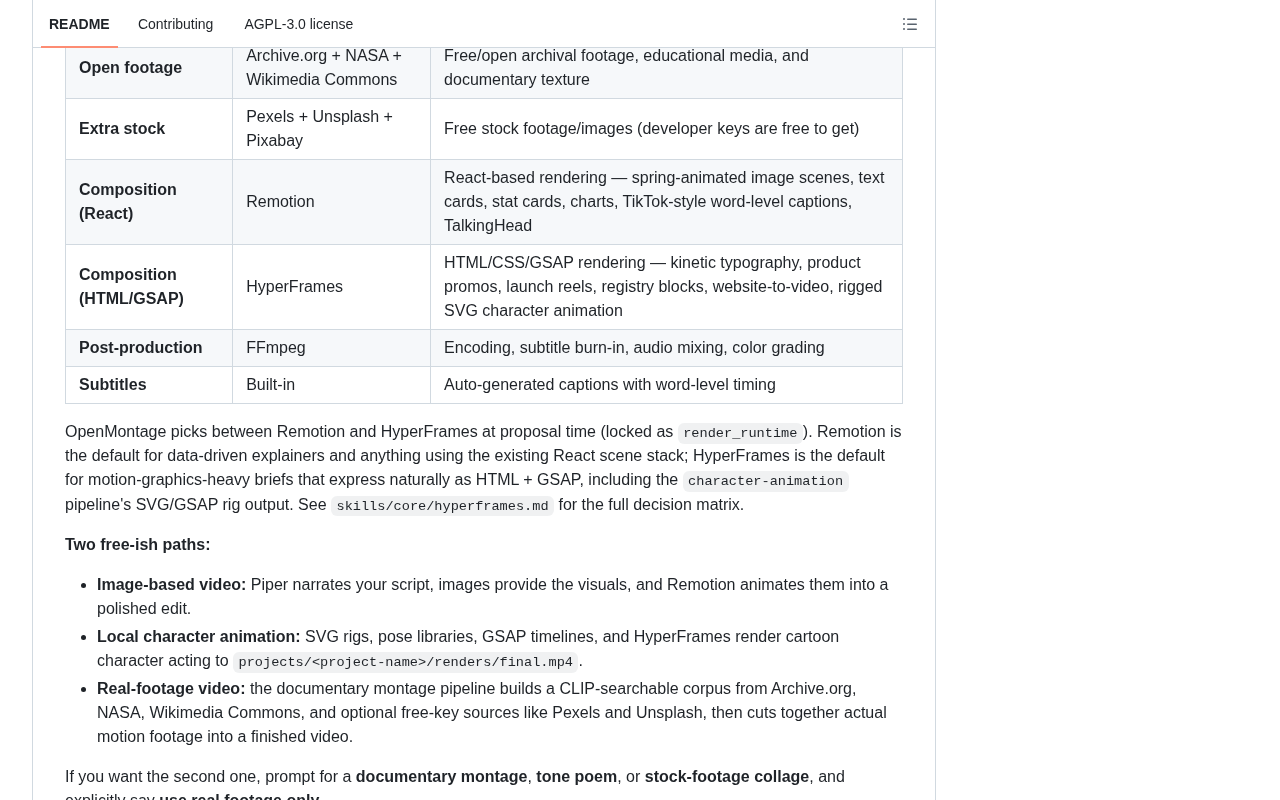
An agent's capability boundary is largely determined by how many tools it can invoke. OpenMontage comes with over 100 built-in tools, theoretically covering every sub-domain of video production: editing, transcoding, VFX, subtitles, audio processing, and more. These tools serve as the agent's "hands" for executing specific tasks.
From a technical implementation perspective, "Tool Calling" is the core mechanism through which large language models interact with external systems. The model generates structured function call requests based on user intent, which are then executed by the runtime environment—for example, calling FFmpeg for video transcoding, Whisper for subtitle generation, or an image generation model for creating thumbnails—and the results are fed back to the model for the next reasoning step. This mechanism was first standardized and introduced by OpenAI in 2023 and has since been widely adopted by major LLM platforms, becoming a foundational capability of agent architectures. OpenMontage's 100+ tools are essentially 100+ predefined function interfaces designed for video production scenarios that can be called by AI.
700+ Agent Skills and Production Knowledge Files
This is perhaps the most imaginative part of OpenMontage. The project provides over 700 agent skill and production-knowledge files. In other words, it doesn't just tell the AI "what tools are available"—it also distills domain knowledge about "how to make a great video."
This approach to knowledge injection is essentially a deep application of Retrieval-Augmented Generation (RAG) in a vertical domain. The core idea behind RAG is that while general-purpose LLMs possess broad language understanding, they often lack sufficiently precise knowledge in specific professional domains. By preparing structured documents containing best practices, production standards, editing techniques, and other professional knowledge in advance, agents can retrieve relevant knowledge fragments as context when executing tasks, compensating for the general model's lack of domain expertise. OpenMontage's 700+ knowledge files effectively equip the AI with a curated "video production textbook," enabling the agent to approach specific production tasks with decision-making logic closer to that of professional creators.
What Does "Agentic" Really Mean?
To understand OpenMontage's value, the key lies in understanding its "agentic" positioning.
Traditional automated editing tools are typically rule-driven: you set templates and parameters, and the tool follows instructions. An agentic system, by contrast, emphasizes goal-driven autonomous decision-making—you simply provide your creative intent, and the agent autonomously plans steps, selects tools, invokes pipelines, and dynamically adjusts based on intermediate results. This shift from "instruction execution" to "goal understanding" is one of the most important paradigm shifts in the current AI engineering landscape. Academics call it "Agentic AI"—intelligent systems with autonomy, reactivity, and social ability, distinct from the passive responses of traditional AI applications.
OpenMontage's approach uses AI coding assistants (such as Cursor, Windsurf, Claude Code, and other Coding Agents) as the "brain," the 12 pipelines and 100+ tools as the "executors," and the 700+ knowledge files as the "experience library." Combined, these three components can theoretically enable AI to evolve from "knowing how to write code" to "knowing how to produce videos."
This architecture reflects a major trend in AI engineering: using coding agents as a general-purpose execution framework and migrating their capabilities to vertical domains through Tool Calling and knowledge injection. Video production is just one application scenario. The same architectural pattern has already appeared in similar practices across data analysis, scientific research, legal document drafting, and other fields.
Whose Pain Points Does OpenMontage Address?
For developers and technically-minded creators, OpenMontage's open-source nature is highly appealing. Compared to the Adobe suite (Premiere Pro, After Effects, etc.), which costs tens of dollars per month in subscription fees, a self-hostable, customizable, and extensible open-source video production system means lower costs and greater freedom. It's worth noting that the video production software market has long been dominated by a handful of commercial products—Adobe, DaVinci Resolve, Final Cut Pro, and others—while open-source alternatives have remained relatively scarce. This is an important backdrop for why OpenMontage has been able to attract community attention so quickly.
For content creators, especially teams that need to produce videos at scale (such as multi-channel media operations, e-commerce short videos, and educational courses), agentic pipelines could deliver significant efficiency gains—delegating repetitive editing, subtitling, and transcoding tasks to agents while freeing human effort to focus on creativity itself.
That said, it's important to remain realistic. The project currently presents primarily descriptive information, and the actual output quality, stability, and ability to handle complex creative requirements still need to be validated through real-world use. The "world's first" marketing claim is certainly eye-catching, but the maturity of agent-automated video production is still in its early exploratory stage.
Industry Signals Worth Watching
OpenMontage's viral success is essentially a concentrated manifestation of the "AI Agent + vertical workflow" paradigm in the video domain. It sends several signals worth paying attention to:
First, AI coding assistants are becoming universal productivity entry points. When a Coding Agent can be endowed with video production capabilities, it means it can be endowed with virtually any professional capability that has well-defined tools and knowledge boundaries. The underlying logic of this trend is that programming itself is a universal ability to "operate on the world," and LLMs happen to excel at translating natural language intent into code and function calls.
Second, open source is accelerating the democratization of professional software domains. Video production was once a field monopolized by a few commercial giants, and projects like OpenMontage offer a community-driven alternative path.
Third, knowledge files are becoming a core asset for agents. The value of 700+ production-knowledge files may be no less than that of the tools themselves—the accumulation and structuring of domain knowledge is the real key to making agents truly "professional." This also suggests that future competition around agents may not just be about model capabilities, but about the quality and coverage of domain knowledge bases.
For developers and creators interested in real-world AI applications, OpenMontage—regardless of its ultimate performance—is an open-source project worth hands-on experimentation and worth watching as it evolves.
Related articles

Chain of Thought Isn't Just for AI: How Humans Can Use CoT to Improve Thinking Quality
Chain of Thought isn't just a prompt trick for large models. Starting from a Hacker News discussion, this article analyzes why CoT works for human thinking too, breaks down actionable ways to transfer it, and highlights the key differences between human CoT and machine CoT.
Cloudflare Teams Up with OpenAI: Closi…
Cloudflare Teams Up with OpenAI: Closing the Loop from Vulnerability Discovery to Defense with AI
Cloudflare uses OpenAI Daybreak to investigate security vulnerabilities and generate reviewable remediation plans, while developers use Codex to boost coding efficiency and quality.

Orca Multi-Agent Orchestration in Practice: A Guide to Parallel Collaboration with Claude and Codex
Orca is Stable AI's free open-source agent workbench supporting 34 agents like Claude Code and Codex in parallel. Learn its Git worktree isolation, multi-model orchestration, and mobile management.