OpenRewrite Recipes Migration: From Maven Central to the Code Genome Project

OpenRewrite Recipes are leaving Maven Central, requiring synchronized adjustments to build configurations and supply chain governance.
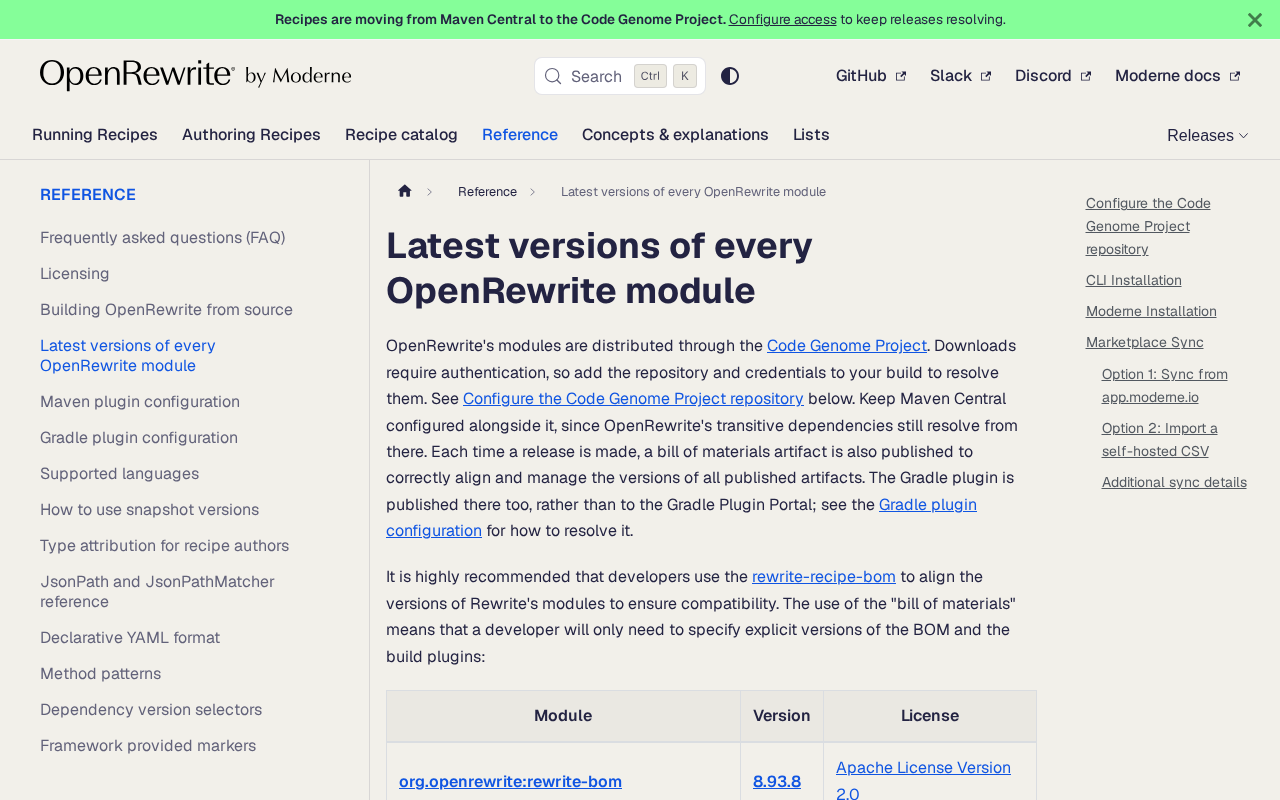
OpenRewrite's core automated refactoring Recipes are migrating from Maven Central to the Code Genome Project, directly affecting downstream build processes. Recipes are distributed as Maven artifacts, and after the migration, build scripts must add or replace repository addresses; otherwise, dependency resolution will fail. Teams using BOMs, dependency locking, or private repository proxies also need to update configurations, and omissions in proxy whitelists are often the first source of failures. The article recommends a two-step migration: first switch the repository and verify the build, then separately handle version compatibility upgrades between Recipes and the core engine. The community is divided on the stability of leaving Maven Central, and redirects for old coordinates, the migration deadline, and the SLA remain unclear. Teams should inventory references and follow official guidance.
The OpenRewrite ecosystem is undergoing an infrastructure-level adjustment: its core automated refactoring Recipes are migrating from Maven Central to the "Code Genome Project." On the surface, this looks like nothing more than a change of repository address, but for teams that rely on OpenRewrite for large-scale code modernization, it touches the underlying logic of build processes, dependency resolution, and supply chain trust.
What the Migration Means
OpenRewrite's Recipes are essentially collections of code transformation rules distributed as Maven artifacts. By declaring dependencies in build scripts, developers can let the tool automatically perform batch refactoring such as framework upgrades, API replacements, and security patches. For a long time, Maven Central has served as the host for these artifacts, providing a mature coordinate system and a global mirror network.
After the migration to the Code Genome Project, the distribution channel for Recipes will be independent of Maven Central. For downstream users, the most direct impact is that build configurations will need to add or replace repository addresses; otherwise, dependency resolution will fail. For teams whose CI/CD pipelines have cached the old coordinates, upgrades may produce errors that the artifacts cannot be found.
The motivation for this migration can be inferred from the name: the Code Genome Project is attempting to establish a more specialized governance and version management system for code transformation rules. Maven Central is a general-purpose artifact repository, whereas Recipes carry strong semantic attributes—they describe "how code should be rewritten." The evolution pace and compatibility constraints of these assets differ from those of general Java libraries.
Maven artifact coordinates consist of three parts: groupId, artifactId, and version. The repository address and the coordinates together determine whether a dependency can be resolved. When migrating to a new repository, the coordinates themselves may remain unchanged, but the resolution path changes. Therefore, any configuration that hardcodes the repository source must be adjusted accordingly.
A BOM (Bill of Materials) is a special POM used only to centrally declare the versions of a set of dependencies. After downstream projects import it via dependencyManagement or Gradle's platform, specific version numbers can be omitted. If OpenRewrite Recipes manage versions through a BOM, the repository source of the BOM itself must also be switched during migration; otherwise, version declarations will become ineffective.
Dependency locking mechanisms (such as Gradle's lockfile and Maven's dependency lock) persist resolution results along with source information into files. After a repository change, checksums or source records may no longer match, and lock files need to be regenerated.
Practical Impact on Build Pipelines
The most practical problem brought by the migration is the change in dependency coordinates. Teams need to check every place in the project that references OpenRewrite Recipes, including Maven's pom.xml, Gradle build scripts, and possibly BOM (Bill of Materials) declarations. If version management plugins or dependency locking mechanisms are used, lock files also need to be updated accordingly.
For organizations that use private repository proxies (such as Nexus or Artifactory), the new repository source needs to be allowed in the proxy configuration; otherwise, internal builds will be interrupted because the external address cannot be accessed. This step is easy to overlook, yet it is often the source of the first batch of failures after migration.
Another point worth noting is version alignment. There is a version compatibility relationship between Recipes and the OpenRewrite core engine. If repository switching and version upgrades are performed at the same time during migration, troubleshooting will become significantly more difficult. A safer approach is to proceed in two steps: first complete the repository address switch and verify that the build passes, then handle version upgrades separately.
Private repository proxies (Nexus, Artifactory, etc.) work as follows: build requests first hit the internal proxy, and when the proxy misses the cache, it pulls from the upstream remote repository. Proxies are usually configured with a whitelist of remote repositories they are allowed to access. If the new repository is not on the whitelist, the proxy will directly reject the request, manifesting as "artifact not found" rather than a network error, which is easy to misdiagnose during troubleshooting.
Therefore, migration requires two things: add a new remote repository entry in the proxy, and add it to the aggregation list of the proxied repository group or virtual repository so that internal projects can resolve the new source through a unified entry point. For environments with offline mode or strict caching policies enabled, metadata refresh also needs to be triggered manually once.
Community Reaction and Open Questions
In discussions on Hacker News, developers focused on the necessity of the migration and the arrangements for the transition period. Some comments expressed reservations about leaving Maven Central—Maven Central's stability, mirror coverage, and toolchain compatibility have been validated over many years, and there is uncertainty about whether the new repository can reach the same level in the short term.
Others believe that a specialized repository can help with the long-term governance of the Recipes ecosystem. General-purpose repositories impose no semantic constraints on artifacts, whereas once code transformation rules introduce breaking changes, they affect downstream projects' build results rather than runtime behavior. This type of risk requires more refined release management.
Details that are not yet clear in public information include: whether old coordinates will retain redirects, whether there is a clear deadline for the migration, and what availability and SLA commitments the Code Genome Project offers. These questions directly determine how urgent the migration is. It is advisable to follow the project's official announcements and migration guide.
In the context of artifact repositories, supply chain trust includes several dimensions: the repository operator's control over publishing permissions, artifact signing and verification, and availability commitments (SLA). Maven Central requires publishers to verify domain ownership and enforces GPG signing, while providing high availability through a global CDN and multiple mirrors.
For an emerging specialized repository to be accepted by enterprise build processes, it usually needs to provide these guarantees at an equal or stronger level; otherwise, security teams will raise obstacles during dependency approval. For organizations that incorporate automated refactoring into compliance processes, the repository's signing verification method and audit log capabilities often affect adoption pace more than the migration itself.
Recommendations for Teams
In the short term, teams that depend on OpenRewrite should inventory the Recipes references in their existing build configurations and confirm whether they are affected. After the official migration guide is released, prioritize validating the feasibility of the repository switch on non-critical pipelines, then gradually roll it out to the main branch.
In the medium term, this migration reminds us that the dependency sources of build tools are also part of the supply chain. For teams that incorporate automated refactoring into their daily processes, establishing a centralized management mechanism for dependency coordinates can reduce repetitive work during similar infrastructure changes.
Code transformation rules are moving from "artifacts attached to general-purpose repositories" toward "an independently governed asset class." This trend itself is worth continued observation.
One-line Summary
OpenRewrite Recipes are moving out of Maven Central, requiring synchronized adjustments to build configurations and supply chain governance.
Paragraph Summary
OpenRewrite's core automated refactoring Recipes are migrating from Maven Central to the Code Genome Project, directly affecting downstream build processes. Recipes are distributed as Maven artifacts, and after the migration, build scripts must add or replace repository addresses; otherwise, dependency resolution will fail. Teams using BOMs, dependency locking, or private repository proxies also need to update the corresponding configurations, and omissions in proxy whitelists are often the first source of failures. The article recommends a two-step migration: first switch the repository and verify the build, then separately handle the version compatibility upgrade between Recipes and the core engine. The community is divided on the stability of leaving Maven Central. Redirects for old coordinates, the migration deadline, and the SLA remain unclear, so teams should inventory references and follow official guidance.
Related articles

Chain of Thought Isn't Just for AI: How Humans Can Use CoT to Improve Thinking Quality
Chain of Thought isn't just a prompt trick for large models. Starting from a Hacker News discussion, this article analyzes why CoT works for human thinking too, breaks down actionable ways to transfer it, and highlights the key differences between human CoT and machine CoT.
Cloudflare Teams Up with OpenAI: Closi…
Cloudflare Teams Up with OpenAI: Closing the Loop from Vulnerability Discovery to Defense with AI
Cloudflare uses OpenAI Daybreak to investigate security vulnerabilities and generate reviewable remediation plans, while developers use Codex to boost coding efficiency and quality.

Orca Multi-Agent Orchestration in Practice: A Guide to Parallel Collaboration with Claude and Codex
Orca is Stable AI's free open-source agent workbench supporting 34 agents like Claude Code and Codex in parallel. Learn its Git worktree isolation, multi-model orchestration, and mobile management.