OpenRouter Alternatives: A Complete Guide to LLM Gateway Selection

A comprehensive guide comparing LLM gateway alternatives to OpenRouter for multi-model orchestration.
This guide explores why developers seek OpenRouter alternatives and compares major LLM gateway options across three categories: open-source self-hosted solutions (LiteLLM, Portkey), cloud provider services (AWS Bedrock, Google Vertex AI), and commercial platforms (Together AI, Fireworks AI). It covers key selection criteria including data privacy, cost control, compliance needs, and architectural portability.
Why Developers Are Looking for OpenRouter Alternatives
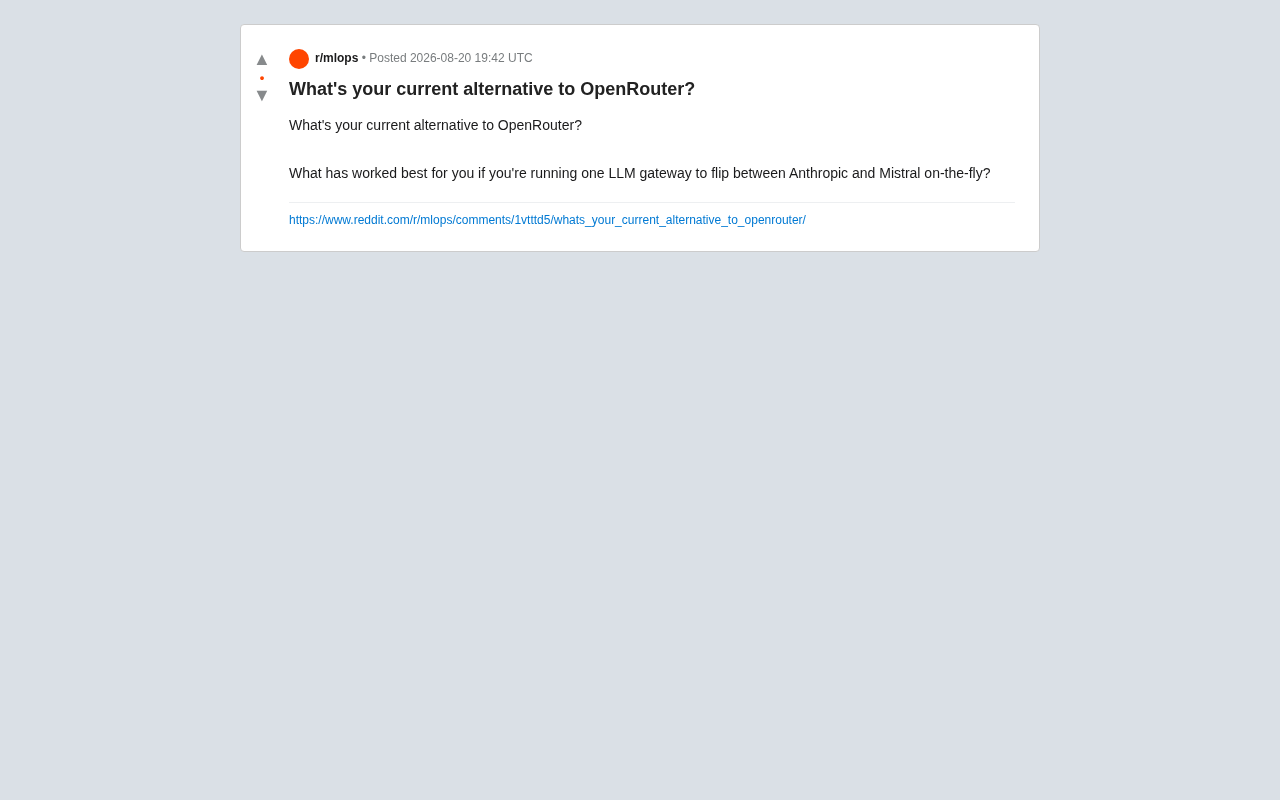
Recently on the Reddit community, a discussion about "OpenRouter alternatives" attracted widespread attention. The original poster raised a very specific scenario question: if you need to run a unified LLM Gateway that switches between different model providers like Anthropic and Mistral in real time, what's the best solution available?
This question seems simple, but it touches on a core pain point in today's AI application development — model orchestration and unified access. As the large model ecosystem rapidly expands, providers like OpenAI, Anthropic, Mistral, Google, and Meta each offer different API interfaces, authentication methods, and billing models. If developers want to flexibly call multiple models within their applications, they inevitably face the challenge of interface fragmentation. OpenRouter rose to popularity in this context: through a single unified API endpoint, it aggregates hundreds of models, saving developers from having to integrate with each provider individually.
However, as usage deepens, more and more developers are considering alternatives. The reasons mainly center on three aspects: data privacy concerns about third-party intermediary layers, additional cost markups, and the need for controllability and self-hosting.
What Problems Does an LLM Gateway Actually Solve
Unified Interface and Real-Time Model Switching
An LLM gateway is essentially an abstraction layer sitting between your application and various model providers. Its core value lies in standardizing heterogeneous APIs — typically unified into an OpenAI-compatible interface format — so developers only need to change a model name parameter to seamlessly switch between Claude, Mistral, GPT, and other models.
The OpenAI-compatible format became the de facto standard because OpenAI was the first company to commercialize LLM APIs at scale. Its Chat Completions API request structure (containing model, messages array, temperature, and other parameters) and response format (choices array containing message objects) has been widely adopted by the industry. When the community says a tool is "OpenAI-compatible," it means you only need to swap the base_url and API key without modifying any business code to switch backend models. This standardization dramatically reduces migration costs and has given rise to the entire LLM gateway ecosystem.
The "on-the-fly" switching requirement mentioned in the original post is particularly critical. In real production environments, developers often need to dynamically route based on task type: for example, using the cheaper Mistral for simple classification tasks, Claude for complex reasoning, or automatically falling back to a backup model when a provider goes down.
Intelligent routing goes far beyond simple load balancing. In production environments, a mature routing strategy typically encompasses multiple dimensions: model selection based on task complexity (e.g., using small models for sentiment analysis, large models for code generation), cost-based routing (preferring lower-priced models when accuracy differences are acceptable), latency-based routing (choosing the fastest-responding model for real-time interaction scenarios), and failure degradation (automatically switching to a backup provider when one returns 5xx errors or times out). These strategies can be combined to form multi-level decision trees. This intelligent routing capability is the core value proposition of an LLM gateway.
Cost Tracking and Observability
Beyond interface unification, a mature LLM gateway should also provide cost tracking, request logging, rate limiting, caching, and other capabilities. For enterprise-grade AI applications, being able to clearly see the token consumption and cost distribution for each model, each team, and each feature is a necessary prerequisite for budget control.
LLM billing uses tokens as the basic unit, and token pricing varies dramatically across models — for example, GPT-4o input costs approximately $2.5/million tokens, Claude 3.5 Sonnet about $3/million tokens, while Mistral's smaller models can go as low as $0.1/million tokens. Additionally, you need to distinguish between input tokens and output tokens (output is typically more expensive), as well as discounted prices for cache hits. For applications handling millions of daily requests, precise token-level cost tracking and attribution analysis directly determines whether operations can stay within budget.
Overview of Major OpenRouter Alternatives
Although the original post didn't provide specific answers, based on common community practices, there are several mature alternative paths worth considering.
Open-Source Self-Hosted Solutions
LiteLLM is currently one of the most popular open-source LLM gateway choices. It's a Python library and proxy server that supports over 100 LLM providers, all unified into the OpenAI format. Developers can either embed it as an SDK in their code or deploy it as a standalone Proxy service for complete self-hosting. For teams that care about data privacy and want to control their own keys and routing logic, LiteLLM is almost the default choice.
LiteLLM's core design is a translation layer: it receives OpenAI-formatted requests, then translates them into the target provider's native API format based on the specified model name prefix (such as "anthropic/claude-3-sonnet" or "mistral/mistral-large"). Its Proxy mode runs as a standalone FastAPI service, supporting virtual key management, team-level budget limits, request retries, and fallback chain configuration. Developers can define model groups, priorities, and rate limiting rules through YAML configuration files without modifying application code.
Portkey builds on the open-source gateway foundation by strengthening observability, semantic caching, and Guardrails functionality, making it suitable for teams that need production-grade monitoring capabilities. Semantic caching is a standout feature of Portkey: unlike traditional exact-match caching, semantic caching uses vector embedding technology to convert user queries into high-dimensional vectors and uses metrics like cosine similarity to determine how semantically similar a new request is to historical requests. When similarity exceeds a threshold, it returns the cached response directly instead of calling the model again. This can significantly reduce latency and costs for FAQ-type scenarios and repetitive queries, though thresholds need to be set carefully to avoid returning irrelevant cached results.
Cloud Provider Aggregation Services
For teams already deeply invested in a particular cloud platform, adopting the cloud provider's managed solution is often more hassle-free. For example, through AWS Bedrock you can call models from Anthropic, Mistral, Meta, and others within a single platform; Google Vertex AI similarly supports multi-model access. The advantage of these solutions is security compliance and enterprise-grade SLAs, though flexibility and model coverage typically don't match dedicated aggregation layers.
The value of these enterprise solutions lies not just in model aggregation, but in their deep integration with the cloud provider's security infrastructure. Bedrock supports fine-grained access control through IAM roles, private network access via VPC endpoints, complete audit logging through CloudTrail, and data never leaves the designated AWS region. Vertex AI similarly provides CMEK (Customer Managed Encryption Keys), VPC Service Controls, and Data Residency guarantees. For regulated industries (such as finance and healthcare), these compliance features are often more important than price and flexibility.
Commercial Gateway Platforms
Besides OpenRouter, the market also has platforms like Together AI and Fireworks AI, which provide unified interfaces while often offering inference optimizations for open-source models at more competitive prices. These platforms typically employ proprietary inference engines (such as optimized versions based on vLLM or TensorRT-LLM), using techniques like quantization, speculative decoding, and continuous batching to dramatically reduce per-inference cost and latency while maintaining model quality.
How to Choose the Right LLM Gateway Solution
Clarify Your Core Requirements
The first step in selection is thinking clearly about what you're actually optimizing for:
- If you value data sovereignty and cost control most, self-hosted open-source solutions like LiteLLM are the top choice
- If you want out-of-the-box convenience and maximum model coverage, managed services like OpenRouter or Together AI are more hassle-free
- If you're in a large enterprise needing compliance and stability, cloud providers' Bedrock or Vertex AI are more reliable
Focus on Portability
Regardless of which solution you choose, an important engineering principle is: keep the interface layer abstract whenever possible. Since virtually all gateways are OpenAI-compatible, as long as your application code follows this standard, the cost of migrating between different solutions in the future will be greatly reduced. This is also why the original poster emphasized "real-time switching" — a well-designed architecture should make model providers interchangeable "plugins" rather than hard-coded dependencies.
This principle aligns with the Dependency Inversion Principle in software engineering: high-level modules should not depend on concrete implementations of low-level modules, but should depend on abstract interfaces. In the context of LLM applications, this means your business logic should program against a unified model invocation interface, while which provider and which model actually responds to requests is dynamically determined through configuration or routing rules.
Don't Overlook Hidden Costs
Self-hosting eliminates middleman markups, but operations, monitoring, and troubleshooting all require human resources. Managed services are convenient but may bring risks of data leaving your jurisdiction and vendor lock-in. The truly optimal solution often depends on a comprehensive trade-off between team size, technical expertise, and business stage.
Specifically, the hidden costs of self-hosting a LiteLLM Proxy include: server resources (although the gateway itself is lightweight, high-concurrency scenarios still require proper planning), version upgrade maintenance (provider APIs change frequently, requiring continuous follow-up), monitoring and alerting setup (requiring integration with observability tools like Prometheus/Grafana), and on-call response during outages. For teams of five or fewer, these operational burdens may offset the savings from eliminating middleman fees.
Conclusion
This brief question on Reddit reflects the maturation process the entire AI application development field is undergoing. From the initial "just make it work" single-model calls, to today's pursuit of multi-model orchestration, cost optimization, and architectural decoupling, developers' infrastructure requirements are increasingly sophisticated. OpenRouter pioneered the unified gateway concept, but it's far from the only answer.
For teams currently evaluating LLM gateways, the recommendation is to start with an open-source solution like LiteLLM for prototype validation, understand your actual routing needs and cost structure, then decide whether to continue self-hosting or migrate to a managed platform. In this rapidly evolving space, maintaining architectural flexibility is always more important than locking into any specific tool.
Related articles

RAG Getting Started in Practice: From Principles to Building an Enterprise Knowledge Base
Bilibili RAG course highlights: from retrieval-augmented generation principles, document chunking and vectorization, to five accuracy factors and enterprise knowledge base boundaries, with fine-tuning vs RAG selection advice.

AI Model Selection Guide: DeepSeek vs. Qwen3 in Practice
How should AI developers choose models? Based on a Bilibili tutorial, this article breaks down the Function Calling differences between DeepSeek V3 and R1, Qwen3's programmatic thinking mode switching and agent capabilities, and outlines a multi-model learning path and practical selection logic.

Anchoring, Loss Aversion, and Nudges: 5 Psychological Tactics Retailers Use to Make You Spend
Behavioral economics reveals how retailers use anchoring, framing, loss aversion, and nudge theory to manipulate your spending decisions. This article breaks down 5 common psychological tactics and offers counterstrategies like slowing down decisions and setting your own anchors to see through the pricing design behind discounts.