opensend.cc: A Self-Hosted Open-Source Email Platform Where Your Data and Sending Reputation Stay Yours

Self-hosted open-source email platform that sends via your own AWS account — no per-email billing, Resend-compatible.
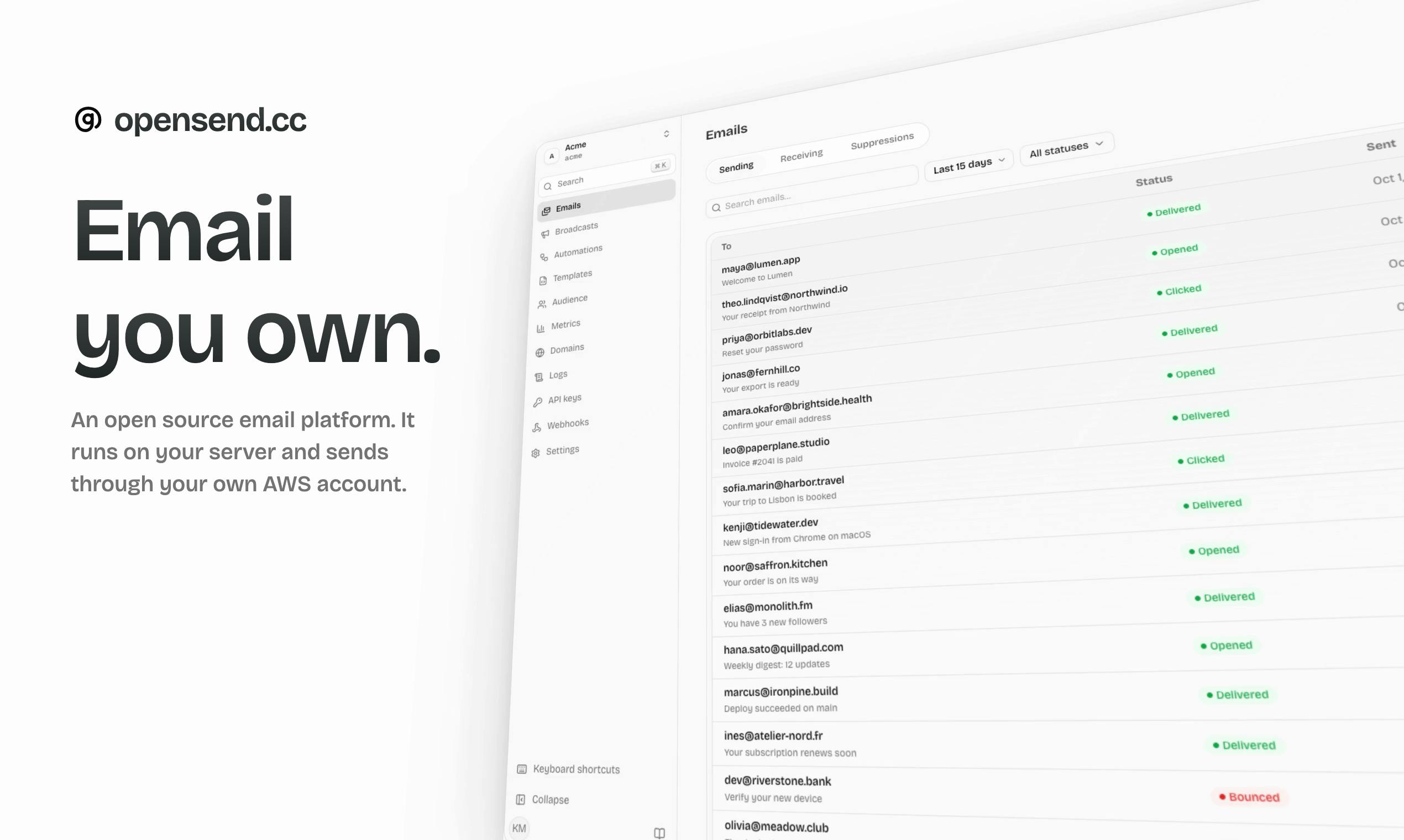
opensend.cc is an open-source email platform you deploy on your own server and send through your own AWS account, keeping your sending reputation, email data, and recipient lists entirely in your hands. It offers a full feature set including REST API, SDK, SMTP, templates, broadcasts, automations, audience management, webhooks, and logs — deployable with a single command, with no per-email billing or feature gates. Teams already using Resend can migrate by changing just two lines of code.
An Email Platform That Runs on Your Own Server
Building an application almost always means sending emails — registration confirmations, password resets, marketing broadcasts, event notifications. Managed email API services are convenient, but they share two common pain points: costs that balloon at scale with per-email pricing, and core data along with sending reputation locked inside a third-party platform. opensend.cc offers a compelling alternative to both.
This open-source project launched on Product Hunt and climbed to 6th place on its debut day (earning 92 upvotes). Built by maker Kamal Panara, its positioning is crystal clear: an open-source email platform that runs on your own server. The core philosophy can be summed up in a single line — "Your domain, your data, your sending reputation — always yours."
Architecture: Sending Through Your Own AWS Account
The most important design decision in opensend.cc is that it doesn't own the email delivery infrastructure itself — instead, it sends email through your own AWS account. This means the actual sending channel runs through your own Amazon SES (or related services), not a shared IP pool managed by a third-party platform.
This approach directly solves the problem of who owns your sending reputation. With traditional shared email services, your domain's sending reputation is tied to the behavior of every other user on the platform — if someone else spams, your deliverability can suffer for it. By routing all sending through your own AWS account, you have full control over building and maintaining your reputation, completely isolated from external risks.
Data sovereignty is equally protected. Email content, recipient lists, and sending logs all stay on your own server, never passing through third-party storage — a significant advantage for teams with compliance requirements or privacy sensitivities.
Install With a Single Command
According to the official documentation, the entire platform can be deployed with a single command (One command installs it). For self-hosted projects, deployment complexity is often the first barrier that turns developers away, and opensend.cc has clearly made simplicity a priority here, lowering the barrier to getting started.
Amazon SES (Simple Email Service) is AWS's cloud email sending service, known for extremely low per-message pricing — typically around $0.10 per thousand emails with no monthly fee, making it well-suited for high-volume sending. SES itself doesn't provide a management interface, template system, or audience management — developers usually have to wrap the API calls themselves. opensend.cc builds exactly these higher-level capabilities on top of SES, combining a low-cost sending channel with a complete platform feature set. Worth noting: new AWS SES accounts default to "sandbox mode," which only allows sending to verified addresses. You'll need to submit a request to AWS to lift this restriction before sending to external users — a prerequisite step to be aware of when self-configuring.
Feature Coverage: On Par With Leading Email API Services
opensend.cc is far more than a simple SMTP relay. It offers a comprehensive feature set covering what you'd expect from a modern email platform:
- REST API & SDKs: Straightforward code integration for sending email
- SMTP support: Compatible with traditional SMTP-based sending
- Templates: Reusable email content structures
- Broadcasts: Bulk sending to large recipient lists
- Automations: Trigger-based email workflows
- Audiences: Organize and segment recipient lists
- Webhooks: Receive email event callbacks
- Logs: Track send records and delivery status
This feature list makes it clear that the goal is to be a developer-friendly, feature-equivalent alternative — not a stripped-down lightweight tool.
Pricing Logic: No Per-Email Billing, No Feature Gates
One of the most common frustrations with commercial email services is the pricing model. Per-email pricing can quickly drive up costs as your user base grows, while feature gates lock advanced capabilities behind more expensive tiers.
opensend.cc explicitly promises no per-email billing and no feature gates. As an open-source self-hosted solution, you only pay for the underlying sending costs generated by your own AWS account (typically far less than what managed services charge after their markup), and the full feature set is available from the start. For high-volume teams, the cost difference can be substantial.
Minimal Migration Cost: Switch From Resend With Two Lines of Code
One detail worth highlighting is its compatibility with Resend. Resend has become a popular email API service among developers in recent years. opensend.cc claims: "Already using Resend? Change two lines and keep your code."
This API compatibility strategy is a classic move for open-source alternatives competing for users — by reducing migration friction, it lets existing users switch with virtually zero cost. For Resend users worried about vendor lock-in or looking to bring their email infrastructure in-house, this is a genuinely attractive selling point.
Resend rose quickly in the developer community in 2023, with its core appeal being a clean REST API, the ability to write email templates in React (via React Email), and a strong focus on developer experience. Its pricing uses a tiered per-email model, with a free tier of 3,000 emails per month before charges kick in. opensend.cc's claim of Resend API compatibility means the two share a consistent interface layer — migrating doesn't require rewriting business logic, just swapping the API endpoint URL and authentication key. This "drop-in replacement" strategy is common in the open-source alternatives space, with similar examples including the many local LLM inference services that advertise OpenAI API compatibility.
Who Is This For?
Putting it all together, the target user profile for opensend.cc is quite clear:
- Teams that prioritize data sovereignty and privacy compliance
- Products with high sending volumes that are sensitive to per-email pricing costs
- Developers who want independent control over their sending reputation and want to avoid shared IP risks
- Technical teams that prefer open source and don't want to be locked into a SaaS vendor
Of course, self-hosting also means taking on operational responsibility — configuring your AWS account, maintaining the server, and dealing with potential deliverability issues. For small projects that only need to send a handful of emails occasionally, a managed service may still be the less stressful choice. But for products where email is a core capability, opensend.cc offers a path that balances control, cost, and feature completeness.
As a newly launched open-source project, community discussion is still fairly limited (only 1 comment at launch), and its stability, documentation quality, and long-term maintenance will need time to be proven out. But from a design standpoint, it accurately addresses several genuine pain points in the email API market, and it's worth adding to the watchlist for developers interested in open-source infrastructure.
Related articles

Felix Rieseberg Personal Homepage
Felix Rieseberg's personal homepage sparks attention on Hacker News. This article covers the Slack engineer's technical background, the rise and fall of nativefier, and the value of a developer homepage as a tech calling card.

@ai-sdk/vue 3.0.306 Patch Release Syncs with [email protected] Update
@ai-sdk/vue 3.0.306 released, synced with [email protected]. A routine patch release for the Vercel AI SDK ecosystem with no public API changes; the Vue adapter layer stays version-aligned with the core package.

Gemini 4 Argon API Launches: The Era of Million-Token Output Begins
Google launches Gemini 4 Argon with sparse MoE architecture, up to 1M output tokens, and a 68.90% Vals Index score, available across API, AI Studio, and the Gemini app.