OpenSense Research Agent Hands-On: From Literature Review to Source Code Reproduction

OpenSense research agent hands-on: literature review and code reproduction shine, but reproduction accuracy and domestic ecosystem have limitations.
Based on a Bilibili creator's hands-on video, this article breaks down the core capabilities and real-world experience of the research agent OpenSense. OpenSense positions itself as Claude Code for researchers, supporting literature review, paper analysis, source code reproduction, data simulation, and output traceability. It includes built-in research Skills and open-source paper data sources, and supports multi-model engine switching and remote access. In testing, its generated literature reviews had standardized formatting and traceable citations, and it could generate code based on papers to verify performance. However, Tencent's paper source code is not open-source, limiting reproduction accuracy; MCP connectors are mostly overseas services with the domestic ecosystem still needing improvement; and large-scale experiments are constrained by local computing power. It is suitable for researchers who need to quickly produce first drafts and validate ideas.
Title
OpenSense Research Agent Hands-On: From Literature Review to Source Code Reproduction
Meta Description
Bilibili creator tests OpenSense research agent: from literature review and paper analysis to source code reproduction and Python verification, with output traceability. This article breaks down its core features, configuration methods, and real-world experience, evaluating its applicable scenarios and limitations.
Article Content
Researchers often face this dilemma: reading papers, organizing literature, reproducing code, and verifying data—every step is time-consuming and laborious. Bilibili creator "Kunpeng Dao" recently conducted a hands-on test of a research agent called OpenSense, which claims to cover the entire workflow from literature research to paper drafting. Is it a research powerhouse or just hype? Based on the hands-on video, this article breaks down its core capabilities and real-world experience.
What Is OpenSense: A Dedicated Agent for Researchers
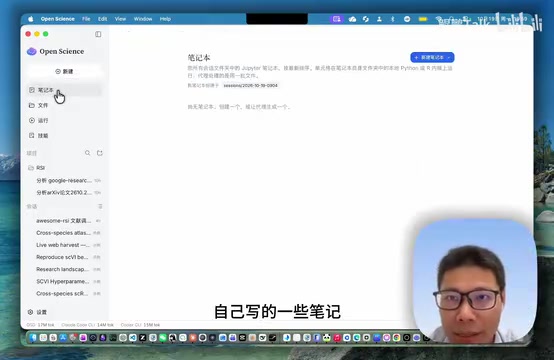
OpenSense positions itself as "Claude Code for researchers," derived from the open-source AFO Science project and built on BIOS. It targets students, teachers, and researchers in fields such as biology, chemistry, and physics, offering capabilities including literature review, paper analysis, source code reproduction, and data simulation. According to the creator, the tool supports Mac, Windows, and Linux platforms and is now available for installation.
Its core differentiator lies in built-in research-specific Skills and paper data sources (both open-source), along with support for a plan-execute-review closed loop. Users can import their own literature materials through the note feature and can also invoke local skills compatible with the Agent Skills protocol.
Agent Skills protocol is the foundation for OpenSense's support of local skill invocation. This protocol defines a standardized interface between agents and external tools or skill packages, enabling models to discover, load, and execute predefined operational workflows (such as literature retrieval, code execution, and data plotting) in a unified manner. Similar to a plugin mechanism, it allows researchers to encapsulate commonly used analysis workflows as reusable Skills, thereby extending the agent's capabilities without modifying core code.
MCP (Model Context Protocol) is an open protocol for enabling large language models to securely and structurally access external data sources and tools. OpenSense connects to databases, APIs, or local file systems through MCP connectors, allowing the agent to retrieve papers, experimental data, and other information in real time. Currently, the MCP ecosystem is dominated by overseas services, and domestic users need to build protocol-compliant interfaces themselves, which limits out-of-the-box usability in domestic research scenarios to some extent.
Core Features Breakdown: A Closed Loop from Literature to Verification
Literature Review and Writing Assistance
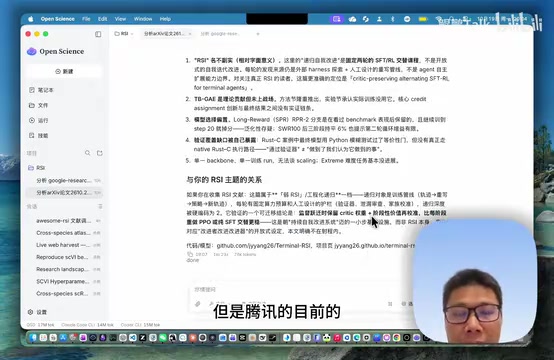
In the hands-on test, the creator fed OpenSense a Tencent Cloud paper on Terminal RSI (trained on Qwen 2.5 7B, improving Terminal Bench accuracy from 20.68% to 50.58%) and asked it to generate a literature review related to RSI (recursive self-improvement). The output included charts, standardized citations, and complete formatting. The creator commented that "the format and professionalism match real papers, saving the hassle of formatting adjustments."
Terminal Bench is a benchmark for evaluating an agent's ability to execute complex tasks in terminal environments, covering real command-line scenarios such as file operations, software installation, and script debugging. The accuracy improvement from 20.68% to 50.58% mentioned in the article reflects the model's performance gains on terminal tasks. This metric is often used to measure an agent's practicality and reliability, but it should be noted that its test environment still differs from actual research workflows.
Source Code Reproduction and Python Verification
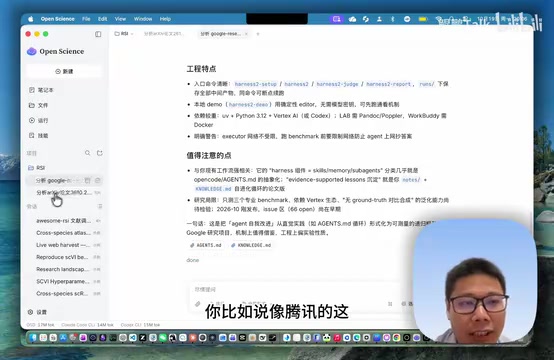
Another highlight of OpenSense is code reproduction. The creator had the agent attempt to reproduce Google's agent code and run tests (not fully completed), and for Tencent's non-open-source paper, had the model generate code based on the paper and verify performance improvements. The video showed code generation and execution logs, demonstrating the auxiliary value of "conducting further research based on prior work."
Output Traceability and Data Citation
All outputs can be traced back to original data and citation sources. The creator emphasized that this is a key requirement in research scenarios—avoiding models "fabricating" literature and ensuring credibility.
Configuration and Extension: Models, Tools, and Remote Access
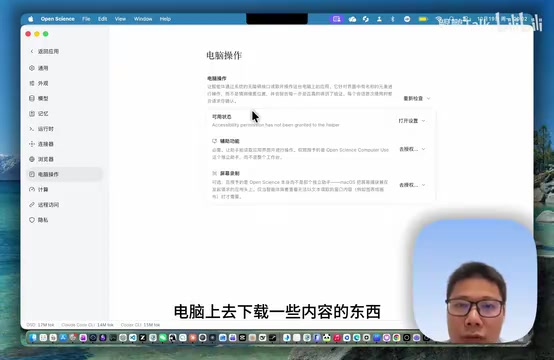
OpenSense supports flexible model configuration. It can invoke free models through OpenCode (such as domestic open-source models and DeepSeekAd) and can also switch to Codex or Claude Code as the engine. In settings, users can manage memory, import external memory, and connect to MCP data sources (currently mostly overseas, with domestic ones requiring self-built packaging).
The tool also supports browser operations and Computer Use, enabling automatic paper downloads and data collection; if GPU resources are available, computations can be run locally to verify paper data. The remote access feature allows deployment on one computer within a LAN and invocation from another, improving collaboration convenience.
Computer Use refers to an AI model's ability to directly operate graphical user interfaces through visual recognition and simulated input (such as mouse clicks and keyboard input). OpenSense leverages this capability to achieve browser automation, automatically visiting academic websites, downloading PDF papers, filling out search forms, and more, thereby incorporating web operations that require human interaction into automated workflows. However, the stability of Computer Use is affected by changes in page structure, and complex dynamic web pages may still fail.
Hands-On Experience and Limitations
The creator affirmed the formatting standards and traceability capabilities, believing that it "allows focus on genuine research exploration." However, limitations were also exposed: Tencent's paper source code is not open-source, so OpenSense can only generate approximate code reproductions without guaranteeing complete consistency; MCP connectors are mostly overseas services, and the domestic ecosystem needs improvement; running large-scale experiments is still constrained by local computing power.
Who Is OpenSense For?
It is suitable for researchers who need to quickly produce literature reviews, validate paper ideas, and reproduce small-to-medium-scale experiments. For research that relies on paid literature databases or requires large-scale computing power, additional configuration or careful evaluation is needed. The creator suggests trying it out with OpenCode's free models first before deciding whether to go deeper.
Overall, OpenSense automates the tedious formatting, research, and first-draft work in research, allowing researchers to focus on innovation points. It is a research agent worth watching.
One-line Summary
OpenSense research agent hands-on: literature review and code reproduction shine, but reproduction accuracy and domestic ecosystem have limitations.
Paragraph Summary
Based on a Bilibili creator's hands-on video, this article breaks down the core capabilities and real-world experience of the research agent OpenSense. OpenSense positions itself as Claude Code for researchers, supporting literature review, paper analysis, source code reproduction, data simulation, and output traceability. It includes built-in research Skills and open-source paper data sources, and supports multi-model engine switching and remote access. In testing, its generated literature reviews had standardized formatting and traceable citations, and it could generate code based on papers to verify performance. However, Tencent's paper source code is not open-source, limiting reproduction accuracy; MCP connectors are mostly overseas services with the domestic ecosystem still needing improvement; and large-scale experiments are constrained by local computing power. It is suitable for researchers who need to quickly produce first drafts and validate ideas.
Related articles

Gemini 4 Argon Hands-On: AI Builds Board Games, Constructs Temples, and Trains Robots Autonomously
Gemini 4 Argon hands-on roundup: AI autonomously builds a desk racetrack and temple in Blender, writes a ray tracing engine, trains a humanoid robot to sink 7 shots, plus API pricing and developer access.

The Magic Octagonal Coin: Why Only 9% of People Can Predict Its Flip?
Only 9% of people can correctly predict the Magic Octagon coin flip. This article explains its spatial rotation mechanism, common cognitive pitfalls, and a new hypothesis based on Relevance Theory, exploring the limits of human spatial reasoning.

Sam Altman: AI Is Entering the Era of Scientific Discovery — Math Breakthroughs Will Replicate in Biology and Energy
Sam Altman says AI is entering the era of scientific discovery — math breakthroughs will replicate in biology, materials science, and energy to help develop new drugs and energy sources.