OpenShip: The Open-Source PaaS with No Vendor Lock-In, Built for Cloud or Self-Hosted Deployments

OpenShip is an open-source PaaS offering Heroku-like deployments with zero vendor lock-in.
OpenShip is an open-source PaaS platform built around zero vendor lock-in, landing at #4 on Product Hunt. It delivers a Heroku-style experience — automated builds, deployments, SSL, monitoring, backups, and secret management — while using a no-proprietary-runtime design that lets you remove the platform without breaking your apps. It supports both official cloud hosting and self-hosted/on-prem deployment, with seamless migration between the two. It's aimed at teams that value data sovereignty, cost control, or simply want to avoid being trapped by a vendor.
An Open-Source Deployment Platform Built Around Zero Lock-In
OpenShip debuted on Product Hunt as an open-source PaaS (Platform as a Service), landing at #4 with 117 upvotes and 15 comments. Its core value proposition hits a classic developer pain point: you want the convenience of a managed platform, but you don't want to be locked into a single vendor.
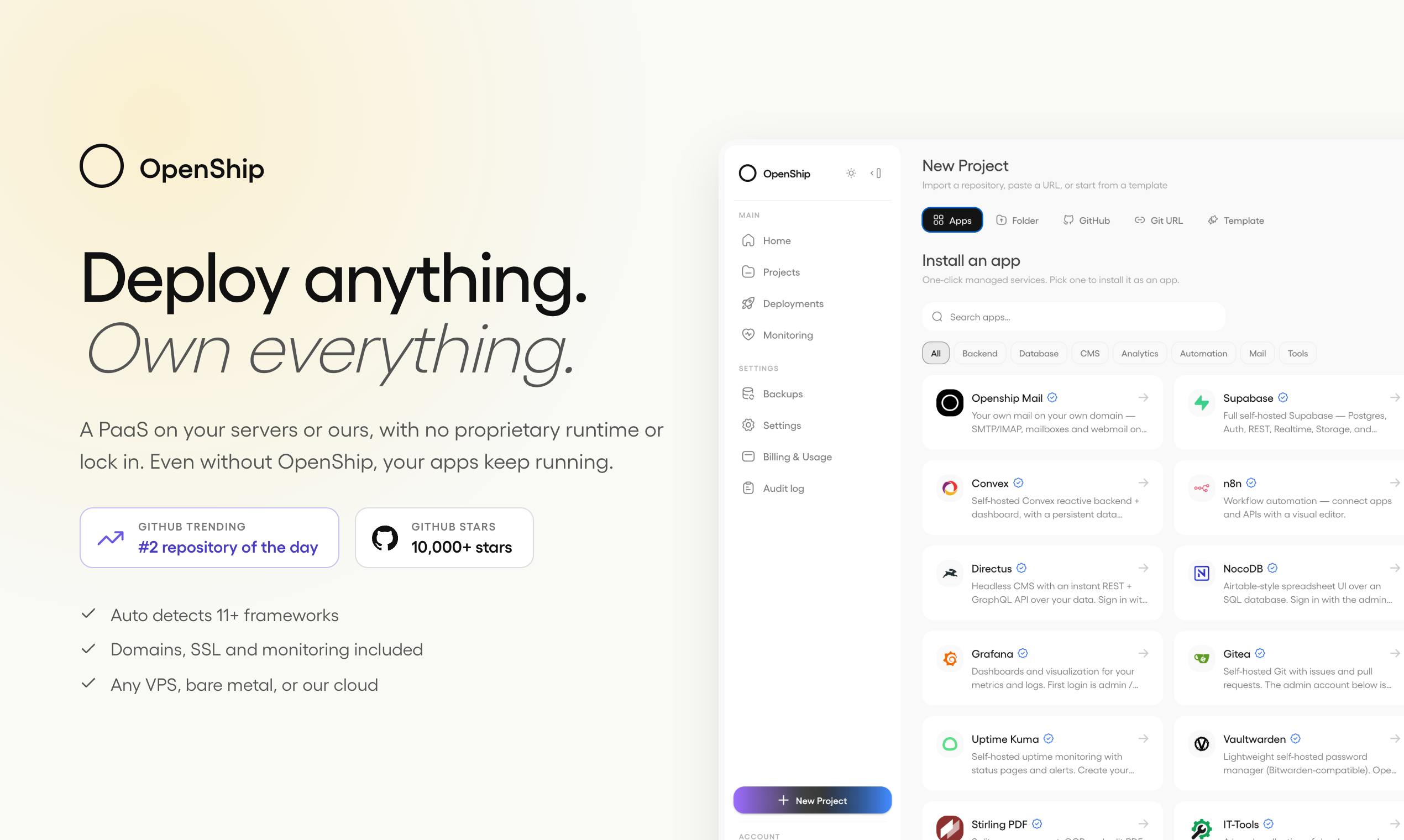
OpenShip's tagline is refreshingly direct — "Deploy anything. Own everything." Push your code, and the platform automatically handles builds, deployments, domains, SSL certificates, monitoring, backups, secret management, and the services your app depends on. The experience mirrors mature PaaS platforms like Heroku, Vercel, and Railway — except OpenShip is open source and lets you choose where it runs.
What "No Lock-In" Actually Means
Vendor lock-in is an unavoidable conversation in the cloud-native era. Many PaaS platforms rely on proprietary runtimes or private protocols, meaning a migration often requires rewriting deployment configs or rearchitecting the application itself. OpenShip aims to eliminate this problem at the root.
The official description highlights three key promises: No proprietary runtime, No vendor lock-in, and the most compelling one — "Remove OpenShip and your apps keep running." This positions OpenShip as an orchestration layer over standardized containers and deployment workflows, rather than a closed ecosystem that traps your applications. In theory, even if you decide to abandon the platform one day, your underlying apps won't break.
A Dual-Mode Model: Cloud-Managed and Self-Hosted
OpenShip offers two deployment modes: use the official OpenShip Cloud for a fully managed, out-of-the-box experience, or self-host it on your own cloud servers or on-premises infrastructure. The genuinely valuable part is that you can migrate freely between the two without changing how you deploy.
This design appeals to teams at different stages: early-stage projects can start fast on the cloud, then smoothly migrate to their own infrastructure as they scale — whether for compliance, cost, or control reasons — without the painful rebuild that typically comes with platform migrations.
The "no proprietary runtime" promise is typically achieved through containerization standards, particularly Docker and the OCI (Open Container Initiative) image spec. Traditional PaaS platforms like early Heroku used private Buildpacks and Dyno runtimes, tightly coupling the app's packaging format to the platform. Container-based deployments, by contrast, can run on any host that supports the Docker runtime — whether that's a public cloud or a local machine. OpenShip's claim that "apps keep running after removal" is essentially a commitment to standardizing the delivery unit as a portable container, not a platform-proprietary format. This aligns with the design philosophy of the Kubernetes ecosystem: the platform acts as a scheduling layer without invading the app's runtime.
"On-prem" (short for on-premises) refers to running software on a company's own physical servers or private data centers, rather than on third-party cloud infrastructure. Common motivations include data compliance requirements (e.g., GDPR, healthcare, or financial regulations that prohibit data from leaving certain jurisdictions), long-term cost optimization at scale (owning hardware can be more economical than pay-as-you-go cloud at high workloads), and fine-grained control over latency and data sovereignty. For a PaaS product, supporting both cloud and on-prem deployment is an architectural challenge — the two environments differ significantly in storage backends, network topology, and authentication mechanisms, which is the primary source of the hidden migration friction discussed in the caveats section below.
Who Is This Built For?
Looking at OpenShip's Product Hunt category tags — Open Source, SaaS, Developer Tools, and GitHub — the target user profile is pretty clear:
- Teams that prioritize data sovereignty: Those who want their apps and data to stay on servers they control.
- Cost-conscious small and mid-sized teams: Self-hosting avoids the fee inflation that managed platforms often impose as you scale.
- Open-source advocates wary of lock-in: Open source means auditable, customizable, and maintainable over the long term.
For these users, OpenShip aims to be the open-source alternative to the Heroku-style experience — while preserving the freedom to leave.
Things Worth Watching
As a product that just launched on Product Hunt, the official messaging is full of ambitious promises, but externally verifiable information is still limited. A few areas worth monitoring:
- Maturity and stability: Builds, monitoring, backups, and secret management form a complex, interconnected system. Real-world production reliability will take time to prove out.
- How seamless migration actually is: The promise of migrating "without changing your deployment" sounds ideal, but differences in networking, storage, and permissions between cloud and self-hosted environments often introduce hidden friction.
- Community and ecosystem: The long-term competitiveness of an open-source PaaS depends heavily on community activity, plugin ecosystems, and documentation quality.
Conclusion
OpenShip addresses the classic tension between managed convenience and infrastructure autonomy, offering its answer through a combination of open source and dual-mode deployment. Its core idea — giving developers one-click deployments without platform lock-in — is genuinely appealing to teams tired of vendor dependency. Whether the product can deliver on these promises remains to be seen through real-world usage and sustained community investment. For teams currently evaluating alternatives to Heroku, Railway, or similar platforms, OpenShip is worth adding to your watchlist.
Related articles

ChatGPT Space Launches: Team Collaboration and New Pages Features Explained
ChatGPT Space is OpenAI's new team collaboration feature with Pages, real-time collaboration, and Slack/Google Drive sync. We break down its privacy design, multi-platform integration, and the full workflow from conversation to document.

Migrating Apache Spark UDFs to GPU Acceleration with AI Agents
NVIDIA developer blog explains how AI Agents rewrite Apache Spark UDFs for GPU acceleration, covering migration criteria, agent rewriting and verification workflows, plus pitfalls like result consistency and CPU-GPU transfer overhead.

Zed Editor v0.40.4-rc2 Released: Usage Credits Now Available Without Upgrading
Zed editor releases v0.40.4-rc2, allowing users to use usage credits for AI features without upgrading to a paid plan, lowering the trial barrier.