OpenSSL Exposes Critical CVSS 9.8 Vulnerability: EVP_EncodeBlock Buffer Overflow

OpenSSL's EVP_EncodeBlock() exposes a CVSS 9.8 buffer overflow vulnerability, drawing intense community attention.
OpenSSL's Base64 encoding function `EVP_EncodeBlock()` has a disclosed buffer overflow vulnerability, CVE-2026-121481, with a CVSS score of 9.8 — the highest severity. The function is often called directly or indirectly by higher-level APIs and third-party projects, and the overflow can cause memory corruption, posing serious threats to confidentiality, integrity, and availability. Hacker News discussion garnered 291 points and 227 comments, reflecting developers' heightened concern about foundational cryptographic library security. Public information mainly points to GitHub PR #33652, though specific trigger conditions and affected versions remain unclear. Developers are advised to inventory OpenSSL dependencies, follow official advisories, prepare patch upgrades, and establish long-term vulnerability intelligence tracking.
Title
OpenSSL Exposes Critical CVSS 9.8 Vulnerability: EVP_EncodeBlock Buffer Overflow
Meta Description
OpenSSL discloses CVE-2026-121481 buffer overflow in EVP_EncodeBlock(), CVSS 9.8. This article covers key points, community reaction, and developer guidance.
Article Content
OpenSSL is once again in the security community's spotlight. A buffer overflow vulnerability tracked as CVE-2026-121481 has been disclosed with a CVSS score of 9.8 — the most severe level. The flaw resides in the EVP_EncodeBlock() function. The news spread rapidly on Hacker News, garnering 291 points and 227 comments, with the heated discussion reflecting developers' heightened sensitivity to the security of foundational cryptographic libraries.
The Core Issue: Why EVP_EncodeBlock Is Dangerous
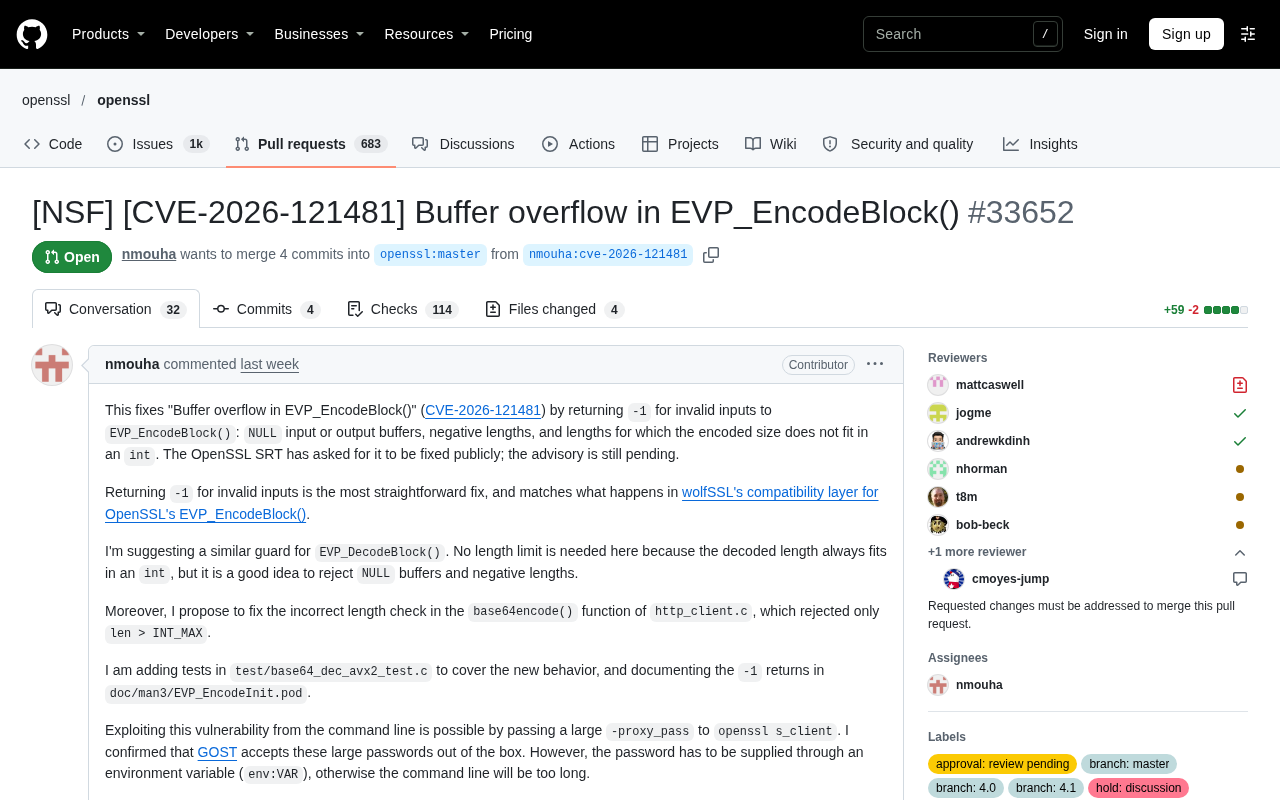
EVP_EncodeBlock() is a low-level Base64 encoding function in OpenSSL, often called directly or indirectly by higher-level APIs and third-party projects. A buffer overflow means that under specific input conditions, the function may write data beyond the bounds of the target buffer, triggering memory corruption. Combined with the CVSS 9.8 rating, this vulnerability poses a serious threat to confidentiality, integrity, and availability.
Currently, public information mainly points to GitHub PR #33652, which appears to be related to the fix or associated code changes. Since the source material does not provide specific trigger conditions, affected version ranges, or exploitation details, developers should closely monitor OpenSSL's official security advisories and patch notes rather than relying solely on social media discussions.
Base64 Encoding and Buffer Overflows
Base64 is an encoding scheme that maps binary data to 64 printable ASCII characters, commonly used to safely transmit binary content over text-based protocols (such as JSON, email, and PEM certificates). The encoded length is typically 4/3 times the original data and requires padding to align to 4-byte boundaries. As OpenSSL's low-level Base64 encoding implementation, EVP_EncodeBlock() requires the caller to pre-allocate a sufficiently large output buffer; if the function incorrectly calculates input length or padding logic internally, it may write data beyond the buffer — a buffer overflow.
At the C language level, a buffer overflow can overwrite control data in adjacent memory (such as return addresses or function pointers). If an attacker can control the input, they may be able to hijack the program's execution flow or cause a denial of service. A CVSS 9.8 rating typically means the vulnerability can be triggered remotely, requires no authentication, and has severe impact — making it especially dangerous for services directly exposed to the network.
Community Reaction: Real Anxiety Behind the High Attention
The 227 comments on Hacker News indicate that this matter has sparked extensive technical discussion. As the foundation for TLS/SSL and a vast number of cryptographic operations, any high-severity vulnerability in OpenSSL can affect countless downstream applications. Memories of past incidents like Heartbleed keep the community highly vigilant about such news.
It is worth noting that the discussion may involve questions about OpenSSL's code audit processes, fuzzing coverage, and maintainer response speed, but specific views should be based on the original thread's comments. For enterprise security teams, the most pragmatic action right now is to inventory their tech stack's dependence on OpenSSL, especially scenarios that directly call EVP_EncodeBlock().
The Reference Significance of the Heartbleed Incident
Heartbleed (CVE-2014-0160) is one of the most famous vulnerabilities in OpenSSL's history. It stemmed from a missing bounds check on request length in the TLS heartbeat extension implementation, allowing attackers to read sensitive data from server memory (such as private keys and session tokens). The vulnerability had an extremely broad impact, and the remediation process forced a large number of systems to upgrade OpenSSL and replace certificates, making it a classic case of security risks in foundational libraries. The community's high attention to the current EVP_EncodeBlock() vulnerability is rooted in memories of Heartbleed's cascading effects — flaws in low-level libraries are rapidly amplified along the dependency chain.
Developer Response: From Dependency Inventory to Patch Follow-Up
Faced with a CVSS 9.8 vulnerability, passive waiting is not advisable. Development and security teams can immediately take several actions: confirm the OpenSSL version used in production environments, check whether the codebase directly or indirectly calls the affected encoding function, and subscribe to OpenSSL's security advisory channels.
If a project depends on OpenSSL indirectly through a language runtime or framework, it is important to monitor the update cadence of upstream maintainers. After an official patch is released, it should be verified in a test environment first, then gradually rolled out to production. For services exposed to the public internet, temporary mitigations (such as restricting anomalous input) are worth evaluating, but the fundamental solution still relies on upgrading to the fix.
Software Bill of Materials (SBOM) and Dependency Transparency
A Software Bill of Materials (SBOM) is a structured inventory recording software components and their dependencies, helping teams quickly locate how a library (such as OpenSSL) is introduced into the tech stack and its version. When facing a high-severity vulnerability, if an organization already maintains an SBOM, it can quickly answer the critical question of "which services use the affected version" without manually checking each project. Common SBOM standards include SPDX and CycloneDX, and many build tools and package managers already support automatic generation. Combined with vulnerability intelligence sources (such as NVD and OpenSSL security advisories), SBOMs can transform incident response from passive searching to proactive querying, significantly shortening the exposure window.
The Long-Term Challenge of Foundational Library Security
This vulnerability once again reminds us that the lower-level and more widely used a library is, the greater the amplifying effect of its security flaws. The OpenSSL community and the entire ecosystem that depends on it need to continuously invest in code auditing, fuzzing, and rapid response mechanisms. For developers, maintaining transparency in dependency inventories and establishing vulnerability intelligence tracking processes is more valuable than reactive firefighting.
Until official details are further disclosed, it is recommended to rely on GitHub PR #33652 and OpenSSL's official channels as information sources, and to avoid spreading unverified exploitation methods.
One-line Summary
OpenSSL's EVP_EncodeBlock() exposes a CVSS 9.8 buffer overflow vulnerability, drawing intense community attention.
Paragraph Summary
OpenSSL's Base64 encoding function EVP_EncodeBlock() has been disclosed to contain a buffer overflow vulnerability, tracked as CVE-2026-121481, with a CVSS score of 9.8 — the highest severity level. The function is often called directly or indirectly by higher-level APIs and third-party projects; the overflow can cause memory corruption and poses a serious threat to confidentiality, integrity, and availability. The Hacker News discussion received 291 points and 227 comments, reflecting developers' heightened sensitivity to the security of foundational cryptographic libraries. Current public information mainly points to GitHub PR #33652, but specific trigger conditions and affected versions remain unclear. The article recommends that developers immediately inventory OpenSSL dependencies, monitor official advisories, prepare for patch upgrades, and establish long-term vulnerability intelligence tracking processes.
Related articles

AI Coding Model Leaderboard: Opus 5.5 Crowned, Gemini Neon Stages a Comeback
Tech blogger Matthew Berman releases an AI coding model tier list: Claude Opus 5.5 holds S-tier, Gemini Neon surprises with A-tier, OpenAI Astra lands B-tier. How do open-source models like DeepSeek fare? We break down the scoring logic and practical takeaways.

New Jersey Joe Sandwich: Meat and Coleslaw on Triple-Decker Rye
New Jersey Sloppy Joe isn't a ground beef burger—it's triple-decker rye bread with meat, Swiss cheese, and coleslaw, plus Russian dressing. Learn the authentic Essex County method and family recipe.

Genie 4's New Trick: Change Scenes in Real Time While Exploring Generated Worlds, and Add Characters Too
Google Genie 4 adds real-time prompting: enter new prompts while exploring generated worlds to add characters or switch scenes, with native audio adapting in sync. Available to eligible Google AI Ultra subscribers in Project Genie.