OpenVorld: Give Your AI Agents a Pixel Village You Can See

OpenVorld visualizes AI agents as pixel villagers and keeps humans in the loop with pre-execution confirmation.
OpenVorld is an open-source AI agent harness that presents each project as a pixel-art village where agents have names and roles and can connect to Claude Code, Codex, or OpenAI-compatible APIs. Its core design includes a visual observability layer and pre-execution permission prompts, letting users supervise agents intuitively and confirm sensitive operations. It's free, open source, runs locally, and requires no account—aimed at developers sensitive about data flows. Product Hunt data shows 70 votes, 5 comments, and 11th place for the day, indicating an early stage. Its value lies in a new perspective on human-AI collaboration rather than enhanced agent capabilities.
From Black Box to Village: A Visual Governance Experiment for AI Agents
AI agents are taking over more and more development tasks, but how they operate remains a black box for most people. OpenVorld, an open-source project that just surfaced on Product Hunt, tries to change that: it places each AI agent in a pixel-art village, gives them names, assigns them roles, connects them to different brains, and lets humans watch the squad work from the sidelines.
According to its Product Hunt page, OpenVorld is an open-source harness. Since launch, it has received 70 votes and 5 comments, ranking 11th for the day. Developer Amir Ghasemi positions it as "a visible home for AI agents"—free, open source, running locally, with no account registration required.
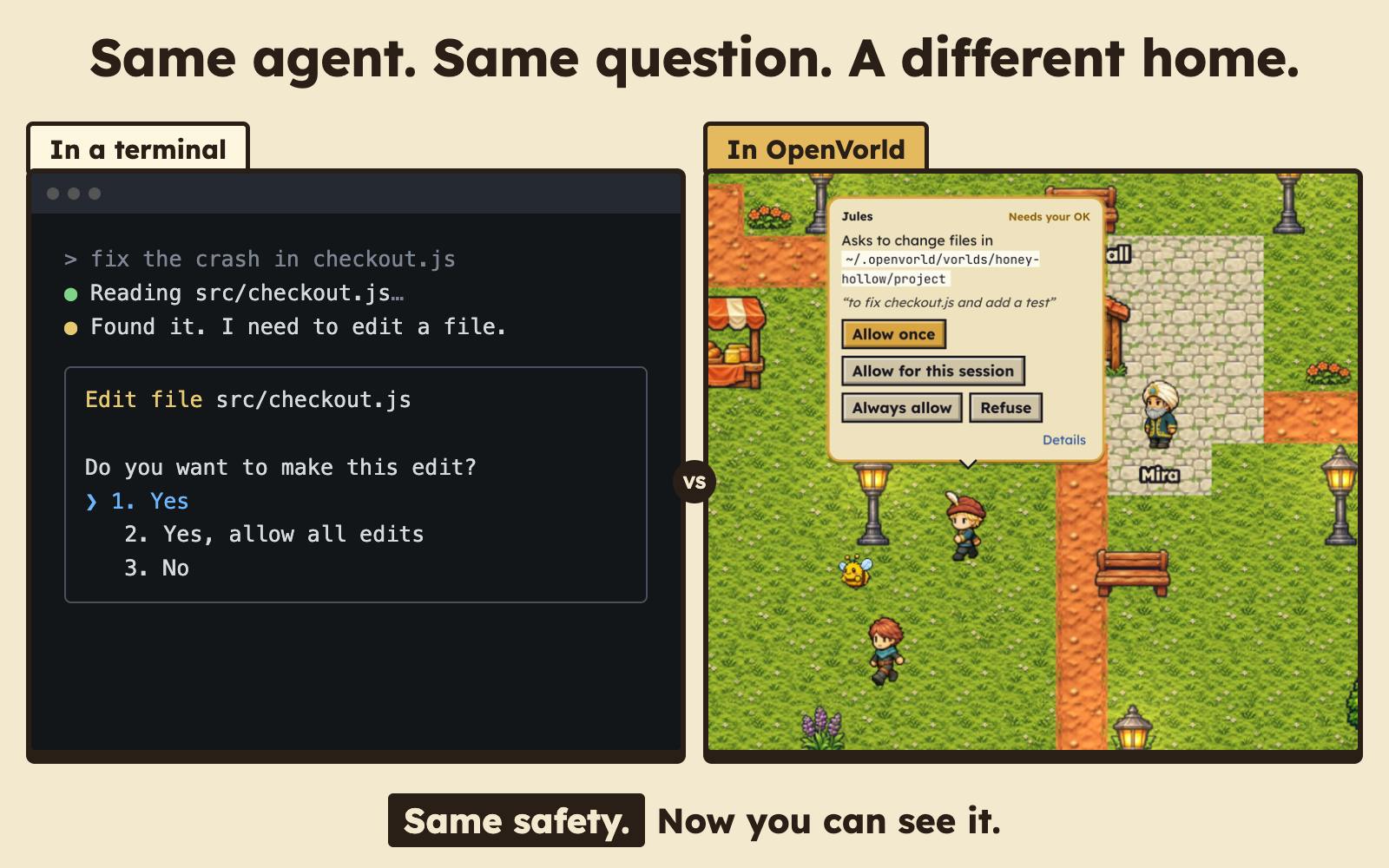
The Pixel Village as an Observability Layer
OpenVorld's core design isn't complicated: each project maps to a pixel-art village, and each agent has its own name and role in the village. Their brains can connect to Claude Code, Codex, or any API compatible with the OpenAI interface. Users don't need to dig through logs to guess what an agent is doing—they simply watch this "team of villagers" at work.
The clever part is making abstract task orchestration tangible. Traditional multi-agent frameworks tend to present status through config files or console output, which makes it nearly impossible for non-engineers to participate in oversight. The pixel village provides an intuitive observability shell that makes key signals—permission requests, task progress—perceptible.
In software systems, observability usually refers to the ability to infer internal system state through logs, metrics, and traces. For multi-agent systems, observability is especially critical: developers need to know which agent is executing which task, whether errors have occurred, and whether sensitive permissions have been requested. Traditional frameworks provide observability through text logs or console output, whereas OpenVorld replaces this layer with the visual metaphor of a pixel village—each agent's state maps to a position, animation, or interaction prompt within the village. This lowers the barrier for non-engineers to participate in oversight, but it remains fundamentally a design choice for an observability interface.
It Asks Before It Acts: Visible Permission Boundaries
Another mechanism OpenVorld emphasizes is the pre-execution confirmation step. Before an agent accesses a folder, runs a command, or opens a website, it first asks the user. In other words, permission boundaries aren't hidden conventions buried in system prompts—they're explicit interaction steps out in the open.
This matters especially for locally running agents. When AI can read and write the file system, invoke the shell, and access the network, a single misstep can be costly. Making confirmation explicit is, in a sense, trading interaction friction for controllability. This is also where OpenVorld differs from products chasing fully automated pipelines: it doesn't try to let agents run unattended at full speed—it keeps humans in the loop.
In the AI agent space, "human-in-the-loop" is a common control pattern that introduces human confirmation or intervention at key points in an automated workflow. Its opposite is the fully automated pipeline, where an agent executes multiple steps continuously without interruption. Every permission prompt in OpenVorld is an implementation of human-in-the-loop, but its distinguishing feature is making the prompts visual and mandatory—not optional logging, but a required step before execution. This design is especially important in local environments, where agents can operate on real file systems and command lines, and the consequences of mistakes are irreversible.
The Trade-offs of Open Source and Local-First
OpenVorld claims to be free, open source, locally run, and account-free. Together, these point to a clear target audience: developers who are sensitive about data flows and want to control their own runtime environment. Local execution means task context and file access don't have to pass through third-party servers, and open source means the permission mechanism and village rendering logic can be audited and modified.
The costs are real too. Local-first usually means users must supply their own API keys and configure model backends, which isn't friendly to non-technical users. The modest engagement of 5 comments on Product Hunt also suggests the project is still in its early stages, with community ecosystem and documentation maturity yet to be proven.
An API compatible with the OpenAI interface refers to a service endpoint that follows the OpenAI Chat Completions specification. Many open-source models (such as the Llama series deployed via vLLM) or third-party APIs (such as DeepSeekAd, Mistral) provide this compatibility layer, allowing the same client code to switch between different model backends. OpenVorld lets agents connect to Claude Code, Codex, or any OpenAI-compatible API, meaning users can use either commercial closed-source models or connect to local inference services—trading off between data privacy and model capability.
Conclusion
OpenVorld's value isn't in proposing new agent capabilities, but in offering a different perspective on human-AI collaboration: treating AI agents as "villagers" who need to be observed and managed, using a visual village to lower the cost of understanding, and using pre-execution confirmation to guard permission boundaries. For developers who want to supervise multi-agent workflows without handing over full control, this is an open-source experiment worth adding to the watchlist.
Related articles

From 0 to 1: Vibe Coding an AI Knowledge Base — A Practical Retrospective and Tech Stack Breakdown
A retrospective on building the AI knowledge base OilBook from scratch with Vibe Coding: Next.js+Neon stack, Oil Dev Skill workflow, Stripe paywall security, interview-style writing, AI-flavor control, and Vercel deployment.

GLM-5.4 Hands-On: Native Vision Meets a New Vibe Coding Workflow
Hands-on with Zhipu GLM-5.4: native vision tested across a 3D product demo, pure-code video generation, and remote-control Vibe Coding, compared with GPT-6.2 and Gemini Neon.

AI and Humans Claim to Prove the Riemann Hypothesis: Machine-Verified, Yet Nobody Can Understand It
Anthropic mathematician and AI Claude claim to prove the Riemann Hypothesis with 17 million lines of Lean code, machine-verified but unreadable by humans. This article analyzes the event, the zero proportion record from 41.6% to 67.2%, and the gap between machine verification and human understanding.