OpenWhispr for iOS: An Open-Source, Free On-Device Transcription Tool

OpenWhispr is a 100% open-source iOS app that transcribes entirely on-device, free and unlimited with BYOK support.
OpenWhispr is an iOS voice transcription app gaining attention on Product Hunt, with a core pitch of being 100% open source, free, and fully on-device — no audio ever uploaded to the cloud. It addresses the privacy trade-offs and ongoing costs of mainstream cloud solutions by running models locally for offline transcription with no usage limits or account needed. It offers local, optional cloud, and BYOK modes, letting users choose their own privacy-versus-performance balance. Open source brings verifiability, customizability, and sustainability. Current traction is modest, and the on-device experience depends on device chip and model size, but it provides a runnable open-source option for privacy-sensitive users.
When Voice Transcription No Longer Needs the Cloud
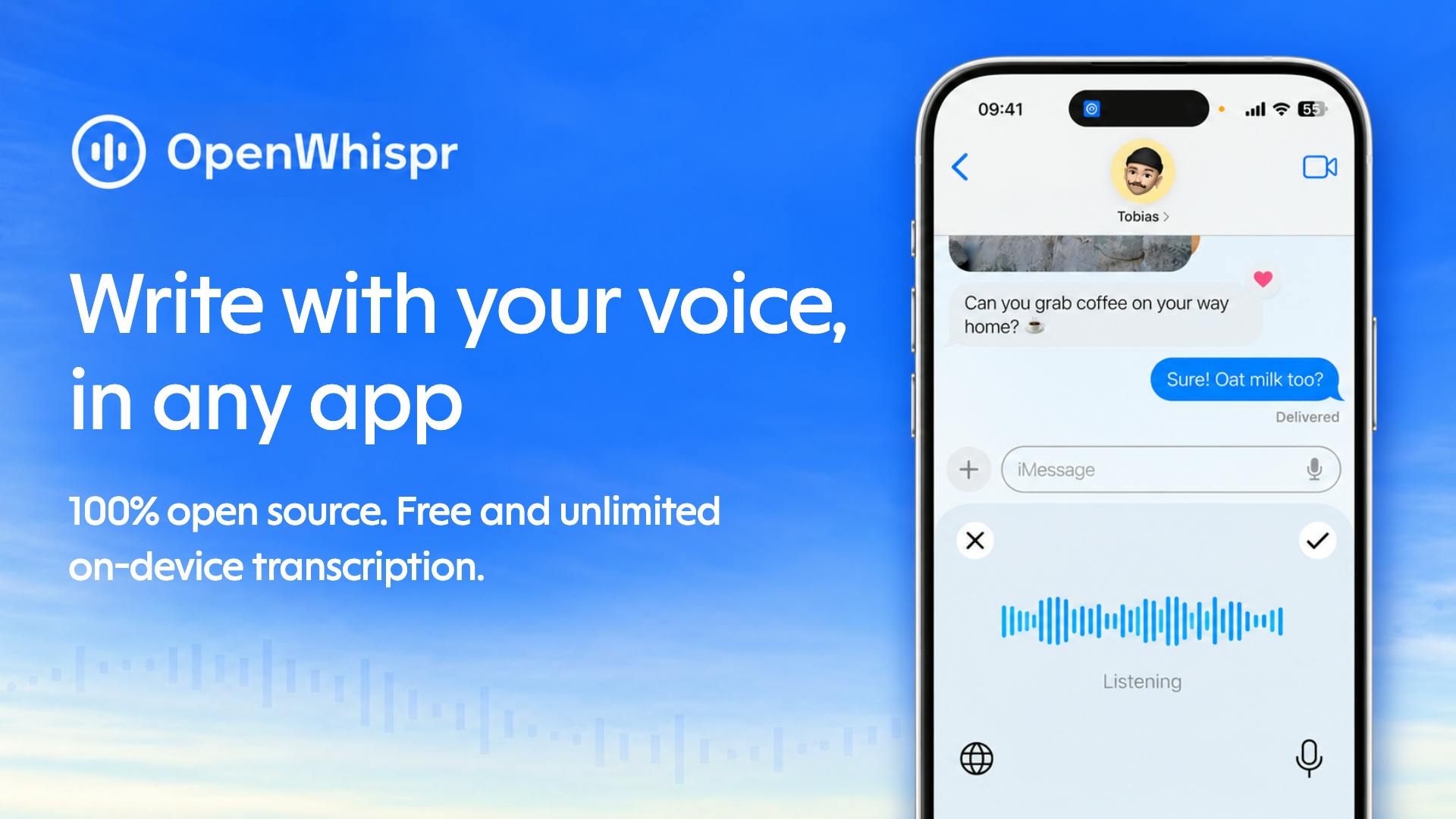
With privacy awareness and offline needs growing in tandem, an iOS app called OpenWhispr has drawn attention on Product Hunt. Its core selling point is refreshingly straightforward: 100% open source, free, and fully on-device transcription.
This means when users speak into an iPhone or iPad, the audio never needs to be uploaded to any server — transcription happens locally, with no usage caps and no account registration or subscription required.
What Problem Does It Solve?
Most mainstream speech-to-text solutions rely on the cloud: record, upload, server inference, return results. This pipeline carries two hidden costs — surrendered privacy and ongoing payments.
OpenWhispr chooses to run the model directly on the phone. Users only need to download the model once, and after that they can transcribe even offline. For those who regularly handle sensitive content — a lawyer dictating memos, a journalist organizing interviews, a doctor jotting down preliminary thoughts — local processing eliminates the concern of audio leaving the device.
The official description notes that you can "speak replies, draft emails, or capture ideas without uploading audio for transcription." This positioning pushes it from being a mere tool to a privacy-first workflow component.
Local Model + Optional Cloud + Bring Your Own API Key
OpenWhispr doesn't make the local route the only option — it offers a tiered strategy:
- Local mode: Fully offline operation after downloading the model, free and unlimited
- Cloud mode: An optional cloud processing path for scenarios demanding higher speed or accuracy
- BYOK (Bring Your Own Key): Users can enter their own API key to connect to third-party transcription services
This design acknowledges a reality: on-device models don't always match cloud-based large models in speed and accuracy. Returning the choice to users, rather than making the privacy-versus-performance trade-off on their behalf, is a sign of maturity for this category of tools.
On-device speech recognition models are typically based on sequence-to-sequence architectures like Whisper. OpenAI's open-source Whisper model comes in various parameter sizes — tiny, base, small, medium, and large — ranging from roughly 39 million to 1.55 billion parameters. Running on iOS devices requires converting the model to Core ML or using inference frameworks like whisper.cpp, accelerated by Apple's Neural Engine. Larger models yield higher recognition accuracy but also increase memory usage and inference latency — for example, the large model may occupy over 1 GB of storage, while the tiny model takes only about 75 MB. This trade-off between accuracy and resources directly determines whether on-device transcription is usable on older iPhones.
Bring Your Own Key (BYOK) is an integration pattern that lets users supply their own third-party API keys. In this model, the app itself doesn't bear inference costs or handle users' keys and audio data — instead, users directly call APIs from services like OpenAI or Deepgram. For developers, this avoids the compliance and billing complications of reselling APIs; for users, it means they can freely choose providers and control costs, though they need to manage key security themselves.
What Does Open Source Mean?
"100% open source" is more than a licensing statement. For a transcription tool, open source delivers at least three forms of value:
Verifiability. Users and auditors can inspect the code to confirm that audio truly isn't being uploaded secretly. Privacy promises shift from "trust us" to "see for yourself."
Customizability. Developers can fork the project, swap models, connect their own backend, or even embed it into larger applications.
Sustainability. Even if the original team stops maintaining it, the community can take over. For long-term workflows that depend on transcription, this matters more than short-term feature iterations.
Verifiability in practice is often strengthened through reproducible builds: if anyone can compile the same source code into a binary identical to the App Store version, it confirms that the released version doesn't contain extra code. The iOS ecosystem has certain limitations here, since apps must be signed to install, but open-source code at least lets security researchers audit the logic, inspect network request behavior, and use packet-capture tools to verify that audio really isn't leaving the device.
Differences in open-source licenses are also worth noting. Permissive licenses like MIT and Apache 2.0 allow closed-source commercial use and redistribution, while the GPL family requires derivative works to also be open source. If OpenWhispr adopts a permissive license, the barrier for community forks is lower — but it also means others can repackage it as a closed-source product. If it adopts a copyleft license, it ensures improvements flow back to the community but restricts how it can be commercially integrated.
Points Worth Watching
As of the time of listing, OpenWhispr had received 84 upvotes and 4 comments on Product Hunt, ranking 14th. The numbers aren't spectacular, but the track it's in — local-first productivity tools — is accumulating genuine demand.
What's worth noting is that the actual on-device transcription experience depends heavily on device chip performance and model size. Larger models mean higher accuracy but more storage and memory usage; there may also be experience differences between iPhone and iPad. These details aren't elaborated in the official description and require real-world use to judge.
For users unwilling to hand their voice to the cloud, OpenWhispr offers an open-source option worth trying. Its value isn't in how flashy the features are, but in turning "privacy" from marketing rhetoric into runnable code.
Related articles

Chain of Thought Isn't Just for AI: How Humans Can Use CoT to Improve Thinking Quality
Chain of Thought isn't just a prompt trick for large models. Starting from a Hacker News discussion, this article analyzes why CoT works for human thinking too, breaks down actionable ways to transfer it, and highlights the key differences between human CoT and machine CoT.
Cloudflare Teams Up with OpenAI: Closi…
Cloudflare Teams Up with OpenAI: Closing the Loop from Vulnerability Discovery to Defense with AI
Cloudflare uses OpenAI Daybreak to investigate security vulnerabilities and generate reviewable remediation plans, while developers use Codex to boost coding efficiency and quality.

Orca Multi-Agent Orchestration in Practice: A Guide to Parallel Collaboration with Claude and Codex
Orca is Stable AI's free open-source agent workbench supporting 34 agents like Claude Code and Codex in parallel. Learn its Git worktree isolation, multi-model orchestration, and mobile management.