OpenWiki: A CLI Tool That Automatically Generates AI Agent Documentation for Codebases

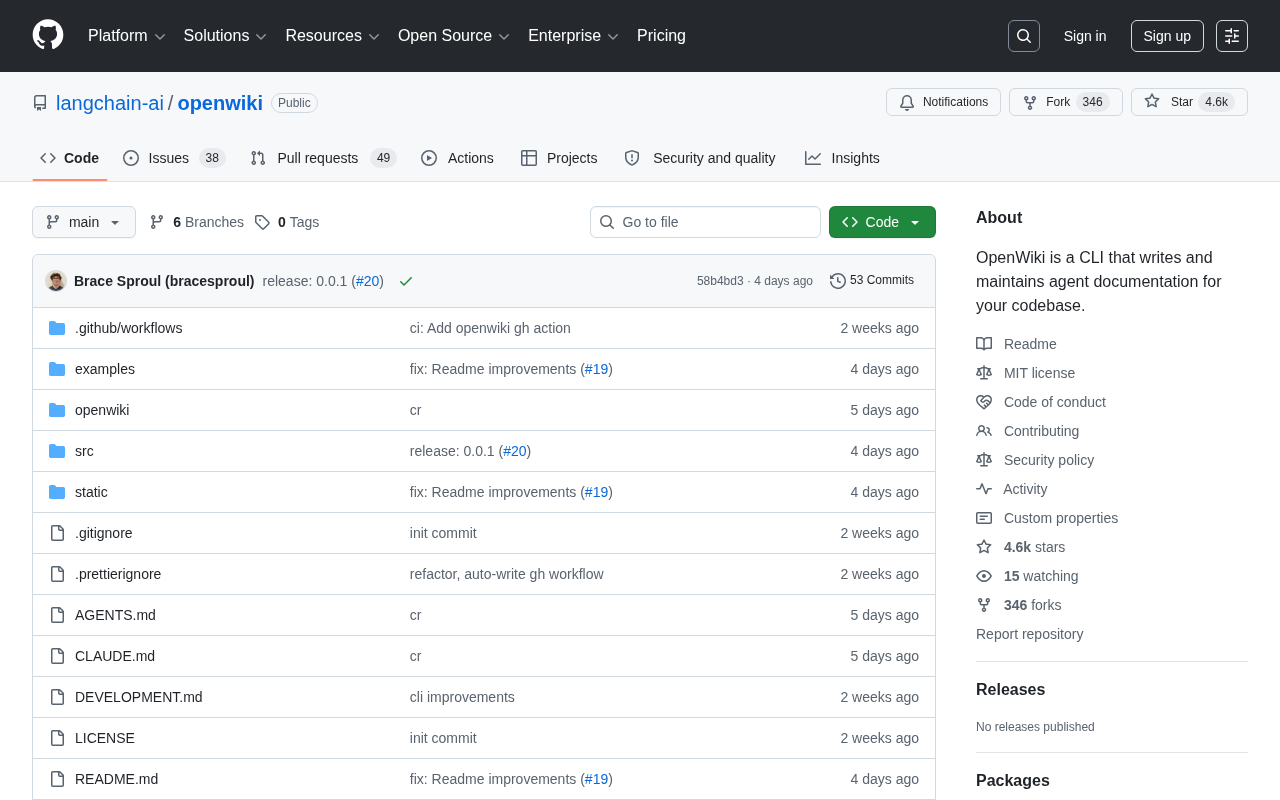
OpenWiki is a CLI tool that auto-generates and maintains AI-agent-readable documentation for your codebase.
OpenWiki is an open-source CLI tool that automatically writes and continuously maintains structured documentation designed for AI agents rather than human developers. It addresses a core pain point in AI-assisted development: agents like Claude Code and Cursor lack project context, leading to inconsistent or incorrect code generation. By automating the creation of machine-readable knowledge bases, OpenWiki supports context engineering and RAG-based workflows.
A New Pain Point in the AI Programming Era: Agents Need Context Too
As AI coding assistants like Claude Code, Cursor, and GitHub Copilot become deeply embedded in development workflows, a new challenge has surfaced: how do AI agents actually understand your codebase?
These tools all rely on large language models (LLMs) to understand code. They work by packaging code snippets, file contents, and user instructions into prompts, which are sent to the model — which then generates responses based on programming patterns learned during training. Architecturally, LLMs use the Transformer attention mechanism, processing each inference independently within a context window, with no persistent state across sessions. This is fundamentally different from traditional software session management. The model has no storage layer; what we call "memory" is simply historical information serialized as text and stuffed into the current context.
This inherent statelessness makes models easy to scale horizontally, but it also means that project background, team conventions, and architectural decisions — all that implicit knowledge — must be explicitly reconstructed in every conversation. Since models can't persist memory beyond a single session, every new task starts from scratch. Project-level context must be injected explicitly each time, rather than relying on any notion of "long-term memory."
Traditional code documentation is written for humans — READMEs, API docs, architecture guides that help new team members get up to speed. But in AI-assisted development, agents also need context to accurately understand project structure, module responsibilities, and coding conventions. Without structured context, AI-generated code often suffers from inconsistent style, misunderstood business logic, and incorrect architectural assumptions.
OpenWiki — an open-source tool that recently sparked discussion on Hacker News — was built specifically to address this pain point. It's a CLI tool that automatically writes and continuously maintains agent-oriented documentation for codebases.
What Is OpenWiki
Core Positioning: Not Documentation for Humans
OpenWiki's positioning can be summed up in one sentence: a CLI tool that automatically writes and continuously maintains agent documentation for your codebase.
Traditional documentation tools like JSDoc, Doxygen, and Sphinx are built around the philosophy of "extracting structured comments from code" — they rely on developers manually writing comments in a specific format, which the tool then parses to generate HTML or PDF output. These tools excel at precision (content fully controlled by humans) and deep IDE integration, but their weakness is obvious: if developers don't write comments, there's nothing meaningful to generate.
AI-native documentation tools like OpenWiki take a completely different approach: they use LLMs' code comprehension capabilities to directly infer natural language descriptions from code logic, with no comments required as an intermediary. OpenWiki's target audience isn't human developers — it's AI agents. The goal is to generate a structured, machine-readable project knowledge base that allows AI assistants to quickly acquire a global view of a project when tackling coding tasks.
This approach aligns with the emerging conventions around AGENTS.md, CLAUDE.md, and .cursorrules files — a standardization trajectory similar to what we saw with .editorconfig and .gitignore. .cursorrules was originally popularized organically by the Cursor editor community to inject project-level coding standards and tech stack preferences into AI context. CLAUDE.md is Anthropic's officially recommended convention: placed in the project root, it's automatically read by Claude Code as a supplement to the system prompt. Since 2024, GitHub Copilot has also introduced support for copilot-instructions.md, and the industry is converging on an informal standard around "AI-readable project metadata."
While these tools use slightly different proprietary formats, their core structure is converging: tech stack description, coding style preferences, module responsibility descriptions, and a list of prohibited behaviors. For teams, it's best to maintain one canonical AGENTS.md or CLAUDE.md as the source of truth, then use symlinks or build scripts to adapt it for each tool's proprietary format — avoiding consistency drift across multiple files. The core value of these files is "write once, reuse every time" — sparing developers from re-explaining project context at the start of every AI conversation. OpenWiki automates this process, dramatically reducing the manual maintenance burden.
Three Core Pain Points It Addresses
Manually maintaining AI context documentation has several obvious problems:
- Staleness: Code evolves continuously, and hand-written docs go out of date quickly. Outdated information can actively mislead AI agents.
- Incomplete coverage: It's difficult to comprehensively describe the responsibilities and dependencies of every module in a large codebase by hand.
- Inconsistency: Documentation maintained by multiple contributors varies in style and lacks a unified structure that AI can effectively use.
OpenWiki automatically scans the codebase via CLI, generates structured documentation, and supports continuous incremental updates — in theory keeping agent documentation in sync with the code at all times.
Why "Agent Documentation" Deserves Developer Attention
The Audience for Documentation Is Changing
Software documentation is undergoing a paradigm shift. "Documentation as Code" has been a cornerstone of software engineering best practices for the past decade — the core idea being to store documentation alongside code in version control (like Git), write it in lightweight markup like Markdown, and build and publish it automatically via CI/CD pipelines. This significantly improved documentation timeliness and maintainability, and companies known for developer experience — like Stripe and Twilio — are strong practitioners.
But Docs as Code assumes the consumers of documentation are human developers. As AI becomes a major "consumer" of codebases, documentation must now serve both humans and machines. Information density (the amount of effective information conveyed per token), structural consistency (formats that are easy for LLMs to parse), and machine readability are now just as important as human readability.
Context Window Constraints and the Value of Documentation
When AI agents perform tasks, they're constrained by the context window — they can't read an entire codebase at once. The context window is the hard limit on how much information a model can process in a single pass, measured in tokens. GPT-4's context window is around 128K tokens; Claude 3 models support up to 200K tokens. But a medium-sized codebase (tens of thousands of lines of code) can easily exceed these limits.
Crucially, a larger context window doesn't proportionally improve comprehension quality. A 2023 Stanford research paper, Lost in the Middle, revealed a key flaw in how LLMs handle long contexts: models are significantly more attentive to information at the beginning and end of the context than in the middle. When critical information is buried in the middle of a very long context, the model's accuracy can drop by more than 20%. This stems from how positional encodings decay in the attention mechanism, combined with biases in training data distribution.
The practical implication for code documentation is clear: even with a large enough context window, placing core architecture information, key constraints, and module dependencies early in the prompt still matters enormously. Document structure is just as important as total information volume when it comes to AI comprehension quality.
This means AI assistants can only see what's explicitly provided within the current conversation window — they have no complete "memory" of the codebase.
To address this limitation, the industry has developed Retrieval-Augmented Generation (RAG). RAG for code understanding typically involves three key engineering components: first, chunking strategy — code files shouldn't be split by fixed character counts, but by semantic boundaries like functions, classes, or modules, preserving complete code units; second, embedding model selection — general-purpose text embedding models (like text-embedding-ada-002) don't understand code semantics as well as code-specific models (like CodeBERT or GraphCodeBERT), which typically achieve 15–30% higher recall on code retrieval tasks; third, retrieval strategy — hybrid retrieval combining semantic vector similarity with BM25 keyword matching effectively compensates for pure semantic retrieval's weaknesses when searching for exact API names or variable names.
By converting text into high-dimensional vectors via embedding models and storing them in vector databases like Faiss, Chroma, or Pinecone, the system can dynamically retrieve the most relevant content at inference time via cosine similarity — rather than loading the entire codebase. Structured agent documentation plays the role of a "knowledge index" in this pipeline. OpenWiki's structured output can serve directly as a high-quality RAG knowledge source; its semantic density is higher than raw code, which significantly improves retrieval precision and lets AI extract maximum project understanding within a limited context budget.
This is the core logic of Context Engineering — an emerging practice that focuses on pre-compressing and structuring a codebase's essential information, transforming project knowledge into a form that AI can consume efficiently, and fundamentally improving the quality of agent task execution.
Continuous Maintenance Is the Core Value
OpenWiki emphasizes not just writing documentation, but maintaining it. This distinction is critical — any statically generated document will become stale as code evolves. Only tools capable of continuously tracking changes and incrementally updating documentation can truly solve the chronic problem of outdated docs. This is what sets OpenWiki apart from one-off documentation generators.
How the Community Views This Kind of Tool
The Hacker News discussion showed the typical two sides of the coin.
Voices of support: Many developers felt it addresses a real pain point. As AI coding tools become ubiquitous, providing quality context to agents is increasingly a key lever for improving output quality, and automation can meaningfully reduce the maintenance burden on teams.
Voices of skepticism: Others raised concerns about the reliability of auto-generated documentation. LLM hallucination stems from the probabilistic nature of generation — the model predicts the next token based on statistical patterns in training data, and when it encounters proprietary business logic, it fills gaps with the "most likely" general pattern rather than admitting uncertainty.
In the context of code documentation, this risk is particularly insidious because hallucinations tend to look highly credible. Models will fill understanding gaps with the most similar design patterns they've seen in training data — for example, describing a custom caching module as a "standard LRU implementation," or fabricating inter-module dependencies and describing them as "decoupled via event bus." These "well-reasoned errors" are more dangerous than obvious nonsense, because downstream AI reasoning won't trigger any skepticism — errors propagate through reasoning chains, creating a risk of cascading "AI misleading AI" failures. Mitigation strategies include adding static analysis tools (like AST parsing) post-generation for fact-checking, and adding confidence markers to auto-generated content.
The most valuable aspect of documentation is conveying the why behind code decisions — and that's precisely what automated tools struggle most to capture.
There's also a thought-provoking paradox worth considering: if AI is powerful enough to read a codebase and automatically generate documentation, why does it need that documentation to understand the codebase in the first place? This gets at the fundamental design intent — it's trading token cost for inference efficiency, pre-"compressing" codebase information to reduce context overhead on every subsequent task.
Practical Advice: How to Get Value From It
For teams actively adopting AI-assisted development, a few points are worth considering:
- Treat it as a starting point, not an endpoint: Let the tool generate a first draft, then have humans review it — adding key design intent and business context, and mitigating the risk of LLM hallucinations. For descriptions of core business logic, consider using AST static analysis tools for fact-checking to reduce the probability of "well-reasoned errors" making it into your knowledge base.
- Prioritize incremental update capability: For projects with frequent code changes, evaluating the tool's maintenance efficiency should be the top priority.
- Integrate with existing team conventions: Use it alongside
AGENTS.md,CLAUDE.md, and similar standards to form a unified AI context management strategy. Maintain one canonical file as the source of truth and use symlinks to adapt it for each AI tool's proprietary format — avoiding content drift across multiple files. - Combine with RAG architecture: Use OpenWiki's structured output as a knowledge source for your vector retrieval pipeline. Prioritize code-specific embedding models (like CodeBERT) and hybrid retrieval strategies to further improve retrieval accuracy and task quality when working with large codebases.
Conclusion: Context Engineering Is Becoming New Infrastructure
OpenWiki's emergence reflects a broader maturation of the AI coding tool ecosystem — we're no longer satisfied with AI that can "write code"; we're now thinking systematically about how to make AI "better understand code."
Agent documentation as a category is still young, and faces real challenges around quality reliability and maintenance cost. But the direction it points is clear: in an era of deep collaboration between AI and codebases, context engineering is becoming core infrastructure for software development. From Docs as Code to Context Engineering, software engineering methodology is undergoing a significant AI-era evolution — the optimization target for documentation has expanded from serving human developers to serving both humans and machines, with RAG, vector retrieval, and semantic compression emerging as the foundational underpinnings of this new infrastructure.
The "Lost in the Middle" effect in context windows reminds us that this isn't just a question of information volume — it's an engineering problem of information structure and positional arrangement. High-quality agent documentation is fundamentally a new engineering discipline: the science of how to efficiently transmit understanding to AI.
Regardless of whether OpenWiki itself becomes a mainstream tool, the direction it's exploring — automated, continuously maintained, machine-readable documentation — is worth every AI-focused developer's sustained attention.
Key Takeaways
Related articles

Kimi K3 Deep Dive: 2.8 Trillion Parameter Open-Source Model Closes the Gap with Closed-Source Frontier for the First Time
Moonshot AI releases Kimi K3 open-weight model with 2.8T parameters and 1M token context. Our deep dive covers coding, 3D dev, agent capabilities, and safety concerns.

How to Choose an AI Agent Platform for Your Team: 5 Evaluation Dimensions and a Decision Framework
Choose the right AI Agent platform by evaluating model flexibility, observability, tool integration, security compliance, and total cost. A complete decision framework to help technical leaders avoid vendor lock-in.

Legora's Legal AI Practice: How Vertical AI Empowers Law Firms and Corporate Legal Transformation
Explore Legora's legal vertical AI practice, covering AI model selection strategies, enterprise legal transformation challenges, and the path to deploying vertical AI in the legal industry.