OpShield: An Open-Source Safety Platform for AI Agents
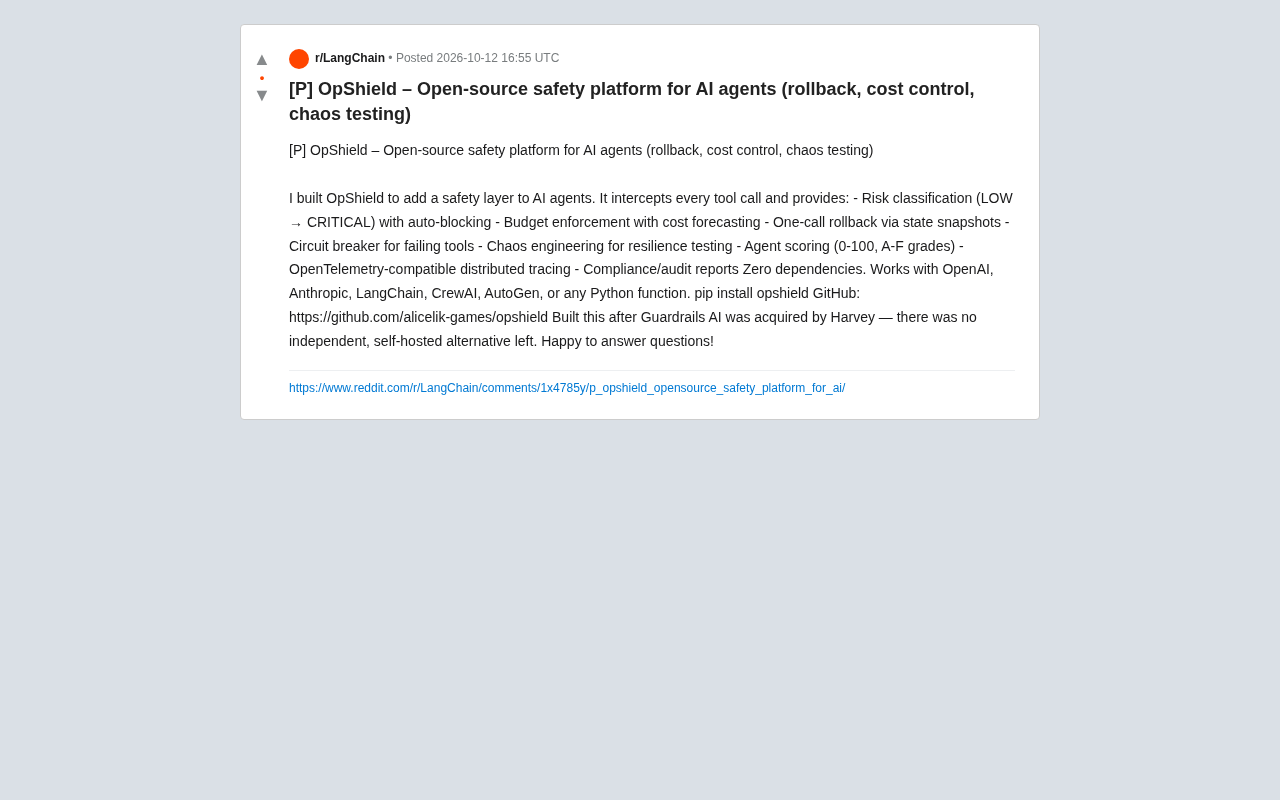
Open-source OpShield provides risk interception, cost control, and state rollback at the tool-call layer for AI agents.
OpShield is an open-source safety middleware for AI agents that intercepts and decides at the tool-call layer, assigning risk levels (LOW to CRITICAL) with automatic blocking of high-risk operations. It offers budget enforcement, cost prediction, circuit breakers, per-call rollback via snapshots, OpenTelemetry-compatible tracing, agent scoring, and chaos engineering. Zero dependencies, compatible with OpenAI, Anthropic, LangChain, CrewAI, and AutoGen.
![reddit source: [P] OpShield – Open-source safety platform for AI agents (rollback, cost control, chaos testing)](/media/screenshots/source/37902_0.png)
As AI agents move toward production environments, safety and cost control are becoming two unavoidable challenges for developers. An open-source project called OpShield recently surfaced on the Reddit community, attempting to answer this question with a layer of "safety middleware" — it intercepts every tool call and, on that foundation, provides capabilities like risk classification, budget enforcement, state rollback, and chaos testing. The author states explicitly in the post that the project was born against the backdrop of Guardrails AI being acquired by Harvey, leaving the market without an independent, self-hostable safety alternative.
Why AI Agents Need a Dedicated Safety Layer
Traditional software has relatively clear security boundaries: input validation, access control, and log auditing all have mature solutions. But AI agents operate completely differently — they autonomously decide which tools to call, in what order, and how many resources to consume. A runaway loop can send API bills skyrocketing, and a single erroneous database operation can cause irreversible data corruption.
OpShield's core approach is "intercept + decide." It operates at the tool-call layer, where every tool call passes through a risk classification engine and is tagged with a level from LOW to CRITICAL. High-risk calls can be automatically blocked without developers having to manually write piles of if-else statements. This design abstracts safety policies out of business code and turns them into configurable infrastructure.
Guardrails AI is an open-source LLM output validation framework that allows developers to impose format constraints, content filtering, and custom validation rules on model-generated content. It was widely used to intercept non-compliant outputs at the end of inference chains. In 2024, the team was acquired by AI legal-tech company Harvey, with core members absorbed into Harvey, and the original project's independent development pace and community maintenance efforts subsequently weakened. For teams that don't want their safety policies bound to a single commercial entity, this means a gap has opened up in the open-source safety layer they could previously rely on. What OpShield responds to is precisely this demand for "neutral, self-hostable, and sustainably evolving" safety middleware — rather than simply replacing some specific feature.
Core Features Breakdown: From Budget to Rollback
OpShield's feature list is quite dense, but it can be broadly grouped into three categories.
Cost and Stability Control: It provides budget enforcement and cost prediction. Before the agent calls a tool, the system estimates the potential cost of that call and compares it against a configured budget threshold. When a tool fails repeatedly, a circuit breaker automatically cuts off calls to that tool, preventing the agent from getting stuck in a cycle of futile retries.
State Management: OpShield supports "per-call rollback" through state snapshots. This means that when an agent performs an erroneous operation, developers can quickly restore to a previous known state without having to manually rebuild the environment. For agents involving file writes or database changes, the value of this capability is very direct.
Observability and Testing: The project has built-in OpenTelemetry-compatible distributed tracing, as well as an agent scoring system (0-100, A-F grades). There is also a chaos engineering module for testing agent resilience in unstable environments — such as simulating tool timeouts or returning erroneous data.
A circuit breaker comes from the classic fault-tolerance pattern in distributed systems. Its basic logic is: when a downstream dependency fails continuously beyond a threshold, the caller stops trying and instead directly returns a failure or degraded result, then tentatively allows requests again after a cooldown period. In AI agent scenarios, this pattern is especially important — agents often automatically recover based on "retry" strategies, but if the tool itself is already unavailable, retries only amplify latency and cost, and may even trigger rate-limiting penalties. The circuit breaker strips this futile loop out of the agent's decision logic and hands it to the infrastructure layer for unified handling, thereby preventing bills and call quotas from being continuously consumed.
Compatibility and the Trade-offs of Zero Dependencies
OpShield claims "zero dependencies" and can work with OpenAI, Anthropic, LangChain, CrewAI, AutoGen, or any Python function. This positioning means it doesn't want to be bound to a specific agent framework, but rather hopes to serve as a universal middleware layer between frameworks and tools.
From an engineering perspective, the benefit of zero dependencies is simple deployment and fewer conflicts, especially suitable for projects already in complex dependency environments. But the cost is that certain advanced features (such as deep integration with specific observability platforms) may require developers to adapt themselves. The project author welcomes questions in the post, indicating that it's still in an early iteration stage, and community feedback may influence future feature priorities.
State snapshots and rollback typically require recording system state before and after each tool call, which may involve serializing the file system, in-memory state, or even external databases. When an agent performs file writes or data changes, a snapshot is essentially establishing a restore point for "a single call," making erroneous operations undoable. However, the cost of snapshots must also be acknowledged: frequent snapshots bring storage and IO overhead, and not all side effects can be fully captured — for example, external API requests that have already been sent and cannot be withdrawn. Therefore, rollback capability is generally better suited for controllable local state or reversible transactions, and developers need to evaluate its actual guarantee boundaries based on specific tools.
The Value of Independent Self-Hosting
After Guardrails AI was acquired by Harvey, some developers became concerned about the independence and data sovereignty of the "safety layer." OpShield emphasizes self-hosting and open source, directly responding to this need. For teams handling sensitive data or operating in environments with high compliance requirements, being able to control where safety policies execute and where logs flow is often more important than feature richness.
That said, OpShield's current information mainly comes from the author's own announcement post, with no third-party independent reviews or production environment cases yet. Its actual interception accuracy, the reliability of its rollback mechanism, and its performance in large-scale agent clusters all still need more validation. For teams considering adoption, it's recommended to first run small-scale tests on non-critical paths, focusing on the false-interception rate and snapshot storage overhead.
The project is open-sourced on GitHub and can be installed via pip install opshield.
OpenTelemetry (OTel) is a vendor-neutral observability standard covering three types of signals: distributed tracing, metrics, and logs. It defines how data is collected, propagated, and exported, allowing the same trace data to be sent to different backends like Jaeger, Grafana Tempo, or Datadog. For AI agents, OTel compatibility means every tool call, decision branch, and duration can be chained together as standard Spans, making it easier to pinpoint which step caused abnormal behavior or cost spikes. OpShield adopts this standard, freeing teams from being locked into a specific monitoring platform and reducing the cost of integrating with existing observability systems in self-hosted environments.
One-line Summary
Open-source project OpShield provides risk interception, cost control, and state rollback at the tool-call layer for AI agents.
Paragraph Summary
OpShield is an open-source safety middleware for AI agents. Its core approach is to intercept and decide at the tool-call layer, assigning a risk level (LOW to CRITICAL) to every call, with high-risk operations automatically blocked. It provides budget enforcement, cost prediction, and circuit breakers to prevent agents from consuming resources uncontrollably, achieves "per-call rollback" through state snapshots to reduce the irreversible risk of erroneous operations, and includes built-in OpenTelemetry-compatible tracing, agent scoring, and chaos engineering modules. The project emphasizes zero dependencies and is compatible with OpenAI, Anthropic, LangChain, CrewAI, AutoGen, and any Python function. Its backdrop is the lack of an independent, self-hostable safety alternative after Guardrails AI was acquired by Harvey. However, currently there is only the author's own account, and actual effectiveness still requires third-party validation.
Related articles

How Big Can Stars Really Get? The Physical Limits of the Largest Stars
Red supergiants are the largest stars by volume, with radii up to 2,000 times the Sun, engulfing the inner solar system. But there is no precise upper limit on stellar size—models predict up to 15,000 solar radii. The most massive blue stars are far smaller than red supergiants—biggest and heaviest are two different things.

Apple HomeView Smart Display Full Feature Breakdown: Wall-Mount or Desktop, $299
Apple launches HomeView, a $299 smart display with wall-mount and desktop options, 12MP camera for facial recognition, smart home control, music playback, and recipe step-by-step cooking. Full breakdown of watch faces, apps, privacy, and cooking integration.

Where Did the Promised New Studio Go? Craft Computing Answers After Five Years
Craft Computing's host responds to viewer questions: the new studio promised five years ago was shelved as construction costs soared from $30,000 to $75,000, and was replaced by a 168-square-foot garage conversion.