Optimal Convergence of Byzantine-Robust Federated Learning with User-Level Differential Privacy

Establishes an information-theoretic lower bound for Byzantine-robust FL under user-level DP and proposes the order-optimal ByzULDP algorithm.
The article discusses the convergence challenge in federated learning when facing both Byzantine attacks and user-level differential privacy: simply combining robust aggregation with centralized DP noise fails to converge to a neighborhood of a stable point because nonlinear aggregation amplifies noise. To fill this gap, the study provides the first information-theoretic lower bound for Byzantine-robust empirical risk minimization under user-level DP and heterogeneous clients, and proposes the centralized DP algorithm ByzULDP, which introduces momentum at both client and server levels to respectively mitigate stochastic gradient variance and compensate for DP noise. Theoretical proofs show that it achieves order-optimal convergence rates of O(1/T) and O(1/√T) for strongly convex and non-convex objectives, matching the lower bound, and experiments on real datasets validate its effectiveness under different privacy budgets.
Title
Optimal Convergence of Byzantine-Robust Federated Learning with User-Level Differential Privacy
Meta Description
This article interprets the latest research on Byzantine-robust federated learning with user-level differential privacy, introducing the information-theoretic lower bound and the ByzULDP algorithm, which achieves order-optimal convergence via dual-layer momentum, with error decay of O(1/T) and O(1/√T) for strongly convex and non-convex objectives respectively, along with experimental validation.
Article Content
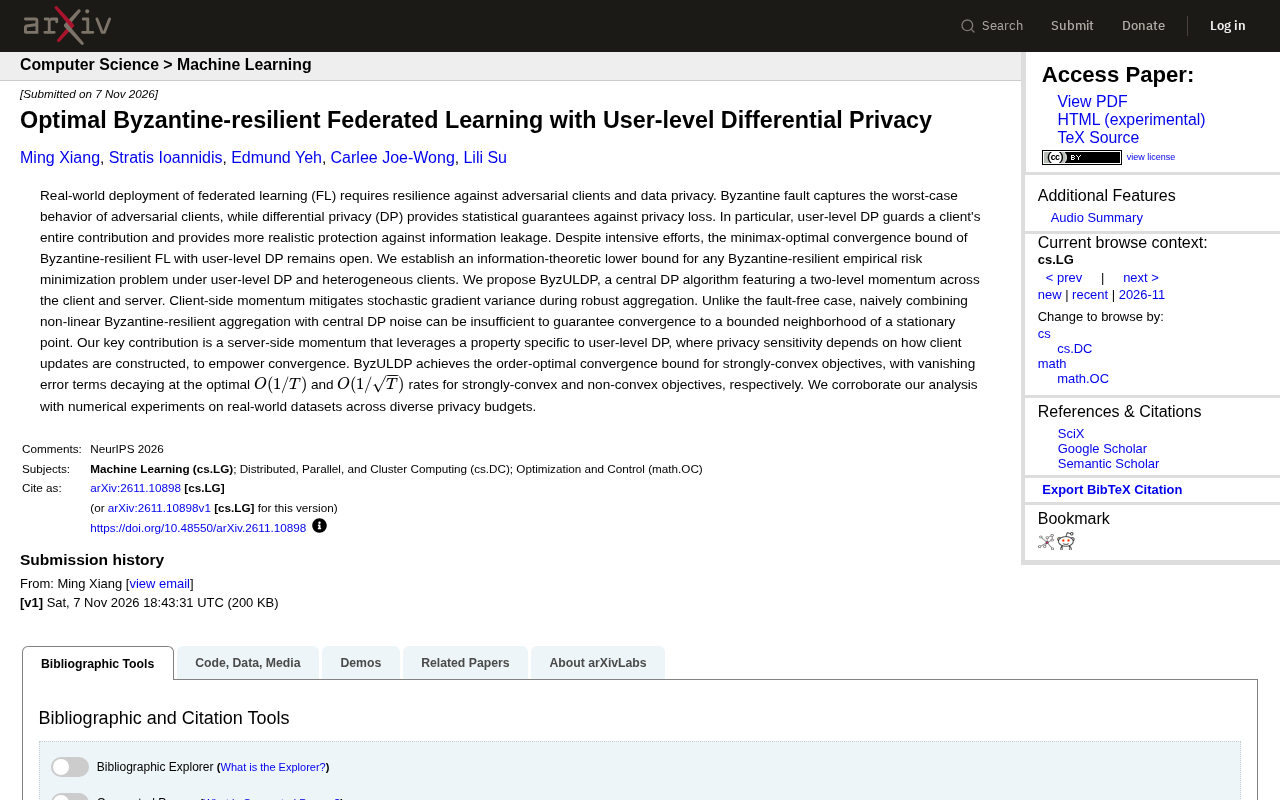
In real-world deployments, federated learning (FL) must both defend against Byzantine attacks from malicious clients and protect user data privacy. Byzantine fault tolerance characterizes the worst-case behavior of adversarial clients, while differential privacy (DP) provides statistical guarantees on privacy loss. User-level DP protects the entire contribution of a client, offering a more realistic safeguard against information leakage. However, the minimax optimal convergence bound for Byzantine-robust FL under user-level DP has remained unresolved. A recent study establishes an information-theoretic lower bound for this setting and proposes the ByzULDP algorithm, which achieves order-optimal convergence.
Core Challenge: The Convergence Dilemma of Privacy and Robustness
A naive combination of Byzantine-robust aggregation and centralized DP noise works in fault-free scenarios, but in the presence of adversarial clients, the superposition of nonlinear robust aggregation and DP noise can break convergence, preventing the algorithm from converging to a bounded neighborhood of a stable point. This phenomenon arises because the way client updates are constructed affects privacy sensitivity: the sensitivity of user-level DP depends on how client updates are computed, and the nonlinear operations of robust aggregation amplify the impact of noise.
While existing research has made progress in either Byzantine-robust FL or user-level DP individually, joint optimization of the two lacks theoretical guidance. This study fills that gap by providing, for the first time, an information-theoretic lower bound for the Byzantine-robust empirical risk minimization problem under user-level DP and heterogeneous clients, setting a performance limit for algorithm design.
Byzantine Fault Tolerance and Robust Aggregation Byzantine attacks refer to arbitrary malicious behavior by some nodes in a distributed system (e.g., sending incorrect gradients, tampering with model updates). The goal of Byzantine-robust FL is to aggregate correctly even in the presence of up to f malicious clients. Common robust aggregation rules include coordinate-wise median, trimmed mean, Krum, etc. Their essence is to perform nonlinear filtering or truncation on client updates to weaken the leverage of outliers. However, while suppressing large-deviation updates, such nonlinear operations also perturb the true gradient distribution to some extent. When combined with DP noise, aggregation bias can accumulate—this is the root cause of why naive combinations fail to converge.
Differential Privacy and User-Level Privacy Sensitivity Differential privacy injects random noise into the computation process, making the output distributions of adjacent datasets hard to distinguish, thereby limiting the information that can be inferred about any single record. In FL, centralized DP typically adds noise at the server, with the privacy budget determined by global sensitivity; user-level DP treats each client's entire local dataset as one "record," and the sensitivity varies with the norm of the client update (a common practice is to clip before adding noise). Therefore, the construction of client updates—such as whether clipping is applied and the clipping threshold—directly affects the required noise scale, which is why the paper emphasizes that "sensitivity is related to update construction."
Minimax Lower Bound and Order Optimality The minimax lower bound characterizes the best convergence error magnitude that any algorithm can achieve in the worst case over a problem class (e.g., strongly convex/non-convex, given Byzantine fraction and privacy budget). An algorithm that attains this lower bound is called order-optimal. Such lower bounds are typically derived using information-theoretic tools (e.g., Fano's inequality, Assouad's lemma) by constructing hard-to-distinguish distribution pairs, thereby giving the error floor that any algorithm must endure.
ByzULDP: Dual-Layer Momentum Driving Convergence
To break the convergence bottleneck, researchers propose ByzULDP—a centralized DP algorithm that introduces momentum at both the client and server levels. Client momentum mitigates stochastic gradient variance during robust aggregation, improving aggregation stability; server momentum leverages a unique property of user-level DP—that privacy sensitivity is related to client update construction—to enable convergence. This dual-layer momentum design is not a simple stacking but rather compensates for the interaction between DP noise and robust aggregation, thereby overcoming the shortcomings of naive combinations.
Theoretical analysis shows that ByzULDP achieves order-optimal convergence bounds for strongly convex objectives, with the error term vanishing at the optimal rate: O(1/T) for strongly convex objectives and O(1/√T) for non-convex objectives. This result matches the information-theoretic lower bound, confirming the minimax optimality of the algorithm.
Dual-Layer Momentum and Variance Reduction Momentum methods reduce the variance caused by stochastic gradient noise by exponentially weighted averaging of historical updates. In Byzantine-robust FL, client momentum is maintained locally, smoothing the aggregated updates and preventing single-round noise from dominating the robust screening results; server momentum smooths the global update after aggregation to compensate for the additional perturbation introduced by centralized DP noise. The two act respectively "before robust aggregation" and "after noisy aggregation," forming a joint compensation for noise and nonlinear aggregation error—this is the key distinction of this design from simply stacking momentum.
Implications of Convergence Rates The O(1/T) and O(1/√T) rates describe the magnitude of error decay with the number of iterations T for strongly convex and non-convex objectives, respectively: in the strongly convex case, the error decays inversely at a linear rate; in the non-convex case, it corresponds to the classical stochastic optimization rate for the squared gradient norm. Matching the lower bound means that, given the privacy budget and Byzantine fraction, the algorithm cannot be further improved beyond a constant factor, providing a theoretical reference for practical tuning.
Experimental Validation and Broad Applicability
Numerical experiments were conducted on real datasets, covering various privacy budgets. The experimental results are consistent with the theoretical analysis, validating the effectiveness and robustness of ByzULDP under different privacy protection strengths. This work provides a theoretical foundation and a practical algorithm for the secure deployment of federated learning in privacy-sensitive scenarios, advancing research on the joint optimization of privacy protection and robustness.
Key Takeaways
- First establishes an information-theoretic lower bound for Byzantine-robust FL under user-level DP, revealing the convergence limit.
- Proposes the ByzULDP algorithm, which resolves the conflict between DP noise and robust aggregation through dual-layer momentum at both client and server levels.
- Theoretically proves that ByzULDP achieves order-optimal convergence rates, with error decay of O(1/T) and O(1/√T) for strongly convex and non-convex objectives, respectively.
- Experiments validate the algorithm's effectiveness under various privacy budgets, providing a reference for practical deployment.
One-line Summary
Establishes an information-theoretic lower bound for Byzantine-robust FL under user-level DP and proposes the order-optimal ByzULDP algorithm.
Paragraph Summary
The article discusses the convergence challenge in federated learning when facing both Byzantine attacks and user-level differential privacy: simply combining robust aggregation with centralized DP noise fails to converge to a neighborhood of a stable point because nonlinear aggregation amplifies noise. To fill this gap, the study provides the first information-theoretic lower bound for Byzantine-robust empirical risk minimization under user-level DP and heterogeneous clients, and proposes the centralized DP algorithm ByzULDP, which introduces momentum at both client and server levels to respectively mitigate stochastic gradient variance and compensate for DP noise. Theoretical proofs show that it achieves order-optimal convergence rates of O(1/T) and O(1/√T) for strongly convex and non-convex objectives, matching the lower bound, and experiments on real datasets validate its effectiveness under different privacy budgets.
Related articles

From 0 to 1: Vibe Coding an AI Knowledge Base — A Practical Retrospective and Tech Stack Breakdown
A retrospective on building the AI knowledge base OilBook from scratch with Vibe Coding: Next.js+Neon stack, Oil Dev Skill workflow, Stripe paywall security, interview-style writing, AI-flavor control, and Vercel deployment.

GLM-5.4 Hands-On: Native Vision Meets a New Vibe Coding Workflow
Hands-on with Zhipu GLM-5.4: native vision tested across a 3D product demo, pure-code video generation, and remote-control Vibe Coding, compared with GPT-6.2 and Gemini Neon.

AI and Humans Claim to Prove the Riemann Hypothesis: Machine-Verified, Yet Nobody Can Understand It
Anthropic mathematician and AI Claude claim to prove the Riemann Hypothesis with 17 million lines of Lean code, machine-verified but unreadable by humans. This article analyzes the event, the zero proportion record from 41.6% to 67.2%, and the gap between machine verification and human understanding.