Optimist Deep Research: A State-Centric Iterative Literature Research Agent

Optimist Deep Research achieves iterative literature evidence acquisition via an explicit, mutable research state.
Optimist Deep Research is an open-source project that critiques the "single retrieval + summarization" pipeline and models literature research as continuous updates to an explicit, mutable research state. It drives search intents via a sub-question tree across arXiv, OpenAlex, Crossref, PubMed, Semantic Scholar, and the open web; builds a source-preserving document registry through four-layer deduplication and citation snowballing until saturation; reads documents in parallel into a structured evidence base recording support relation, location, type, and strength; and uses an eight-dimensional critic to return research actions that dynamically modify sub-questions. A case study reports retrieving 237 documents and reading 28 in about 3.5 minutes, with weaknesses also disclosed. The article argues its value lies in making the research state explicit and mutable and constraining the language model pipeline with deterministic mechanisms for auditability.
Traditional retrieval-augmented systems usually treat literature search as a "single retrieval + summarization" pipeline, but real literature research is not like that: a researcher's understanding changes as they read, sub-questions keep emerging, and evidence needs to be weighed rather than simply piled up. The open-source project Optimist Deep Research proposes an iterative evidence acquisition approach centered on an explicit, mutable research state, attempting to make AI agents work more like human researchers.
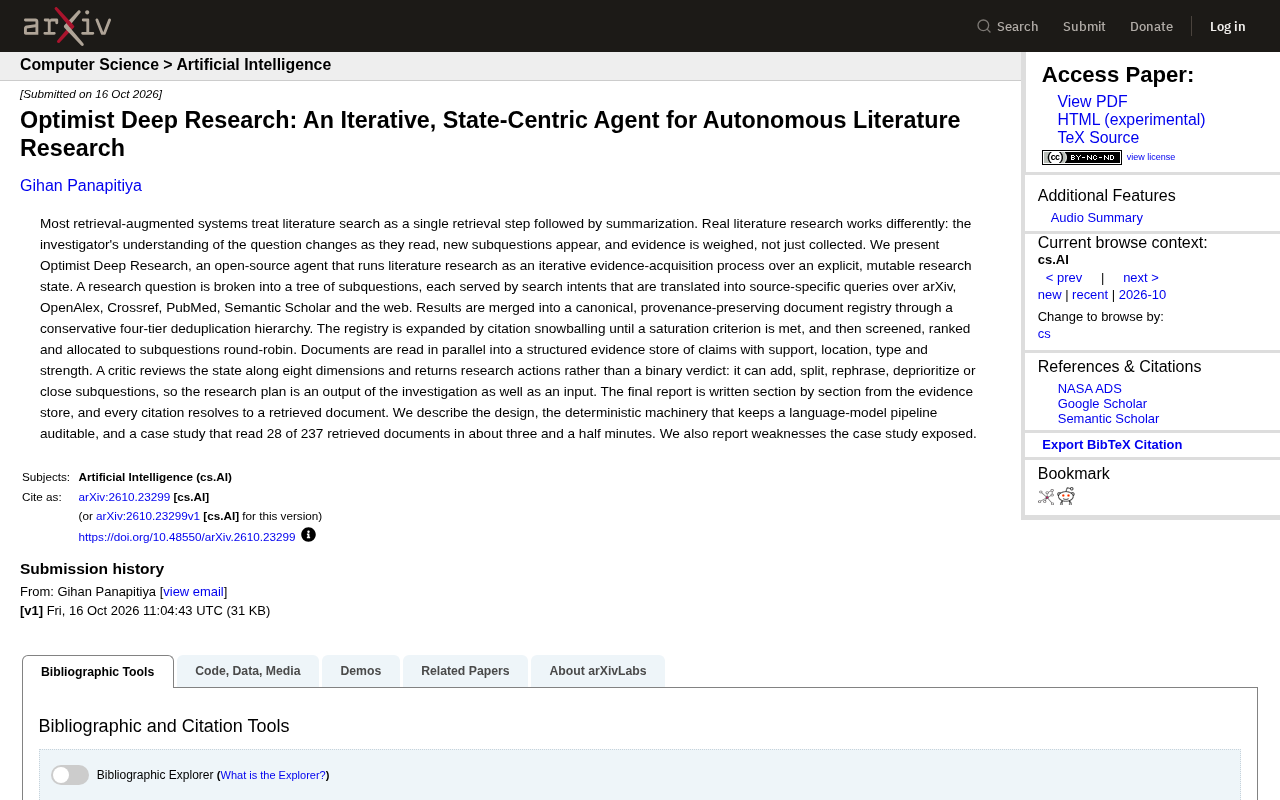
From single retrieval to iterative evidence acquisition
The core design of Optimist Deep Research is to model literature research as continuous updates to a research state. The system first decomposes the research question into a tree of sub-questions, each driven by several "search intents" that are translated into specific queries targeting arXiv, OpenAlex, Crossref, PubMed, Semantic Scholar, and the open web.
Retrieval results are not fed directly into a summarizer; instead, they pass through a conservative four-layer deduplication hierarchy and are merged into a normalized document registry that preserves source information. The system then expands the registry via citation snowballing until saturation criteria are met, after which documents are filtered, ranked, and assigned to sub-questions in a round-robin fashion. This design makes the retrieval process traceable and lays the foundation for subsequent evidence management.
Citation snowballing is a systematic search strategy commonly used in literature reviews, divided into forward and backward directions: backward snowballing traces a paper's references to uncover its intellectual foundations, while forward snowballing finds subsequent work that cites the paper to track its influence and development. In Optimist Deep Research, this technique is used to recursively expand the document registry starting from the core documents already retrieved, thereby covering clusters of related literature without relying on exhaustive keyword search. The system sets saturation criteria (e.g., several consecutive rounds with no new relevant documents) to control expansion depth and avoid unbounded sprawl. This approach can effectively improve recall, but it may also introduce topic drift, so it needs to be combined with deduplication and relevance ranking.
Structured evidence base and eight-dimensional review mechanism
Documents are read in parallel and transformed into a structured evidence base: each claim records its support relation, location, type, and strength. This layer is what distinguishes the system from ordinary RAG—evidence is not summarized into a block of text but decomposed into reviewable atomic units.
The system introduces a "critic" role that reviews the research state from eight dimensions and returns research actions rather than binary judgments. It can add, split, rewrite, downgrade, or close sub-questions, meaning the research plan is both an input to and an output of the investigation. This dynamic adjustment capability allows the agent to revise its understanding of the question during reading rather than being locked in by the initial query.
The final report is written section by section based on the evidence base, and every citation can be traced back to an actually retrieved document. For language model pipelines that require auditability, this "parseable citation" constraint is particularly important.
Critic role in agent architectures usually refers to an independent review module whose job is not to directly generate answers but to diagnose the current research state and suggest improvements. Optimist Deep Research's critic evaluates the state across eight dimensions (such as question coverage, evidence sufficiency, source diversity, contradiction detection, etc.) and returns specific research actions (add sub-questions, split questions, downgrade or close questions) rather than simple "pass/fail" judgments. This design decouples review from execution, enabling the language model to participate in the planning loop in a structured way while preserving a human-readable audit trail. The specific definitions of the eight dimensions determine the system's behavioral boundaries and are also key parameters for subsequent tuning.
Structured evidence base, unlike the summarization-style context of ordinary RAG, decomposes the claims in each document into atomic units and records their support relation (support/refute/neutral), location (section or paragraph), type (fact, method, conclusion, etc.), and strength (e.g., strong, medium, weak). This representation enables the system to aggregate evidence across documents, detect contradictions, and achieve citation-level traceability in the final report. Atomic storage also makes it easier for the critic to review item by item, avoiding information loss in long-text summaries. However, automatic assessment of evidence strength remains an open problem; the current system may rely on heuristic rules or model scoring, and its reliability needs to be validated in more cases.
Case study: reading 28 documents in three minutes
The author reports a case study: the system retrieved 237 documents in about three and a half minutes and actually read 28 of them. This data illustrates the trade-off between efficiency and depth in an iterative agent—it does not try to read all retrieval results but controls the reading scope through saturation criteria and round-robin assignment.
The author also candidly reports the weaknesses exposed by the case study. Such self-disclosure is uncommon in academic tool projects, but it also reminds us that state-centric agent design is still in its early stages, and its review mechanism, saturation judgment, and evidence strength assessment all have room for refinement.
Saturation originates from qualitative research methods such as grounded theory and refers to the point at which new data no longer produces new codes or themes, indicating that the sample is saturated. In automated literature research, saturation criteria are usually operationalized as: after several consecutive rounds of retrieval or snowballing, the overlap between newly added documents and existing evidence exceeds a threshold, or the number of new evidence items for a sub-question drops to zero. Optimist Deep Research uses saturation criteria to decide when to stop citation expansion, thereby balancing recall and computational cost. However, saturation judgment itself is subjective, and the system needs to design quantifiable proxy metrics (such as document similarity and evidence increment); otherwise, it may terminate too early and miss key literature.
Implications for AI literature research tools
The value of Optimist Deep Research lies not in any single technology but in making the "research state" explicit and mutable, and in using deterministic mechanisms to constrain the language model pipeline so that it remains auditable. For developers building autonomous research agents, designs such as the sub-question tree, four-layer deduplication, citation snowballing, and eight-dimensional review provide engineering paradigms worth borrowing.
The project is open source, and interested readers can directly examine its implementation details and assess its applicability to their own scenarios.
One-line Summary
Optimist Deep Research uses an explicit, mutable research state to achieve iterative literature evidence acquisition.
Paragraph Summary
Optimist Deep Research is an open-source project that critiques the "single retrieval + summarization" pipeline of traditional retrieval-augmented systems and proposes modeling literature research as continuous updates to an explicit, mutable research state. The system drives search intents through a sub-question tree, covering arXiv, OpenAlex, Crossref, PubMed, Semantic Scholar, and the open web; retrieval results are deduplicated through four layers and expanded via citation snowballing to build a source-preserving document registry until saturation; documents are then read in parallel and transformed into a structured evidence base, where each claim records its support relation, location, type, and strength. An eight-dimensional critic role reviews the research state and returns research actions, dynamically adding, removing, or modifying sub-questions. A case study shows that the system retrieved 237 documents and read 28 in about 3.5 minutes, and the author also reports its weaknesses. The article argues that its value lies in making the research state explicit and mutable, and in using deterministic mechanisms to constrain the language model pipeline so that it is auditable.
Related articles

Chain of Thought Isn't Just for AI: How Humans Can Use CoT to Improve Thinking Quality
Chain of Thought isn't just a prompt trick for large models. Starting from a Hacker News discussion, this article analyzes why CoT works for human thinking too, breaks down actionable ways to transfer it, and highlights the key differences between human CoT and machine CoT.
Cloudflare Teams Up with OpenAI: Closi…
Cloudflare Teams Up with OpenAI: Closing the Loop from Vulnerability Discovery to Defense with AI
Cloudflare uses OpenAI Daybreak to investigate security vulnerabilities and generate reviewable remediation plans, while developers use Codex to boost coding efficiency and quality.

Orca Multi-Agent Orchestration in Practice: A Guide to Parallel Collaboration with Claude and Codex
Orca is Stable AI's free open-source agent workbench supporting 34 agents like Claude Code and Codex in parallel. Learn its Git worktree isolation, multi-model orchestration, and mobile management.