Optimizing Active Learning Initial Data Selection with Foundation Models: 6.6% mAP50 Improvement

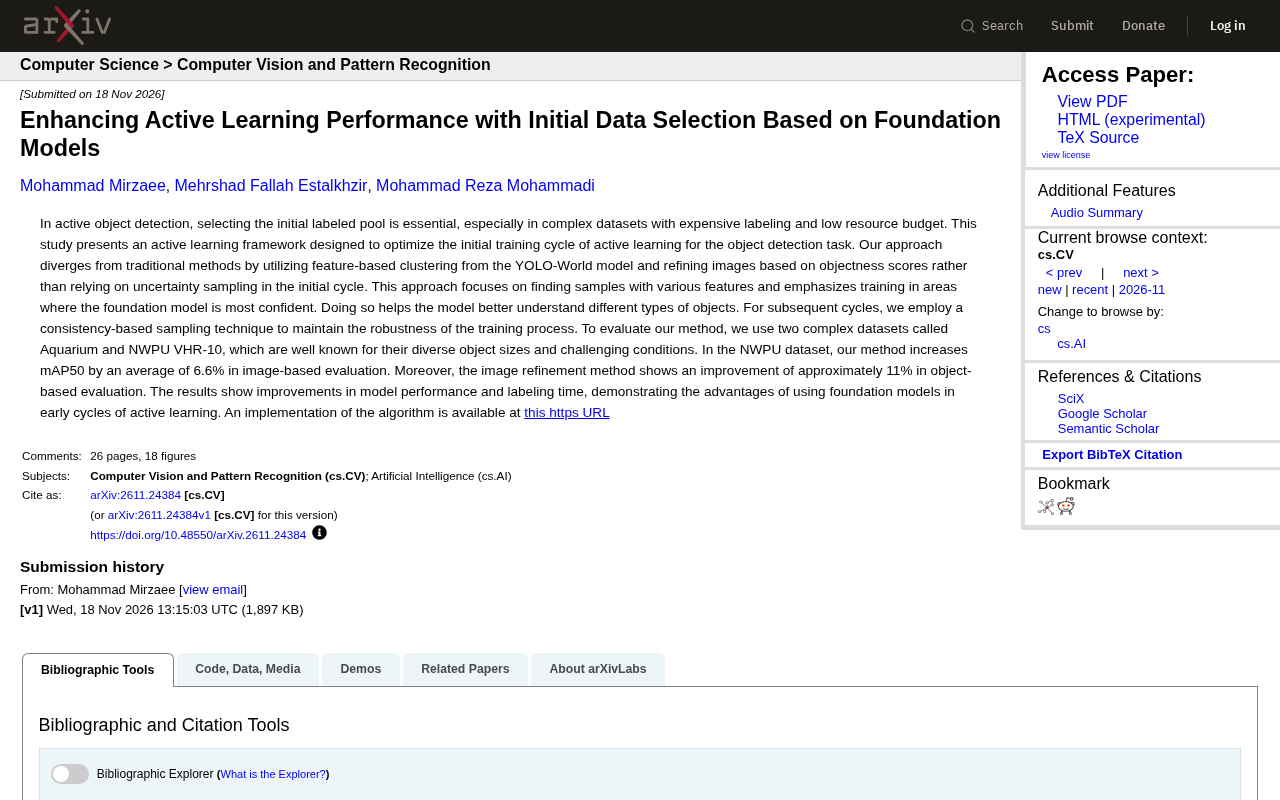
Using YOLO-World feature clustering and objectness scoring to build the active learning initial annotation pool improves mAP50 by an average of 6.6% on NWPU VHR-10.
This article addresses the long-standing pain point of initial annotation pool selection in active learning, noting that traditional uncertainty sampling is inefficient early in training due to model unreliability. The study proposes using the foundation model YOLO-World to extract and cluster image features to ensure initial sample diversity, and to refine images based on objectness scores to focus early training on high-confidence regions. After the initial cycle, it switches to consistency-based sampling for robustness. Experiments on Aquarium and NWPU VHR-10 show an average image-based mAP50 improvement of 6.6% on NWPU, about 11% on object-based evaluation, and improved annotation time. The authors open-sourced ALBoost-FM, but the method depends on foundation model feature quality, and generalization still needs more validation.
In object detection, a long-standing pain point of active learning is: how should the initial annotation pool be chosen? Traditional approaches rely on uncertainty sampling, but on complex datasets with high annotation costs and limited budgets, this strategy is often inefficient in the first training cycle. A recent study proposes a different idea — using the feature clustering and objectness scoring of a foundation model (YOLO-World) to construct the initial annotation pool, achieving an average mAP50 improvement of 6.6% on the NWPU VHR-10 dataset.
Why the Initial Annotation Pool Is So Critical
The core assumption of active learning is that a model can actively select the most valuable samples for annotation, thereby achieving better performance with fewer annotations. But in practice, the selection strategy for the first cycle is often overlooked — at this point the model has not been sufficiently trained, and judgments based on uncertainty sampling are unreliable.
The study points out that on complex datasets where annotation is expensive and resource budgets are tight, the quality of the initial annotation pool directly affects the training efficiency of all subsequent cycles. If the initial samples lack feature diversity, the model will struggle early on to build an understanding of different types of objects, and subsequent cycles will require more annotations to compensate.
This observation forms the starting point of the research: rather than letting an untrained model "guess" which samples are worth annotating, it is better to rely on a foundation model that already possesses rich visual knowledge to make the judgment.
Active Learning is a semi-supervised machine learning paradigm whose core idea is to let the model actively select the most informative unlabeled samples for human annotation, thereby maximizing model performance under a limited annotation budget. A typical workflow is: train an initial model, use some sampling strategy (such as uncertainty sampling, diversity sampling, query by committee, etc.) to select a batch of samples, annotate them and add them to the training set, then retrain the model, and repeat this loop. The efficiency of active learning depends heavily on the quality of the sampling strategy — the better the strategy, the fewer annotations are needed to reach a target accuracy. However, in the early stage of training, the model itself is weak, and its uncertainty estimates are often very noisy, which is precisely the context for the "initial annotation pool" problem addressed in this article.
Method Breakdown: Feature Clustering + Objectness Scoring
Feature Clustering with YOLO-World
The first layer of logic in this method is to ensure the feature diversity of the initial samples. The research team uses the YOLO-World model to extract image features, performs feature-based clustering on this basis, and selects samples from different clusters to ensure that the initial annotation pool covers as diverse a range of visual patterns as possible.
This forms a sharp contrast with the idea of uncertainty sampling: the latter tends to select the samples the model is "least sure" about, but in the early stage of training, the model's "uncertainty" is often just noise rather than truly valuable information. Feature clustering, by contrast, starts from the data distribution itself and bypasses the problem of unreliable model judgments.
YOLO-World is an open-vocabulary object detection model that introduces vision-language alignment capabilities on top of the YOLO architecture, enabling it to detect objects of arbitrary categories based on text prompts rather than being limited to the fixed categories seen during training. Its key advantage lies in leveraging large-scale image-text pretraining to acquire rich visual semantic knowledge, so even when facing a new dataset, it can extract discriminative image features and objectness scores. In the method presented in this article, YOLO-World is not used directly for detection but as a feature extractor: its backbone network outputs image-level or region-level embeddings, which are then clustered. This use of a "foundation model as a data advisor" precisely leverages the generalization ability of open-vocabulary models on unseen domains to compensate for the lack of knowledge of the initial detection model.
Refining Images by Objectness Score
The second layer of logic targets the quality within samples. The research team does not directly use the entire image but instead refines the image according to the objectness score, focusing training on the regions in which the foundation model is most confident.
The benefit of this is to help the model better understand different types of objects — the high-confidence regions of the foundation model usually correspond to clear, typical object instances, and using these regions as early training signals is more efficient than letting the model struggle with ambiguous or difficult samples.
Objectness score is a scalar output by an object detection model, representing the confidence that a candidate region contains any object (rather than background). In the YOLO family, each predicted box is accompanied by an objectness score, which is usually multiplied by the classification score to obtain the final confidence. This article uses the objectness scores output by YOLO-World to filter the regions in an image that "look most like objects" rather than using the entire image for training. This is equivalent to using the prior knowledge of the foundation model to perform soft cropping or attention weighting on the image, allowing early training to focus on clear, typical object instances and avoiding interference from background noise and ambiguous regions. The level of the objectness score reflects the foundation model's confidence in the region, so it can serve as a proxy indicator of the internal quality of a sample.
Switching to Consistency-Based Sampling in Subsequent Cycles
After the initial cycle, the method switches to a consistency-based sampling technique to maintain the robustness of the training process. This design shows that the authors do not completely abandon the traditional active learning framework; rather, they introduce foundation model priors in the most fragile initial stage and return to conventional strategies in later stages.
Consistency-based sampling is another commonly used strategy in active learning. Its idea is to select samples for which the model's predictions have low consistency under different perturbations (such as data augmentation, dropout, or different initializations) — that is, samples for which the model gives contradictory predictions for the same input, which are generally considered to lie near the decision boundary and to have high information content. Compared with uncertainty sampling, consistency-based sampling does not rely solely on softmax probabilities but measures sample value through the prediction variance across multiple forward passes, making it more robust to model calibration errors. This article switches to consistency-based sampling after the initial cycle because by then the model has been trained to some extent and its predictions begin to become meaningful; consistency metrics can more reliably identify difficult samples, thereby maintaining the robustness of subsequent active learning cycles.
Experimental Results: Validation on Two Complex Datasets
The study was evaluated on two datasets known for diverse object sizes and complex conditions: Aquarium and NWPU VHR-10.
On the NWPU dataset, image-based evaluation shows an average mAP50 improvement of 6.6%; the image refinement method improves object-based evaluation by about 11%. The results also show improvements in both model performance and annotation time, indicating that the use of foundation models in the early cycles of active learning has practical advantages.
It should be noted that the above data all come from the original paper's reported results, and the experimental scale and the generalization ability across datasets still require more independent verification.
Insights and Limitations of This Work
From a methodological perspective, the value of this research lies in repositioning the role of foundation models in the active learning pipeline: not as detectors used directly, but as "data advisors" that provide references for feature diversity and confidence during the stage when the model is not yet well trained. This idea can be transferred to other vision tasks with expensive annotation.
The limitations are also obvious. The method relies heavily on the feature quality of YOLO-World; if the foundation model is unfamiliar with the target domain, the reliability of clustering and objectness scoring will decrease. In addition, the experiments cover only two datasets, and whether the method is equally effective in a broader range of scenarios still requires community reproduction. The authors have open-sourced the implementation (ALBoost-FM), providing a basis for subsequent verification.
One-line Summary
Using YOLO-World feature clustering and objectness scoring to construct the initial annotation pool for active learning, achieving an average mAP50 improvement of 6.6% on NWPU VHR-10.
Paragraph Summary
This article addresses the long-standing pain point of initial annotation pool selection in active learning, pointing out that traditional uncertainty sampling is inefficient in the early stage of training because the model is unreliable. The study proposes using the foundation model YOLO-World to extract image features and perform clustering to ensure the feature diversity of initial samples; at the same time, it refines images based on objectness scores to concentrate early training on the high-confidence regions of the foundation model. After the initial cycle, it switches to consistency-based sampling to maintain robustness. Experiments on two complex datasets, Aquarium and NWPU VHR-10, show that on NWPU the image-based mAP50 improves by an average of 6.6%, object-based evaluation improves by about 11%, and annotation time is also improved. The authors have open-sourced the ALBoost-FM implementation, but the method depends on the feature quality of the foundation model, and its generalization still requires more verification.
Related articles

Prompt Engineering for Beginners: From Writing Prompts to Engineering Thinking
Starting from the essence and four functions of prompts, this article systematically explains the six-step process, four success criteria, learning value, and practical limitations of prompt engineering to help you build a complete understanding.

Anthropic Launches Nasdaq IPO: AI Giant's Listing and Risk Disclosures
Anthropic officially launches its Nasdaq IPO under ticker ANT, with market valuation expected to potentially exceed SpaceX's record. The prospectus devotes nearly 100 pages to AI risks, while first-half revenue grew over 14x but net losses widened sharply, reigniting the AI bubble debate.

Rust cURL Clone Uses 4,832 unsafe Blocks—Is the Memory Safety Myth Broken?
A Rust cURL clone uses 4,832 unsafe keywords, challenging Rust's memory safety narrative. We analyze what unsafe really means, compare Fil-C, and examine rewrite motives.