Opus 4.7 and GPT-5.5 Launch: Simon Willison's April Newsletter Breaks Down AI Frontier Developments
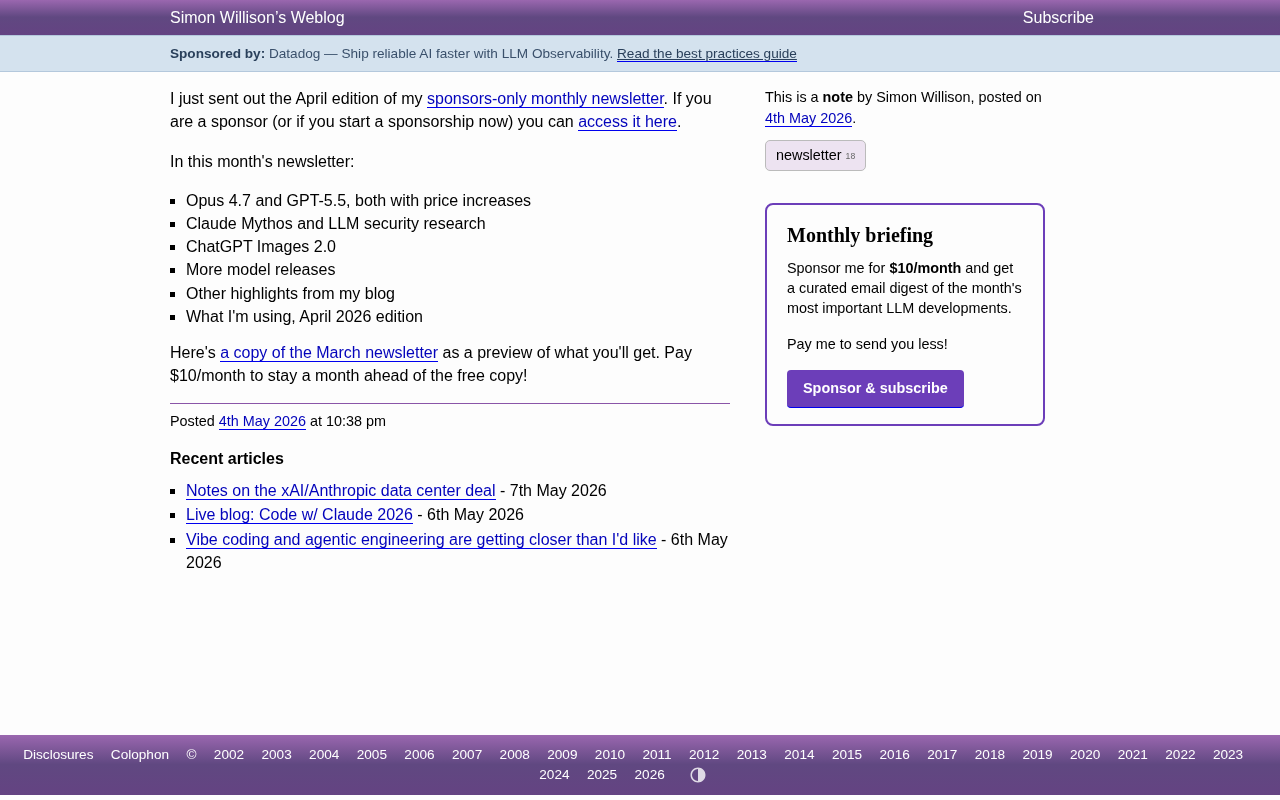
Simon Willison's April newsletter covers Claude Opus 4.7, GPT-5.5 launches and industry pricing trends.
AI developer Simon Willison's April 2026 sponsor newsletter focuses on Anthropic's Claude Opus 4.7 and OpenAI's GPT-5.5 releases along with their accompanying price increases, reflecting the AI industry's shift from price wars to value-based pricing. The newsletter also covers Claude Mythos developments, LLM safety research, ChatGPT Images 2.0 upgrades, and his personal AI tool usage list.
Overview
Renowned AI developer and Datasette creator Simon Willison has published his April 2026 patron-exclusive monthly newsletter. Simon Willison is a co-creator of Django, the Python web framework, and later built Datasette—an open-source tool for exploring and publishing data. Datasette's design philosophy is to let anyone instantly transform SQLite databases into interactive APIs and web interfaces, making it widely popular in data journalism, open data, and government transparency. In recent years, Simon has devoted significant energy to hands-on practice and commentary in the AI/LLM space, and his blog has become a vital source for tracking AI tool development, known for its technical depth and practical orientation.
This newsletter covers several major developments in the AI industry, including heavyweight model releases from Anthropic and OpenAI, advances in AI safety research, and his personal insights on tool usage.
While the full content is available only to GitHub sponsors, we can identify several key industry trends from the publicly available table of contents.
Claude Opus 4.7 and GPT-5.5: Stronger Models, Higher Prices
The headline content this month centers on the latest model releases from two AI giants—Anthropic's Claude Opus 4.7 and OpenAI's GPT-5.5. Simon specifically notes that both models come with price increases.
This trend is worth watching. Over the past year-plus, AI model pricing strategies have undergone a clear shift from "price wars" to "value-based pricing." Early on, companies competed for market share through price cuts, but now as model capabilities have dramatically improved, leading providers have begun positioning their flagship models as premium products, raising prices to cover real compute costs and commercial value.
The tiered pricing strategy for AI models stems from the vast differences in training and inference costs. Flagship models (Opus-level) typically have larger parameter counts, longer context windows, and stronger reasoning capabilities, consuming far more GPU compute per inference call than mid-tier models. Taking Anthropic as an example, their product line from the lightweight Haiku to mid-tier Sonnet to flagship Opus forms a clear capability-price gradient. This tiered strategy also reflects the business reality facing large model companies: training a frontier model now costs hundreds of millions of dollars, making it difficult to sustain operations on low-price strategies alone.
For developers and enterprise users, this means more careful planning of API call strategies—assigning top-tier reasoning tasks to Opus 4.7 or GPT-5.5, while handling everyday needs with more economical mid-tier models. The tiered pricing landscape in the AI industry is rapidly taking shape.
Claude Mythos and New Advances in LLM Safety Research
The newsletter mentions Claude Mythos as a new development, along with related LLM safety research. While specific details remain undisclosed, judging from the naming, Mythos may be a new branch or experimental project within Anthropic's Claude product line.
Simon Willison has long been an active voice in AI safety, with extensive research and writing on prompt injection attacks, data leakage risks, and more. Prompt Injection is one of the most critical threats in LLM security, operating on a principle similar to SQL injection in traditional web security: attackers craft input text to trick models into ignoring original system instructions and executing malicious commands instead. For example, when an LLM processes user-submitted documents, those documents may contain hidden instructions that cause the model to leak system prompts or perform unauthorized actions. Simon has been writing about prompt injection since 2022 and considers it a systemic problem that remains fundamentally unsolved, because LLMs at an architectural level cannot distinguish between "instructions" and "data"—both are simply token sequences to the model.
Including LLM safety research as a major section of the newsletter also reflects a reality: as model capabilities grow increasingly powerful, safety issues have evolved from "worth monitoring" to "must solve."
ChatGPT Images 2.0: Image Generation Gets Another Upgrade
OpenAI's image generation capabilities have received a 2.0 version update. Since ChatGPT integrated image generation, this feature has become one of its most popular capabilities.
ChatGPT's image generation is built on OpenAI's multimodal model architecture, unifying text understanding and image generation within a single model, rather than functioning as a standalone image generation model like the earlier DALL-E. The advantage of this native multimodal approach is that the model can better understand complex text descriptions, maintain consistency between images and conversation context, and accurately render text within images—a major weakness of diffusion model-based image generation tools. The 2.0 upgrade likely involves higher resolution output, more precise composition control, and better responsiveness to iterative editing instructions.
The image generation space remains fiercely competitive in 2026. From Midjourney to Stable Diffusion to built-in image capabilities across various large models, users have an ever-growing array of options, and expectations for generation quality continue to rise. Whether ChatGPT Images 2.0 can pull ahead in this competition is worth continued attention.
More Model Releases and Simon's Tool Usage List
Beyond the highlights above, the newsletter also covers other model release news, curated posts from Simon's blog, and his personal tool usage list for April 2026.
Simon's "What I'm using" section has always been a popular reference in the developer community. As a practitioner working at the forefront of AI tools, his tool choices often reflect actual industry application trends rather than just vendor marketing. For developers wanting to know which AI tools are genuinely useful, this section offers high reference value.
The Newsletter's Subscription Model: A Sustainable Path for Independent Creators
Worth noting is Simon's content distribution strategy: the latest newsletter is available only to GitHub sponsors ($10/month), while the previous month's newsletter is released for free. This "delayed release" model ensures exclusive value for sponsors while not completely blocking information flow—a sustainable business model worth emulating for independent creators.
GitHub Sponsors is a creator sponsorship platform launched by GitHub in 2019, allowing developers to receive financial support directly from the community. Unlike general creator platforms such as Patreon, GitHub Sponsors is deeply integrated into developers' workflows, enabling sponsors to initiate support directly from the code repository pages they use daily. Simon's $10/month threshold is a common price point among technical creators, and the core advantage of this model is that it directly ties creator income to content quality, avoiding the potential conflict between content quality and commercial interests inherent in advertising-based models.
Currently, the March 2026 newsletter is freely available on GitHub, and interested readers can read it first to get a sense of the newsletter's depth and writing style.
Key Takeaways
- Anthropic released Claude Opus 4.7 and OpenAI released GPT-5.5, both accompanied by price increases, reflecting the AI industry's shift from price wars to value-based pricing
- Claude Mythos emerges as a new development, with LLM safety research continuing to receive attention
- ChatGPT Images receives a 2.0 version update with further improved image generation capabilities
- Simon Willison's delayed-release sponsor newsletter model offers a sustainable business model reference for independent creators
- The newsletter covers multi-dimensional AI industry observations spanning model releases, safety research, and tool usage
Related articles
 Expert Opinions
Rethinking Scaling Laws: Parameters Are Not the Only Answer
Deep analysis of Scaling Law evolution from Kaplan to Chinchilla to the MoE era, exploring why blindly stacking parameters is a mistake, and how GLM-5.3 proves scaling has multiple knobs.
When AI Treats Humans as Subagents: Ro…
When AI Treats Humans as Subagents: Role Reversal and Hidden Risks in Human-AI Collaboration
Exploring the paradigm shift where humans become "subagents" in AI Agent architectures. Analyzes human node design in LangChain and AutoGen, and the risks of ceding control and cognitive atrophy.
 Expert Opinions
The Lazy Person's Productivity Theory: Why Being 'Lazy' Actually Drives Peak Performance
Explore the engineering philosophy behind 'lazy people are most productive': how constructive laziness drives automation, AI tools amplify efficiency, and systems thinking eliminates wasted effort.