Opus 4.7 and GPT-5.5 Price Hikes in Sync: The AI Model Pricing Inflection Point Has Arrived
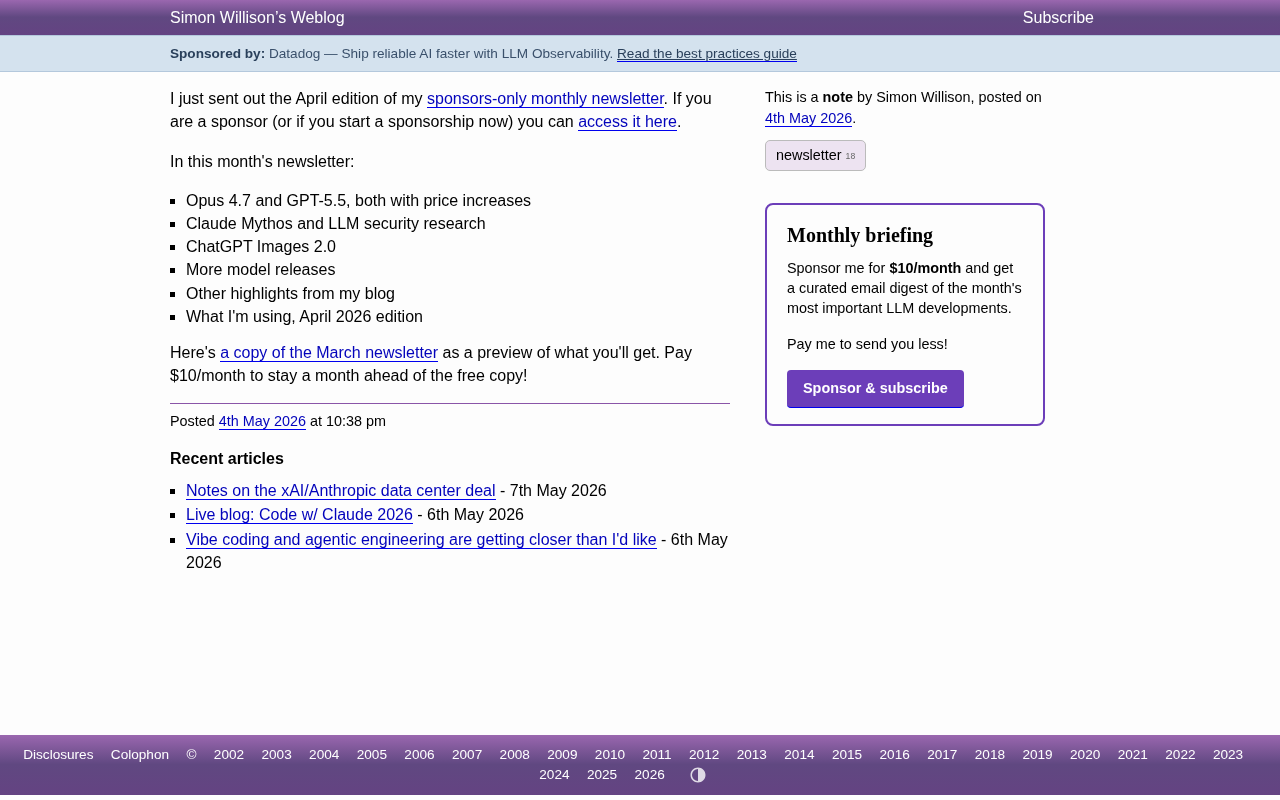
Simon Willison's April 2026 newsletter covers Opus 4.7, GPT-5.5 releases with price hikes and key AI trends
Simon Willison's April 2026 monthly newsletter highlights Anthropic's Opus 4.7 and OpenAI's GPT-5.5 launching simultaneously with price increases, signaling a shift toward tiered pricing for premium AI models. The edition also covers Claude Mythos' debut, ChatGPT Images 2.0 multimodal upgrades, and the growing urgency of LLM security research—particularly prompt injection. Overall, it reveals an AI industry in fierce competition with unprecedented model iteration cadence.
Simon Willison's April 2026 Newsletter: What Happened in AI This Month
Django co-creator and prominent AI developer Simon Willison has published his April 2026 sponsor-exclusive monthly newsletter. This edition is exceptionally information-dense, covering the release of two heavyweight models—Opus 4.7 and GPT-5.5—the debut of Claude Mythos, the ChatGPT Images 2.0 update, and the latest developments in LLM security research.
Simon Willison is not only the co-creator of the Django framework but has also been one of the most influential independent voices in the AI developer community over the past few years. His Datasette project is an open-source tool for exploring and publishing data, and his LLM CLI tool allows developers to call various large language models directly from the command line. His blog, simonwillison.net, is renowned for its exceptionally high update frequency and information density, and is widely regarded as one of the most reliable English-language sources for tracking the cutting edge of AI technology. His monthly newsletter is essentially a systematic overview of all significant events in the AI field for a given month, with coverage far exceeding that of typical tech media.
Simon Willison's unique position in the AI developer community stems from his combination of deep engineering expertise and sharp technical judgment. His LLM CLI tool supports not only mainstream model providers like OpenAI, Anthropic, and Google, but also locally-run open-source models like Llama and Mistral through its plugin system. His concept of "AI-enhanced development"—using LLMs as programming assistants rather than replacements—has influenced the practices of a large number of independent developers. During periods of rapid AI development, his blog averages 2-3 posts per day, each accompanied by reproducible code examples and detailed technical analysis. This "build while you write" style gives his content both timeliness and practical value.
Here are the core takeaways from this edition and my analysis.
Opus 4.7 and GPT-5.5 Launch Simultaneously: Performance Up, Prices Up Too
The most closely watched news this month—Anthropic's Opus 4.7 and OpenAI's GPT-5.5 were released in succession. Both models show significant performance improvements, but both also come with price increases.
To understand the positioning of these two models, you need to know their respective product line structures. Anthropic's Claude model series uses a three-tier naming system: Opus (flagship), Sonnet (mid-range), and Haiku (lightweight). The Opus series is positioned for maximum performance, targeting demanding scenarios like complex reasoning, long-text processing, and professional coding. OpenAI's GPT series has iterated from GPT-3.5 all the way to GPT-5.5, with each generation showing significant leaps in parameter scale, context window length, and multimodal capabilities. Both companies' pricing strategies are typically calculated per million tokens for input/output, and price increases mean higher costs per API call—something that particularly impacts enterprise applications with high call frequency.
A further note on token economics: A token is the basic unit by which large language models process text, roughly equivalent to 3/4 of an English word or 1-2 Chinese characters. Model pricing is typically split into input tokens and output tokens, with output token prices usually 2-4x higher than input prices, since generating text requires more computational resources than understanding it. For a GPT-4-class model, processing a 5,000-character Chinese document consumes approximately 3,000-4,000 tokens. For enterprise applications—such as customer service systems handling tens of thousands of conversations daily—even a few-dollar increase per million tokens can translate to tens of thousands of dollars in additional monthly costs. This is why the principle of "good enough is good enough" in model selection is increasingly emphasized.
This trend sends a clear signal: the pricing strategy for top-tier AI models is shifting. Vendors are no longer relying solely on low prices to capture market share—they're beginning to realize higher commercial returns through premium models. This closely parallels the development trajectory of the cloud computing industry—in the early days, vendors fought for developer and enterprise customers through aggressive pricing and even loss-making operations, but as the market matured, differentiated pricing became inevitable. Currently, mainstream vendors generally offer three to four tiers of model products: lightweight models (like Haiku, GPT-4o mini) for high-throughput, low-cost scenarios; mid-range models (like Sonnet) balancing performance and cost; and flagship models (like Opus, GPT-5.5) for professional scenarios with extremely high quality requirements. Training a top-tier large model now costs hundreds of millions of dollars, and the GPU compute consumption during inference is equally staggering—vendors need the premium pricing of high-end products to maintain sustainable business models.
The AI industry competition of 2025-2026 has evolved from a pure "model performance arms race" into a multi-dimensional ecosystem competition. Anthropic has won over many developers through its deep safety research foundation and Claude's coding capabilities; OpenAI maintains its leading position through ChatGPT's consumer user base and API ecosystem first-mover advantage; Google's Gemini series differentiates through integration with search and cloud services. Meanwhile, Meta's open-source Llama series continues to disrupt the market, forcing closed-source vendors to make more concessions on pricing and feature openness. This competitive landscape means no single company can monopolize the market long-term, and developers and enterprise users actually benefit—they can flexibly switch between different vendors' products based on specific needs.
For developers and enterprise users, this means model selection requires more nuanced trade-offs—the balance between performance requirements and cost control has become more critical than ever. Blindly pursuing the most powerful model isn't necessarily cost-effective; choosing the appropriate model tier for your actual use case is the right approach.
Claude Mythos Debuts and New Progress in LLM Security Research
Anthropic didn't just release Opus 4.7 this month—they also unveiled Claude Mythos. Equally noteworthy alongside new model releases is the continued deepening of LLM security research.
Simon Willison has long tracked LLM security issues, with particularly deep research into prompt injection attacks. Prompt injection is one of the core security threats facing large language models, with a mechanism similar to SQL injection in traditional software security—attackers craft input text designed to trick the model into ignoring its original system instructions and instead executing attacker-specified operations. For example, when an LLM application is designed to summarize user-uploaded documents, those documents might contain hidden instructions that cause the model to leak system prompts or perform unauthorized actions. Simon Willison was one of the first developers to systematically study and publicly discuss this problem, and he repeatedly emphasizes that the industry has yet to find a fundamental solution to prompt injection—making any application that exposes an LLM to untrusted input potentially vulnerable.
The danger of prompt injection attacks lies in their exploitation of a fundamental LLM design characteristic—models fundamentally cannot distinguish between "system instructions" and "user input" because both appear to the model as text sequences. Current industry defense strategies include: input filtering (detecting and blocking suspicious instructions), output monitoring (checking whether model responses deviate from expected behavior), permission isolation (limiting the scope of operations the model can execute), and multi-layer verification (critical operations require additional confirmation). However, these are all mitigation measures rather than fundamental solutions. Between 2025-2026, with the rise of AI Agents (AI systems capable of autonomously executing multi-step tasks), prompt injection risks have been further amplified—an Agent injected with malicious instructions could autonomously execute operations like sending emails, modifying files, or even calling external APIs, with consequences far more severe than mere information leaks.
In the newsletter, he emphasizes that as large language model capabilities continue to grow, security issues have risen from a peripheral topic to a core industry concern.
The point is straightforward: the more powerful a model becomes, the broader its potential attack surface. Security research is no longer a nice-to-have—it's a mandatory component of every model upgrade.
ChatGPT Images 2.0: Multimodal Capabilities Upgraded Again
OpenAI's ChatGPT Images received a 2.0 version update. The iterative improvements in image generation capabilities reflect the continued evolution of multimodal AI—from text understanding to image creation, AI applications in the creative tools space are becoming more mature and practical.
Multimodal AI refers to artificial intelligence systems capable of simultaneously processing and generating multiple data types (text, images, audio, video, etc.). The underlying technology of ChatGPT Images is based on Diffusion Models, a generative AI technique that produces high-quality images from random noise through a gradual denoising process. Compared to the earlier DALL-E series, the new generation of image generation models shows qualitative leaps in text instruction comprehension accuracy, image detail realism, and style control flexibility. A 2.0 update typically signals breakthroughs in previously weak areas such as consistency (maintaining the same character appearance across multiple images) and text rendering (accurately generating text within images).
From a technical evolution perspective, the working principle of diffusion models can be analogized as "learning to reverse a destruction process": during training, the model observes the process of many images having noise gradually added until they become pure noise, then learns how to reverse this process—restoring clear images step by step from pure noise. This technical approach was brought to public attention in 2022 by Stability AI's Stable Diffusion and OpenAI's DALL-E 2, and has since undergone multiple major iterations. Key technical breakthroughs include: latent space diffusion (operating in compressed feature space rather than pixel space, dramatically reducing computational cost), Classifier-Free Guidance (achieving conditional generation without an additional classifier), and Flow Matching (a more efficient training paradigm). The advances in ChatGPT Images 2.0 likely benefit from continued optimization of these underlying technologies, as well as the introduction of larger-scale, higher-quality training data.
For designers, content creators, and product teams, the actual performance of ChatGPT Images 2.0 is worth hands-on experience and evaluation.
More Highlights: Model Updates and Developer Tool Recommendations
Beyond the above focal points, this edition of the newsletter also includes:
- Other model release updates: Multiple heavyweight model updates within a single month, with industry competition pace clearly accelerating
- Simon's blog highlights: Deep reflections on AI technology trends, ideal for readers wanting to understand the industry's direction
- "What I'm Using" section: Simon shares his personal AI tool usage for April 2026, offering tremendous reference value for readers interested in cutting-edge developer workflows
How to Read Simon Willison's Monthly Newsletter
Simon Willison is the co-creator of the Django framework and the author of well-known open-source projects like Datasette. Django is one of the most popular web frameworks in the Python ecosystem—notable products like Instagram and Pinterest were originally built on Django. His monthly newsletter is available to GitHub sponsors ($10/month), providing in-depth analysis and personal insights on the latest developments in AI. This sponsorship model is increasingly common in the open-source community—developers use platforms like GitHub Sponsors or Patreon to reward supporters with exclusive content while maintaining the sustainability of independent creation.
Free users can read past editions with a one-month delay—the currently publicly available issue is the March 2026 newsletter.
Four Key AI Industry Trends from This Newsletter
Synthesizing the content of this newsletter edition, here are several industry directions worth continued attention:
- Intensifying model pricing stratification: With Opus 4.7 and GPT-5.5 raising prices simultaneously, the AI services market is forming a more distinct high-mid-low tier structure. Cheap models still exist, but top-tier performance now comes at a higher price.
- LLM security shifting from optional to essential: Security research is as important as model releases, and defense against attack vectors like prompt injection has become a prerequisite for product launches.
- Multimodal competition reaching fever pitch: The ChatGPT Images 2.0 update demonstrates that multimodal capabilities like image generation are a core battleground for major vendors.
- Unprecedented model iteration cadence: Anthropic and OpenAI densely released multiple models within the same month, pushing industry competition intensity to new heights. For developers, simply keeping up with the pace is itself a challenge.
Key Takeaways
- Opus 4.7 and GPT-5.5 released in succession, both accompanied by price increases, reflecting a shift in premium model pricing strategy
- Claude Mythos launch and LLM security research are key focus areas in this edition
- ChatGPT Images 2.0 update shows continued evolution of multimodal AI capabilities
- AI model market competition is white-hot, with multiple major releases in a single month
- Simon Willison's newsletter operates on a $10/month sponsorship model; free users get access with a one-month delay
Related articles
 Expert Opinions
Rethinking Scaling Laws: Parameters Are Not the Only Answer
Deep analysis of Scaling Law evolution from Kaplan to Chinchilla to the MoE era, exploring why blindly stacking parameters is a mistake, and how GLM-5.3 proves scaling has multiple knobs.
When AI Treats Humans as Subagents: Ro…
When AI Treats Humans as Subagents: Role Reversal and Hidden Risks in Human-AI Collaboration
Exploring the paradigm shift where humans become "subagents" in AI Agent architectures. Analyzes human node design in LangChain and AutoGen, and the risks of ceding control and cognitive atrophy.
 Expert Opinions
The Lazy Person's Productivity Theory: Why Being 'Lazy' Actually Drives Peak Performance
Explore the engineering philosophy behind 'lazy people are most productive': how constructive laziness drives automation, AI tools amplify efficiency, and systems thinking eliminates wasted effort.